TL;DR: In mice, two visual areas of the brain kept signals they agreed on going longer and let mismatched signals fade faster. The two-way wiring between the areas appears to be what makes this happen.
Key Findings
- Two areas recorded at once: 194 neurons in the main visual area and 228 in a higher one, in 7 mice.
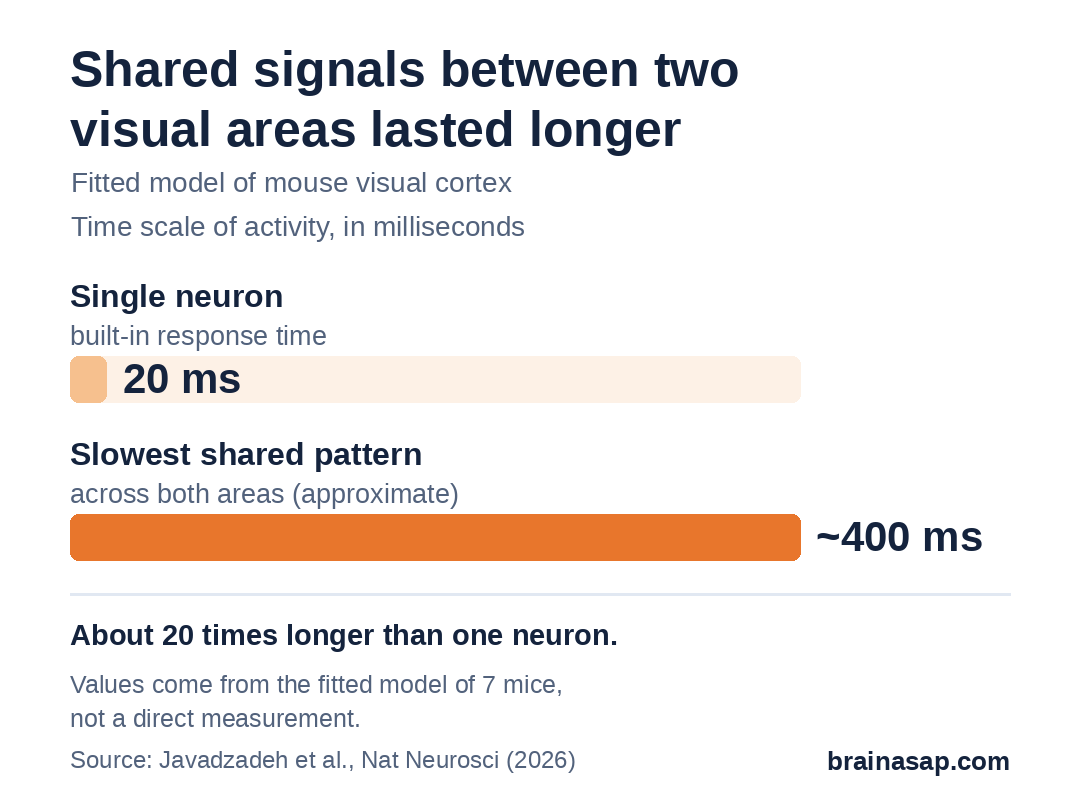
- Shared activity lasted: The slowest shared pattern lasted about 400 milliseconds, roughly 20 times longer than a single neuron’s response time in the model.
- Agreement lingered, conflict faded: In the recordings, activity where both areas agreed faded more slowly than activity where they disagreed.
- Cross-area links were key: Cutting the connections in the model, or silencing one area in mice, made the other area’s activity fade faster.
Source: Nature Neuroscience (2026) | Javadzadeh et al.
Your brain splits the job of seeing into pieces. One area picks out edges and lines, others handle shapes, motion and meaning. So what happens when two areas reach different conclusions about the same thing?
A team from Cambridge, University College London, Cold Spring Harbor and Stanford looked at how two visual areas in mice sort this out. Their answer: the areas talk back and forth, and that conversation keeps shared conclusions alive while letting conflicts die out.
Recording Two Visual Areas While Mice Watched Stripes
The researchers used recordings from mice trained on a simple task. Each mouse saw striped patterns tilted one of two ways for half a second, and only one tilt earned a reward.
Probes recorded from two connected areas at once:
- V1: the primary visual area, first stop in the cortex for signals from the eyes
- LM: a neighboring higher visual area that trades signals with V1 in both directions
On some trials, a brief flash of light switched on inhibitory neurons in one area for 150 milliseconds, quieting it. That let the team see how one area’s activity depended on the other.
A Computer Model Built From the Mouse Data
The team fit a computer model of both areas to the spiking data from each mouse. The model followed basic rules of cortex wiring: each area had excitatory and inhibitory units, and only excitatory units could send signals to the other area.
The model passed several checks. It predicted how neurons would respond when an area was silenced better than a version trained without silencing data (average correlation 0.34 vs 0.12). Its predicted excitatory and inhibitory cell types were also consistent with their spike shapes.
Shared Signals Lasted About 20 Times Longer
Inside the model, the visual stimulus mainly gave a quick kick at the start and end. What kept activity going during the half-second was the back-and-forth between the two areas.
That reverberation created one especially slow pattern, lasting about 400 milliseconds. A single model neuron’s built-in response time was 20 milliseconds.
When the model’s links between the areas were cut, each area on its own lost this slow pattern and its activity faded faster.
Agreement Lingers While Conflict Fades
A simpler version of the model explained why. Activity in the two areas can line up (both say “something is there”) or point in opposite directions (one says yes, the other no). The two-way excitatory links slowed the fading of patterns where the areas agreed and sped up the fading of patterns where they disagreed.
That made a testable prediction, which the researchers checked directly in the recordings without using the model:
- Agreeing activity faded more slowly than disagreeing activity, both before and during the stimulus.
- Same pattern for stripe direction: Agreement about which way the stripes tilted also lasted longer than disagreement.
- Silencing one area reduced slow activity in the other.
- Distracted mice lost the effect: On trials when mice groomed instead of doing the task, agreeing activity no longer lasted longer.
In simulations, strong two-way links let the areas settle on the answer that the input supported more, even when the input to the two areas conflicted.
Limits of a Model-Based Mouse Study
- Existing data: The team reanalyzed earlier recordings from 7 mice rather than running new experiments.
- Only two areas: The brain has many more connected areas; how this scales is untested.
- Model assumptions: Conclusions rest on a fitted model; authors ran extra checks to show the method does not invent slow patterns.
- Task mixes signals: Visual input overlapped with movement and reward signals, which the authors say cannot be fully separated.
- Mice, not people: Whether human cortex works the same way is unknown.
Does This Rule Hold Across the Whole Cortex?
The authors suggest “consensus building” through two-way links may be a general way the cortex keeps its parts consistent. The next test is whether the same pattern shows up between other pairs of areas, and in tasks where reaching agreement actually changes what an animal decides.
Citation: DOI: 10.1038/s41593-026-02437-3. Javadzadeh M, Schimel M, Hofer SB, Ahmadian Y, Hennequin G. Reciprocal connections dynamically build consensus between neocortical areas. Nat Neurosci. 2026.
Study Design: Reanalysis of simultaneous V1 and LM recordings with optogenetic silencing in mice, combined with fitted circuit models and mathematical analysis.
Sample Size: 7 mice; 194 V1 neurons and 228 LM neurons.
Key Statistic: Slowest shared activity pattern about 400 ms vs 20 ms single-neuron time constant; agreeing activity decayed more slowly than disagreeing activity in the recordings.
Caveat: Model-based analysis of existing mouse data from two visual areas; not tested in humans.