TL;DR: A Singapore hospital looked back at 28 outpatients whose depression had not improved after at least 2 kinds of antidepressants, and who then had a course of magnetic brain stimulation. Their depression ratings dropped by about half on average, and 16 of 28 ended with ratings low enough to count as remission, though there was no comparison group.
Key Findings
- Depression ratings halved: Average clinician-rated depression scores fell from 29.6 to 13.9, a clear drop.
- Response and remission: 19 of 28 patients (68%) responded, and 16 of 28 (57%) reached remission.
- Hard-to-treat group: 24 of 28 had already tried at least 3 kinds of antidepressants without success.
- Exploratory finding: Shorter episodes, lower starting depression scores, and better quality of life were associated with remission.
Source: Frontiers in Psychiatry (2026) | Tay and Thng
When 2 or more antidepressants have failed, many people with depression start to wonder if anything will work. One option is repetitive transcranial magnetic stimulation (rTMS), which uses a magnetic coil held against the scalp to stimulate a mood-related area of the brain.
Clinical trials show rTMS can help. But records of how it works in everyday hospital care in Southeast Asia are scarce.
28 Patients at a General Hospital in Singapore
A 2026 study in Frontiers in Psychiatry, by Y. H. Tay and E. W. C. Thng, reviewed the records of 28 outpatients treated with rTMS at Khoo Teck Puat Hospital in Singapore between May 2022 and May 2025.
All had treatment-resistant depression, defined as no improvement after trying at least 2 different classes of antidepressants for at least 6 weeks each. Most had tried even more: 24 of 28 had failed 3 or more classes.
Treatment targeted the left front of the brain, using a scalp position called F3. Of 28 patients, 26 received high-frequency stimulation, 1 received theta-burst stimulation, and 1 switched from high-frequency to theta-burst stimulation.
- 10 Hz stimulation: the classic high-frequency form
- Theta-burst stimulation: a faster form that packs pulses into short bursts
Depression was rated with the Montgomery-Åsberg Depression Rating Scale (MADRS), a clinician interview scored from 0 to 60, where higher means more severe.
Depression Ratings Fell by About Half
On average, MADRS scores dropped from 29.6 before treatment to 13.9 after it, a fall of about 16 points. These are group averages. Individual patients varied in how much their scores changed.
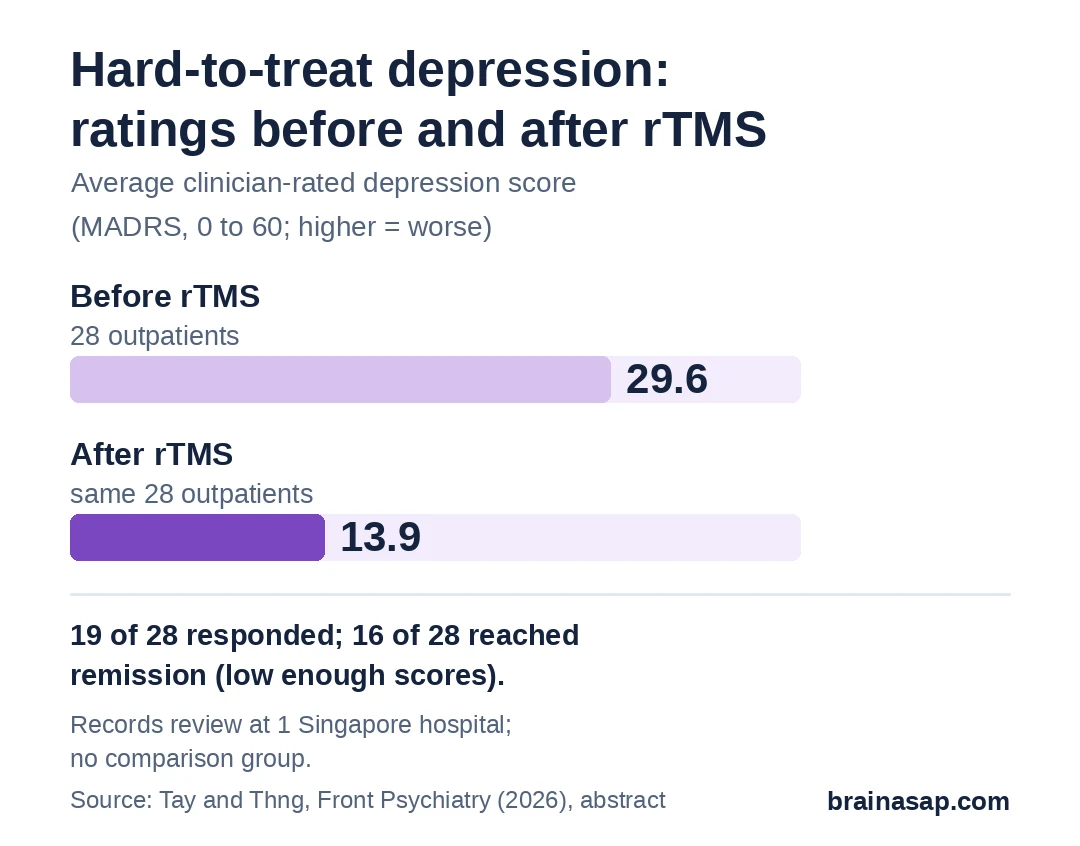
- Response: 19 of 28 (68%) had a large enough drop to count as responding
- Remission: 16 of 28 (57%) ended with scores low enough to count as remission
- Other measures: Self-rated depression, anxiety, stress, quality of life and day-to-day functioning all improved clearly
The study defined response as at least a 50% drop in the score and remission as an end-of-treatment score of 10 or lower.
Who Was Most Likely to Reach Remission?
In exploratory analyses, shorter episodes, lower starting depression scores, and better quality of life were associated with remission. The analysis did not adjust for multiple comparisons.
The study did not compare different starting times for rTMS, so it cannot tell whether starting sooner would improve the outcome.
Why These Results Need a Comparison
- No comparison group: Some improvement can come from time, ongoing medications or the extra attention of daily clinic visits
- Small group: 28 patients at 1 hospital
- Records review: There was no random assignment. The researchers used baseline scores for two patients who left early without a final assessment
- 2 types of rTMS combined: The pooled results mostly describe high-frequency stimulation. The study was too small to compare protocols
- Short follow-up: Outcomes were measured at the end of treatment, so this study does not show whether remission lasted
Real-World Support for rTMS in Southeast Asia
For people in Singapore and nearby countries with depression that has resisted several medications, this adds local evidence that standard rTMS can be a practical option at a general hospital.
A larger study that follows patients for months after treatment would show how long the improvement lasts.
Citation: DOI: 10.3389/fpsyt.2026.1924135 · Tay YH, Thng EWC. Repetitive transcranial magnetic stimulation for treatment-resistant depression in Singapore: a retrospective, naturalistic study. Frontiers in Psychiatry. 2026. · Original journal article
Study Design: Retrospective naturalistic study at 1 general hospital, May 2022 to May 2025.
Sample Size: 28 outpatients with treatment-resistant depression.
Key Statistic: MADRS fell from 29.6 (SD 7.6) to 13.9 (SD 11.1), p < 0.001; response 67.9%, remission 57.1%.
Caveat: No control group, small single-site sample, and outcomes measured at the end of treatment. The published abstract and journal methods and results were checked.