TL;DR: A survey published in 2026 of 323 adults in Buraydah, Saudi Arabia, who opened Snapchat at least twice a day asked how emotionally attached they felt to the app, along with standard questions about depression and anxiety symptoms.
People more attached to Snapchat reported slightly more depression and anxiety symptoms, but the link was weak. It largely disappeared once the researcher also accounted for addiction-like social media use, such as feeling restless when unable to log on.
Key Findings
- Weak link with symptoms: Snapchat attachment scores explained under 10% of the differences in depression scores and about 6% for anxiety.
- Held after basic adjustment: The link remained after accounting for age, marital status and income.
- Faded with addiction-like use: Adding a measure of compulsive social media use made the Snapchat link too small to separate from chance.
- Many had symptoms: About 1 in 4 scored in the moderate or higher range for depression symptoms, and a similar share for anxiety.
Source: Cureus (2026) | Alqossayir
Snapchat is one of the most used apps in Saudi Arabia. Disappearing photos and streaks keep people opening it many times a day.
A 2026 study in Cureus by Fuhaid Alqossayir of Qassim University asked a narrower question than "is social media bad for you?": among adults who already use Snapchat often, do the ones most wrapped up in it report more depression and anxiety symptoms?
Who Took Part?
In 2023, 12 randomly chosen schools in Buraydah passed an Arabic online survey to their staff, who could forward it to adult family members. This analysis used the 323 adults who opened Snapchat at least 2 to 4 times a day.
- Age: average 33, range 18 to 57
- Women: 63%
- Teachers: 39%; 68% had a university degree
- Social media time: about 3 hours 20 minutes a day on average, across all apps
What Did "Snapchat Intensity" Mean?
Rather than counting minutes, the survey used 6 statements about attachment, adapted from an older Facebook questionnaire. Items covered how much Snapchat was part of daily routine and how people would feel if it shut down. Scores ran from 6 to 30.
Depression and anxiety symptoms came from 2 widely used screening questionnaires, scored out of 27 and 21. These flag symptoms; they do not diagnose a condition.
A separate 6-item scale measured problematic use: signs of compulsive, addiction-like social media habits across all apps.
How Big Was the Link?
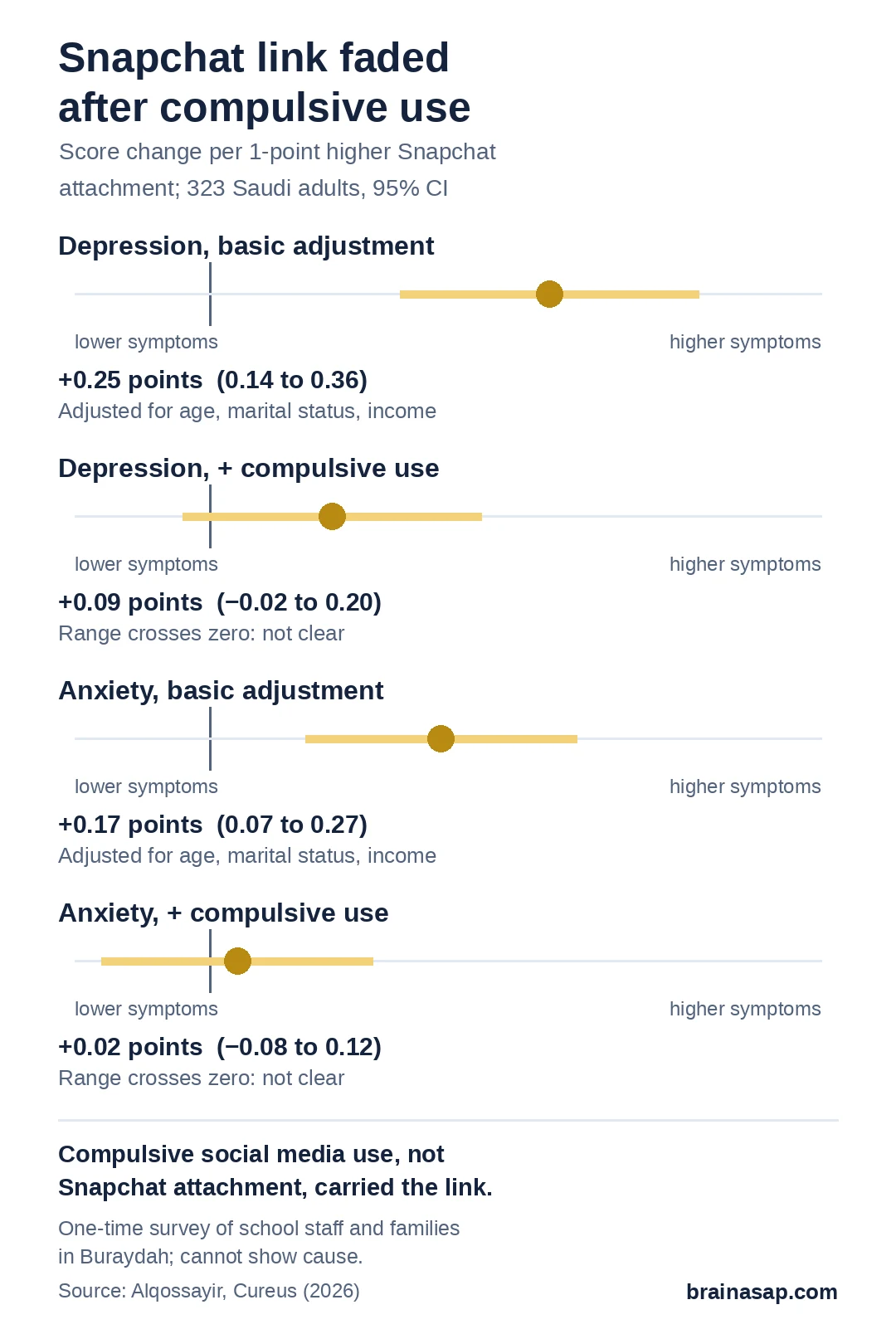
After adjusting for age, marital status and income, each extra point of Snapchat attachment went with 0.25 more points on the depression questionnaire and 0.17 more on the anxiety one.
Across the full range of the attachment scale, that adds up to roughly 6 depression points and 4 anxiety points between the least and most attached users. Even so, Alqossayir stressed that the link explained only a small slice of why people's symptoms differed.
Was It Snapchat, or Compulsive Use?
One extra step gave the most telling result. When the analysis also accounted for problematic social media use, the Snapchat link shrank:
- Depression: from 0.25 to 0.09 points, no longer statistically clear
- Anxiety: from 0.17 to 0.02 points, no longer statistically clear
Problematic use itself was clearly linked to both symptom scores. In other words, compulsive habits across apps, rather than attachment to Snapchat as such, appeared to carry most of the signal. Total daily social media time was not linked to either symptom score.
What Limits These Findings?
- One moment in time: People who feel low or anxious may turn to Snapchat more, rather than the other way round.
- Not a typical sample: Mostly school staff and their families in one city, more educated than average.
- Untested questionnaire: The Snapchat attachment scale had not been validated in Arabic.
- Subgroup analysis: This was a slice of a larger project, with no separate sample size plan.
- Not measured: Sleep, fear of missing out, social comparison and life stress.
Compulsive Use May Matter More Than Any One App
For heavy Snapchat users, the takeaway is not that the app itself harms mood. A stronger signal pointed to compulsive, hard-to-control social media habits in general.
Whether cutting back on those habits would ease depression or anxiety symptoms in Saudi adults would need a study that follows people over time or tests a change directly.
Citation: DOI: 10.7759/cureus.115058 Alqossayir F. Snapchat Usage Intensity and Symptoms of Depression and Anxiety Among Adults in a Central Region of Saudi Arabia: A Cross-Sectional Study. Cureus. 2026;18(8):e115058.
Study Design: Cross-sectional Arabic online survey (January–August 2023), cluster-randomized school selection with voluntary response; adapted 6-item Snapchat Intensity Scale, PHQ-9, GAD-7, adapted Bergen problematic use scale; Spearman correlation and multivariable linear regression.
Sample Size: 323 adults in Buraydah, Qassim region, using Snapchat at least 2 to 4 times daily (subgroup of a larger project).
Key Statistic: Spearman rho 0.311 (PHQ-9) and 0.242 (GAD-7). Adjusted B = 0.25 (95% CI 0.14–0.36) for PHQ-9 and 0.17 (0.07–0.27) for GAD-7; after adding problematic use, B = 0.09 (−0.02 to 0.20, P = 0.12) and 0.02 (−0.08 to 0.12, P = 0.74). PHQ-9 ≥10: 23.8%; GAD-7 ≥10: 22.6%.
Caveat: Cross-sectional; non-representative staff-network sample; unvalidated Snapchat scale adaptation; subgroup analysis; key mechanisms unmeasured.