TL;DR: In a small German study of 24 refugee women with trauma symptoms, scores on three symptom questionnaires stayed flat during an 8-week wait, then dropped after 8 weekly dance movement therapy sessions. The group’s average PTSD checklist score slipped just under the usual clinical cutoff. There was no separate comparison group, so the study cannot say the dance sessions alone caused the improvement.
Key Findings
- Everyone started with clinically relevant symptoms: All 24 women scored in the clinical range for PTSD symptoms, and 22 of 24 in the most severe category.
- The waiting period changed little: Average scores on all three questionnaires barely moved over the 8 weeks with no therapy.
- Scores fell after dance therapy: The average PTSD checklist score went from 50.1 to 43.7, just under the cutoff of 44. Depression, anxiety and stress scores also fell.
- Not every symptom moved: Re-experiencing trauma memories and DASS21 anxiety did not change by a statistically significant amount.
- Long-term effects are unclear: Only 10 women came back for follow-up, and the one-year results did not show a clear lasting change.
Source: BMC Complementary Medicine and Therapies (2026) | Koch et al.
Many women who flee war and violence carry trauma with them for years. In Germany, the authors note, fewer than 10% of refugees who need mental health care receive it, in part because of language barriers, funding rules and a shortage of trained staff. Talk therapy also depends on words, which is a hard fit when the therapist and the patient do not share a language.
Those barriers are why researchers have been interested in arts-based approaches such as dance movement therapy. It uses movement, music and group interaction, guided by a trained therapist, to help people work with emotions that are hard to put into words. Earlier work with refugees was mostly interviews and case reports. This study is an attempt to measure symptoms with standard questionnaires.
How the Study Worked
The researchers recruited 30 refugee women in southern Germany through social workers, a psychosocial center, flyers, and a Ukrainian community chat group. Twenty-four completed enough of the program to be analyzed. They ranged in age from 20 to 65 and came from Ukraine (close to 60% of the group), Afghanistan, Turkey, Nigeria and Cameroon. During the study, none of them received any other psychotherapy.
The plan was a randomized trial, but too few women signed up in the first round to make two groups. Instead, every woman served as her own comparison:
- The waiting period: Symptoms were measured at the start, then again 8 weeks later, with no therapy in between.
- The dance therapy period: The women then joined 8 weekly group sessions of 90 minutes, and were measured a third time at the end.
The sessions took place in a dance studio in Heidelberg, in three separate groups led by two certified dance movement therapists, with student co-therapists who translated. Childcare was offered, and each session opened with coffee and cake. The therapy was resource-oriented rather than scripted: grounding and mirroring exercises, relaxation, and a “Baum circle,” in which each woman chose her own music and movement and decided how much to share with the group.
The three questionnaires
Higher scores mean more symptoms on all three. The women completed them in an interview format or on their own, in a language they spoke well.
- RHS-15 (main measure): A short refugee mental health screener covering depression, anxiety and trauma symptoms, with a top score of 56.
- PCL-S: A 17-item PTSD symptom checklist, with a top score of 85 and a commonly used cutoff of 44.
- DASS21: A 21-item scale of depression, anxiety and stress, with a top score of 126.
What They Found
At the start, symptoms were high. On the PTSD checklist, 22 of 24 women scored in the most severe category and the other 2 in the next one down. After the 8-week wait, the averages had hardly changed. After the dance sessions, all three scores dropped.
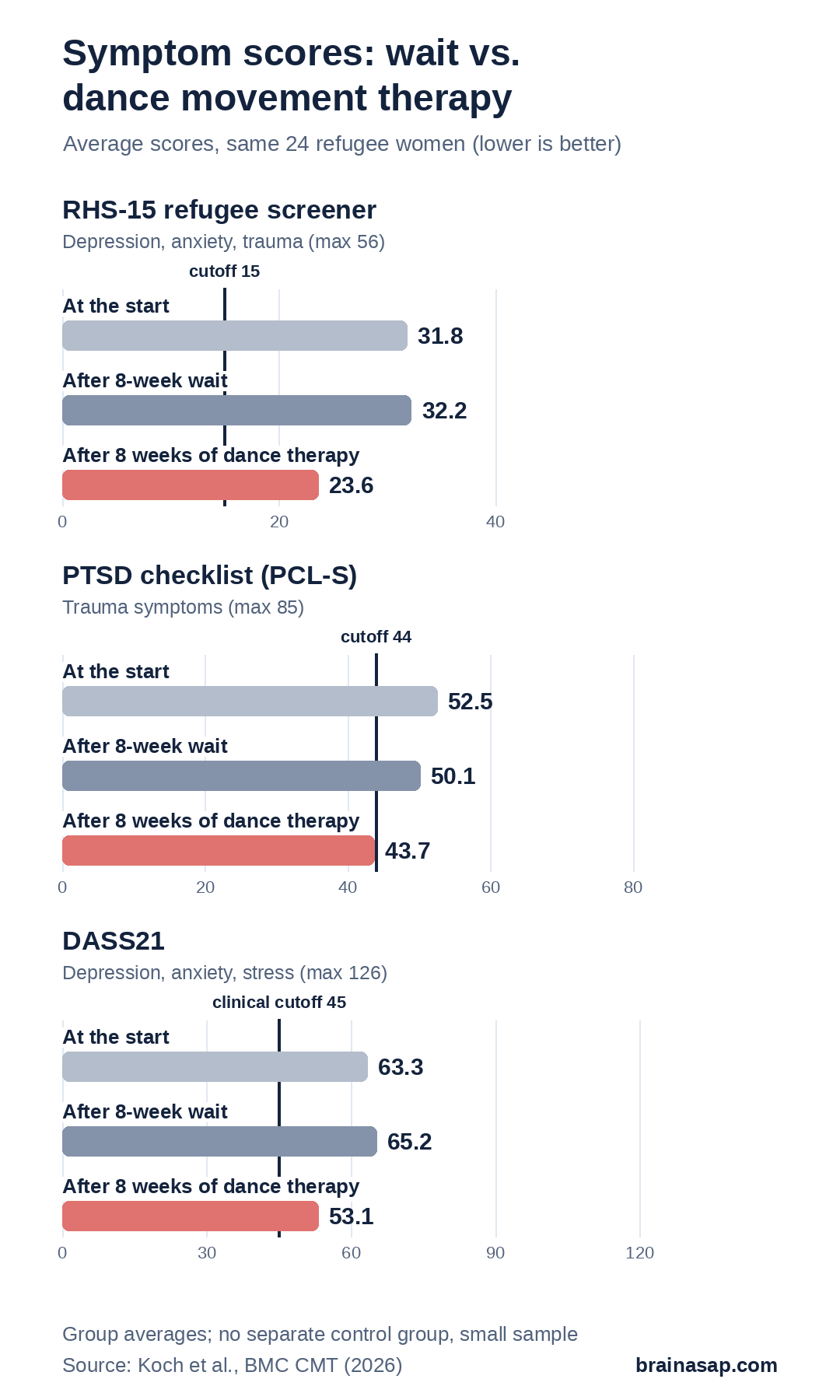
- RHS-15: 32.2 after waiting, 23.6 after dance therapy.
- PTSD checklist (PCL-S): 50.1 after waiting, 43.7 after dance therapy, just under the cutoff of 44.
- DASS21: 65.2 after waiting, 53.1 after dance therapy. That moved the group average below the researchers’ threshold for “severe” distress (62), but not below the clinical cutoff of 45.
The improvement after therapy was statistically significant on all three total scores. Comparing the 8-week waiting period with the 8-week therapy period, the researchers report effect sizes (partial eta squared) of about 0.30 for the RHS-15, 0.32 for the PTSD checklist and 0.25 for the DASS21, larger than the medium effect the study was powered to detect.
Where the change was less clear
The averages hide some detail. On the PTSD checklist, avoidance and hyperarousal (feeling constantly on edge) dropped significantly, but re-experiencing (intrusive memories and images) showed only a trend that did not reach statistical significance. On the DASS21, depression and stress fell significantly, while anxiety did not. And “just under the cutoff” describes the group average. It does not mean every woman fell below it.
Women with higher starting symptom burden improved more, and the authors saw a hint that Ukrainian participants benefited more than others (a borderline result, p = 0.051; the authors say the reasons for it remain speculative).
Did the Benefits Last?
In July 2024, all 24 women were invited back for a follow-up. Ten came: five from the first year of groups, and five from the second. Their symptoms were lower than before therapy, but the comparison was borderline (p = 0.064 on the main measure). Split by timing, the 5 women seen at about 8 weeks still showed a significant improvement, while the 5 seen after about one year did not. Those were different women, and they started with different symptom levels, so this is too little data to say how long the effect lasts.
In a short focus group after the final session of one of the three groups, women described feeling safer, calmer and more confident. Several also said they wanted more sessions. The authors agree that 8 sessions felt short and suggest at least 10 next time.
What This Study Can’t Tell Us
- No separate control group: Comparing each woman with her own waiting period is better than no comparison, but it cannot rule out other things that changed over time, such as new housing, support or simply the attention of a caring group. The authors say the improvement is likely due to the therapy because the women had no other treatment, but that is an argument rather than a test.
- Small, self-selected sample: Women who chose to sign up for a dance program may have been more open to it. The group was also relatively well educated, and most had secure residency.
- Expectations: The women, therapists and interviewers knew a therapy was being tested, which can nudge questionnaire answers.
- Imperfect measurement: Some questionnaires used informal translations, interviews were done by therapists-in-training rather than clinicians, and the RHS-15 coping item confused many participants.
- Missing data and dropouts: Six of the 30 women who enrolled were not analyzed. Baseline scores for four women in the first group were estimated statistically.
- No fixed protocol: The therapists adapted the sessions to each group, so it is hard to say exactly what was delivered or to repeat it.
- Registered after the fact: The trial was registered retrospectively, in 2023, after the study began.
Why It Matters
This does not show that dance therapy treats PTSD. What it offers is a measured, consistent signal in a group that is rarely studied, using a therapy that does not require a shared spoken language, and it fills a gap in what had been a research area of interviews and case reports. A trial with randomly assigned comparison groups, larger numbers, more sessions and longer follow-up is the obvious next step.
Citation: DOI: 10.1186/s12906-026-05299-1. Koch SC, Nazemi Z, Arnaud C, Cook K, Steltmann SJ, Tomaszewski C. The effect of dance movement therapy on traumatized refugee women – a clinical controlled trial. BMC Complementary Medicine and Therapies. 2026;26:277.
Study Design: Within-group controlled trial: the same women were measured at baseline, after an 8-week waiting period, and after 8 weekly 90-minute dance movement therapy sessions, with an exploratory follow-up. Retrospectively registered (OSF).
Sample Size: 24 refugee women analyzed (of 30 recruited) in southern Germany; 10 at follow-up.
Key Statistic: Average PCL-S score 50.1 after waiting versus 43.7 after dance therapy (cutoff 44); RHS-15 32.2 versus 23.6; DASS21 65.2 versus 53.1. Partial eta squared 0.25 to 0.32 on the three total scores.
Caveat: No separate control group; small self-selected sample; unblinded, partly informally translated measures; unclear long-term effect.