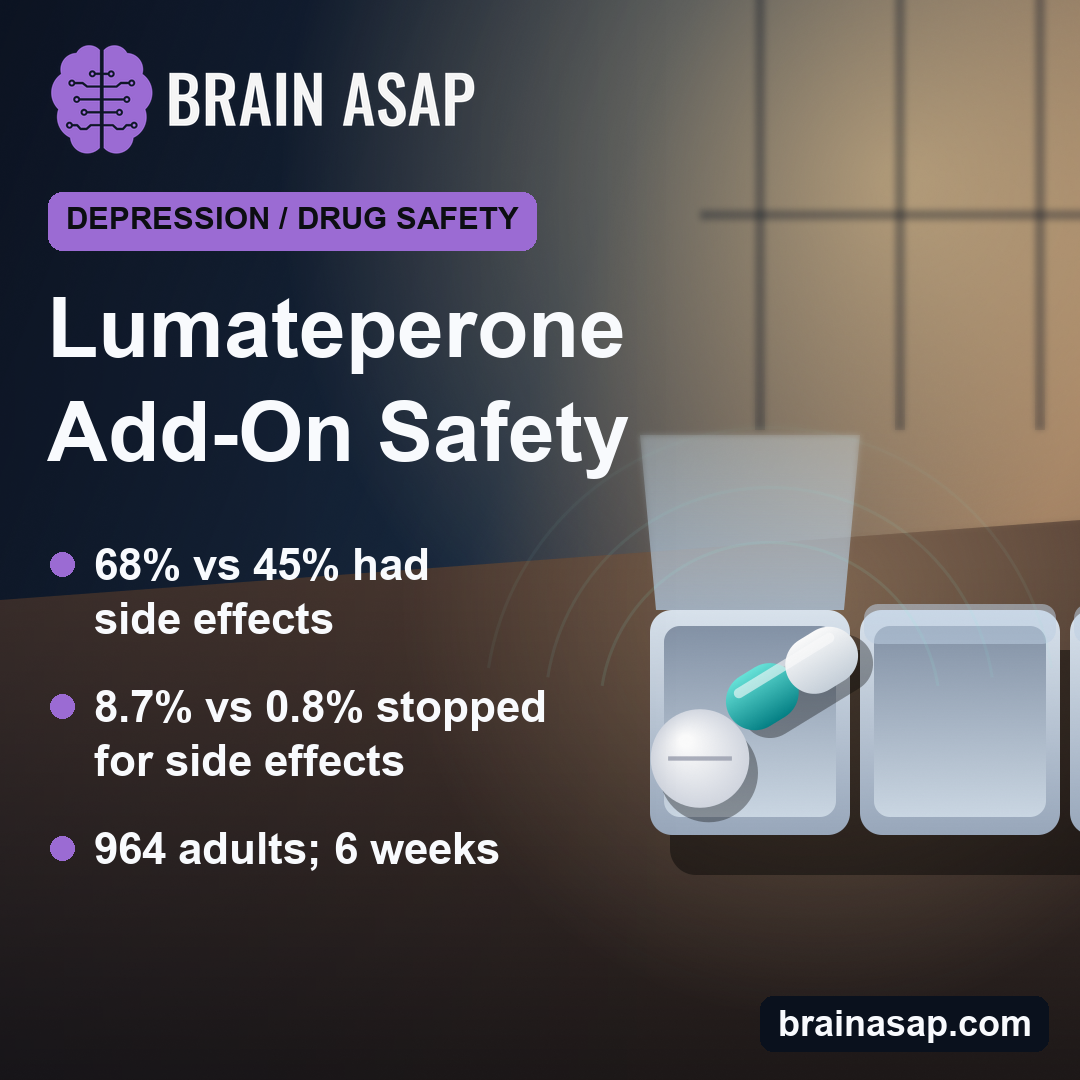
TL;DR: A 2026 pooled analysis in CNS Drugs combined two six-week trials of adults whose depression hadn’t responded well enough to an antidepressant. Adding the antipsychotic lumateperone instead of a placebo raised the share of people with side effects from 45.1% to 68.1% and the share who quit because of them from 0.8% to 8.7%.
Key Findings
- Side effects: 68.1% vs 45.1%: Among 964 adults who all kept taking their antidepressant, those who added lumateperone 42 mg were more likely to report at least one new or worsened side effect than those who added a placebo.
- Quitting because of side effects: 8.7% vs 0.8%: 42 of 483 people stopped lumateperone for this reason, compared with 4 of 481 on placebo.
- Dizziness, dry mouth, and sleepiness led the list: Each hit roughly 12% to 17% of the lumateperone group versus 2% to 5% of the placebo group, and most side effects were mild or moderate.
- The six common side effects appeared most often early: In week one, 33.7% of the lumateperone group had one of them for the first time, versus 7.7% on placebo. New cases of each were below 1% by week four.
- Weight and metabolism barely moved in six weeks: Average weight changed by −0.1 kg, and 7% weight gain was rarer on lumateperone (0.4%) than placebo (1.3%) — but six weeks is too short to settle long-term metabolic safety.
Source: CNS Drugs (2026) | Earley et al.
When an antidepressant only partly works, there are two broad options: switch to a different one, or keep it and add something on top. Adding an antipsychotic is one of the established ways to do the second.
The trouble is that antipsychotics have a reputation for side effects — restlessness, sedation, weight gain — that make some people stop taking them.
Lumateperone is one of the newer drugs used this way. Two earlier trials reported that adding it to an antidepressant improved depression scores more than adding a placebo. This analysis looked at the other side of the ledger: what people actually experienced in the first six weeks, and how often it was enough to make them quit.
964 Adults Kept Their Antidepressant and Added Either Lumateperone or Placebo
Researchers pooled two trials that used an identical design. Adults aged 18 to 65 with major depressive disorder were randomly assigned to take lumateperone 42 mg or a look-alike placebo once a day for six weeks. Everyone stayed on the antidepressant they were already taking, so the only difference between the groups was the extra pill.
Participants weren’t people for whom nothing had worked. They had moderate-to-marked depression and had improved by less than half after at least six weeks on one or two antidepressants in the current episode. Most (88.6%) had just one such inadequate response, and people with a lifetime history of treatment-resistant depression were excluded.
The pooled safety group included 964 adults: 483 who added lumateperone and 481 who added placebo. About two-thirds were women, the average age was about 45, and most were on a common SSRI such as escitalopram or sertraline.
Side Effects Were Reported by 68% With Lumateperone Versus 45% With Placebo
The trials counted what’s called a treatment-emergent adverse event: any unwanted health problem that started, or got worse, after the first dose. That net is deliberately wide. It catches headaches and upset stomachs whether or not the drug caused them, which is why almost half the placebo group reported something too.
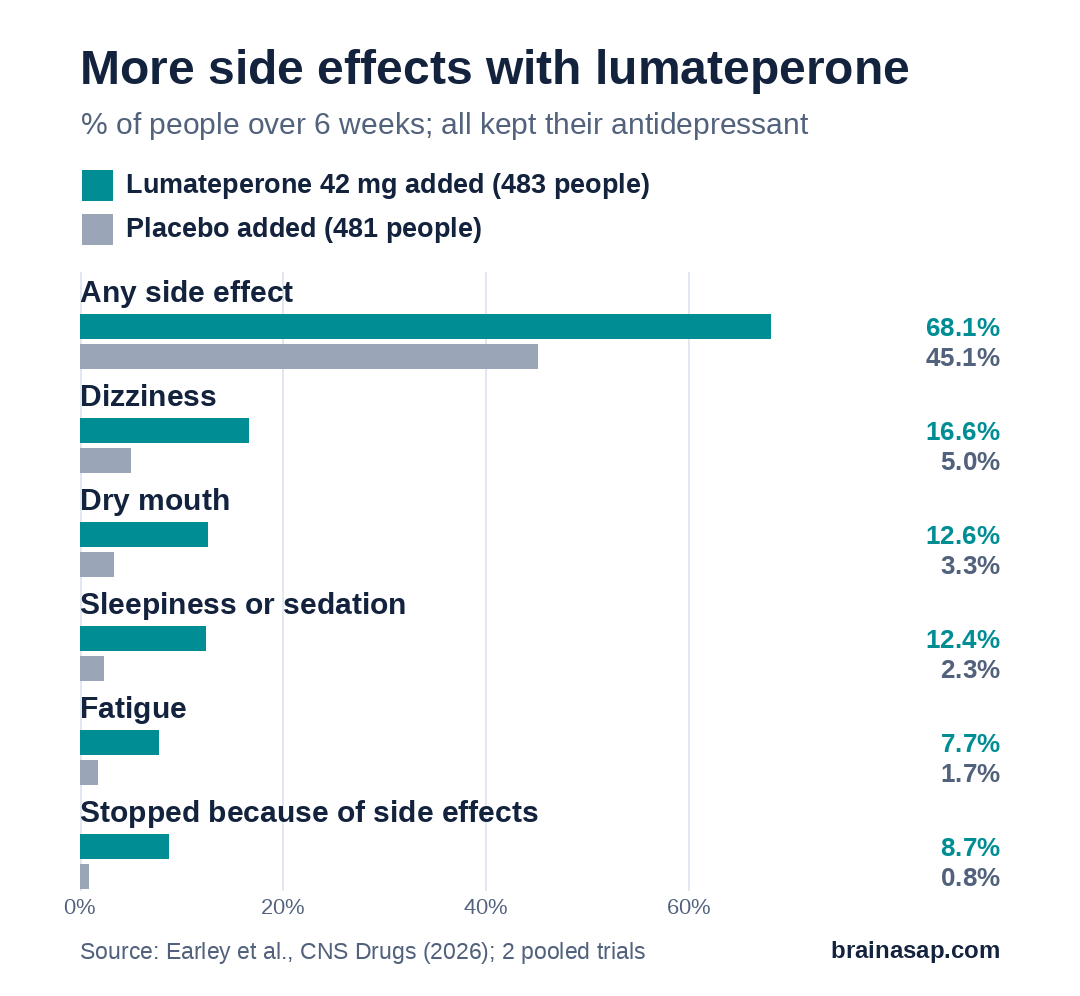
The useful number is the gap. At least one side effect was reported by 68.1% of the lumateperone group and 45.1% of the placebo group — a difference of 23 percentage points. When investigators judged which events were likely caused by the study drug, the split was wider: 50.5% versus 20.2%.
Most of those events weren’t severe. Among lumateperone users who had a side effect, about 57% had nothing worse than mild ones and 38% had at least one rated moderate. One serious event occurred in each group, and neither was judged related to the study drug.
Dizziness, Dry Mouth, and Sleepiness Led the List
Researchers singled out side effects that affected at least 5% of the lumateperone group and occurred at more than twice the placebo rate. Six qualified:
- Dizziness: 16.6% vs 5.0%
- Dry mouth: 12.6% vs 3.3%
- Sleepiness or sedation: 12.4% vs 2.3%
- Nausea: 8.5% vs 4.0%
- Fatigue: 7.7% vs 1.7%
- Diarrhea: 4.6% vs 1.2%, which made the cut after rounding
Headache was actually the most common complaint on lumateperone (18.4%), but it was common on placebo too (12.9%), so it didn’t clear the doubling bar.
Timing is the part a person starting this drug would probably most want to know. In week one, 33.7% of the lumateperone group experienced one of these six common side effects for the first time, compared with 7.7% on placebo.
New cases became less frequent after that: for each of the six, fewer than 2% had a first case in week two and fewer than 1% by week four.
How long they lasted varied. Nausea and diarrhea cleared in about a week on average. Dry mouth lingered longest, at roughly three weeks, and fatigue averaged about 21 days on lumateperone versus 12 on placebo.
About 1 in 13 Extra People Stopped Because of Side Effects
Quitting is where side effects stop being a nuisance and start costing someone the treatment. 8.7% of the lumateperone group stopped because of a side effect, compared with 0.8% on placebo. Put another way, for roughly every 13 people who added lumateperone instead of placebo, one extra person stopped for this reason (a figure calculated from the two reported rates).
No single symptom drove the dropouts. Dizziness (1.9%) and fatigue (1.2%) were the only reasons that led more than 1% of the lumateperone group to stop; the rest were scattered across drowsiness, diarrhea, and a long tail of one-off complaints. Overall, 88.0% of the lumateperone group finished the six weeks, versus 94.8% on placebo.
The study authors suggested that the early timing of side effects may help explain the gap in dropouts. A burst of dizziness or drowsiness in the first days on a new pill is exactly the kind of experience that can end a treatment early.
Weight, Blood Sugar, and Movement Problems Stayed Low in the Short Term
Weight gain and metabolic changes are the side effects many people associate with antipsychotics, so the trials watched them closely. Over six weeks, average weight changed by −0.1 kg on lumateperone and 0.0 kg on placebo. A gain of 7% or more of body weight occurred in 0.4% versus 1.3%.
Average changes in cholesterol, triglycerides, fasting glucose, insulin, and prolactin (a hormone some antipsychotics raise) were small in both groups.
Movement side effects — the category doctors call extrapyramidal symptoms, which includes tremor, stiffness, and akathisia, an inner restlessness that makes it hard to sit still — were reported by 5.8% of the lumateperone group and 1.7% on placebo. Tremor made up most of that difference: 19 people (3.9%) on lumateperone versus one on placebo.
That tremor usually appeared in the first two weeks, lasted about 12 days on average, and led one person to stop. Akathisia or restlessness stayed at about 1% in both groups, and clinician-rated movement scales showed no meaningful average change.
Researchers also tracked suicidal thinking with a standard clinician-administered scale. New suicidal thoughts appeared in 1.6% of the lumateperone group and 2.5% on placebo, and no suicidal behavior occurred during treatment.
Six Weeks, No Rival Drug, and Company-Run Analysis Limit What This Shows
The biggest limit is time. Six weeks can show what people feel early on, but weight gain, metabolic shifts, and late movement disorders can take months to appear. The authors point to a separate 26-week open-label study as reassuring, but that study had no placebo group to compare against.
There was also no other add-on drug in these trials. The authors cite rates from other antipsychotics’ trials — for example, akathisia was the most common side effect in pooled trials of aripiprazole — but those studies used different designs and populations, so this analysis can’t say whether lumateperone is gentler or harsher than the alternatives.
Trial rules shaped who was studied. People over 65, those at immediate suicide risk, and those with bipolar disorder or psychotic disorders weren’t enrolled, and the results apply to an inadequate response to one or two antidepressants rather than to treatment-resistant depression broadly.
Finally, this was a safety-only analysis, and it was run by the drug’s maker. Intra-Cellular Therapies, now part of Johnson & Johnson, was responsible for the design, analysis, and interpretation, and four of the six authors were current employees.
The randomized, placebo-controlled design makes the side-effect counts fairly solid, but anyone weighing whether the depression benefit is worth these side effects will need the efficacy results alongside this one.
Citation: DOI: 10.1007/s40263-026-01314-8. Earley et al. Safety and Tolerability of Adjunctive Lumateperone for the Treatment of Major Depressive Disorder: A Pooled Analysis of Two Randomized Placebo-Controlled Trials. CNS Drugs. 2026.
Study Design: Pooled safety analysis of two identically designed six-week randomized, double-blind, placebo-controlled phase III trials of lumateperone 42 mg or placebo added to an ongoing antidepressant.
Sample Size: 964 adults aged 18 to 65 with major depressive disorder and an inadequate response to one or two antidepressants (483 lumateperone, 481 placebo).
Key Statistic: Side effects in 68.1% vs 45.1%; stopping because of side effects in 8.7% vs 0.8%.
Caveat: Six-week, sponsor-analyzed trials with selected participants and no active-drug comparison cannot show long-term safety or how lumateperone compares with other add-on medicines.