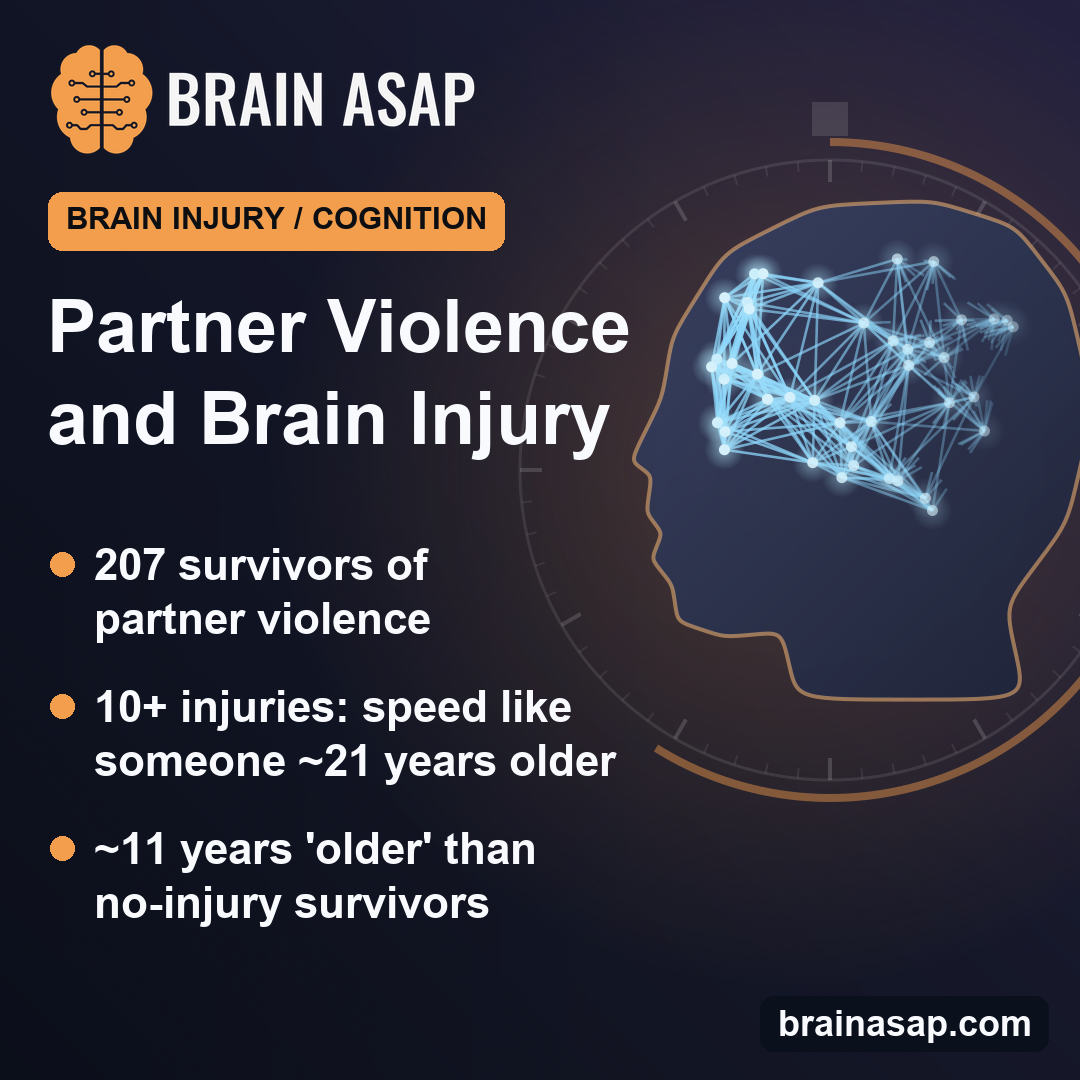
TL;DR: Women who reported 10+ brain injuries from a partner performed on a speed test like someone about 21 years older than their actual age. They scored about 11 years “older” than survivors with no brain injury; the study of 207 women found a link, not proof that the injuries caused the difference.
Key Findings
- Brain injuries were common: 2 of 3 survivors (139 of 207) reported at least one brain injury caused by a partner, and 86 reported more than one.
- Scores fell below typical levels: Survivors with any brain injury scored below the general population on 11 of 16 thinking skills, with reaction time showing the biggest gap.
- The heaviest injury load stood out: Survivors with 10+ brain injuries scored worse overall than nearly 4 of 5 people in the general population.
- A decade-plus gap among survivors: On psychomotor speed, survivors with 10+ brain injuries performed about 11 years “older” than survivors with no brain injury.
- Count mattered more than presence: Simply having any injury versus none didn’t clearly separate survivors; scores dropped as the number of injuries rose.
Source: medRxiv preprint (2026) | McFarland & Valera
When people picture repeated head injuries, they usually think of football players or soldiers. Those groups have been studied for decades, with helmets, sideline checks, and return-to-play rules to show for it.
Far less attention has gone to a group that may be larger: people hurt by an intimate partner. Blows to the head, being shoved into walls, and strangulation can all injure the brain. These injuries often happen again and again, rarely get checked by a doctor, and leave no one watching for recovery.
This new study asks a straightforward question: how does that add up in a person’s everyday thinking skills?
207 Survivors of Physical Partner Violence
The researchers, from Mass General Brigham, Harvard, Oxford, and Stanford, recruited 207 women through community programs, hospital and police-affiliated initiatives, survivor-support organizations, and social media. Every woman had experienced at least one instance of physical violence from a partner. A brain injury wasn’t required to take part.
In structured interviews, the women described their history. A brain injury here meant an event that disrupted brain function — losing consciousness, a gap in memory around the event, or feeling dazed or confused afterward. Changes in consciousness caused by strangulation or violent shaking also counted.
Here’s what they reported:
- 139 women (2 of 3) reported at least one partner-inflicted brain injury.
- 86 reported more than one.
- 56 reported at least one strangulation-related injury.
- Among injured women, the typical (median) count was 2, and 1 in 4 reported 9 or more.
Each woman then took a computerized test battery over video call, covering 16 thinking skills such as memory, attention, reaction time, and mental flexibility. Scores are adjusted for age, so 100 is average for someone of the same age, and most people land between 85 and 115.
The Groups Being Compared
The study makes two different comparisons, and it helps to keep them apart:
- The general population: the test’s standard reference scores, gathered from ordinary adults of each age.
- Survivors with no brain injury: the 68 women in this study who experienced physical partner violence but reported no brain injury from it.
- Survivors with any brain injury: the 139 women who reported at least one.
- Survivors with 10+ brain injuries: the 34 women who reported ten or more.
Comparing against the general population shows how far below typical scores a group falls. Comparing against survivors with no brain injury is the sharper test. Both groups lived through physical abuse, so the difference points more specifically toward the injuries themselves rather than the abuse in general.
What “Cognitive Age” Means
Test scores like “88” aren’t very meaningful to most people, so the authors translated them into cognitive age: the age at which a typical person in the general population would score the same.
The authors give a simple example. If a 30-year-old performs like a typical 48-year-old, her cognitive age gap is 18 years.
This is a translation of test scores, not a measurement of the brain itself. The authors say plainly that a gap in years describes how a younger woman’s scores resemble an older one’s. It doesn’t show that her brain has literally aged.
More Injuries, Lower Scores on Speed and Memory Tests
Survivors scored below typical levels on most skills
Survivors with any brain injury scored below the general population on 11 of 16 skills. The biggest gap was in reaction time (average 88.0), followed by simple attention and memory. One skill held steady: recognizing emotions in faces stayed right at the population average.
The gap grew with more injuries
Survivors with 10+ brain injuries showed the largest gaps. Their overall thinking score averaged 87.6, worse than nearly 80% of the general population. On eight skills, including reaction time, memory, and psychomotor speed, they performed more than 20 years “older” than the general population.
The authors consider psychomotor speed — how quickly you can see something and respond with your hands, measured with finger-tapping and symbol-matching tasks — one of the easiest skills to translate into years in a meaningful way, because it declines steadily with age. Here’s how it looked across injury groups:
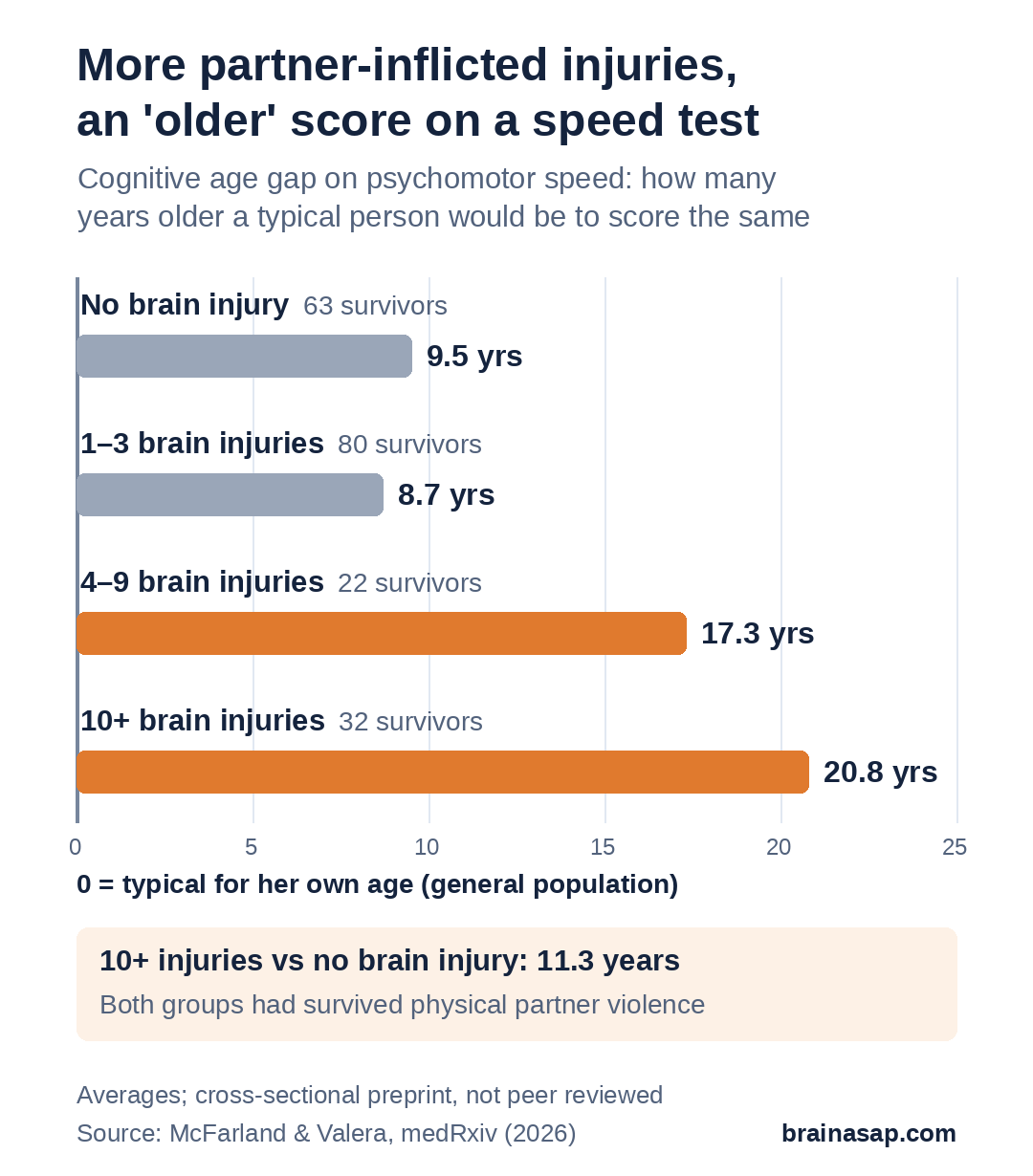
For an average 30-year-old in the 10+ group, that works out to psychomotor speed like a typical 51-year-old.
Compared with other survivors, the gap was still about a decade
Against survivors with no brain injury, those with 10+ brain injuries scored lower on all 16 skills. The difference was clear on four: overall thinking score, reaction time, psychomotor speed, and processing speed.
In cognitive-age terms, they performed about 11 years “older” on psychomotor speed, 12 years on reaction time, and 14 years on verbal memory than survivors with no brain injury.
Counting injuries mattered more than “yes or no”
One of the more practical findings: when the researchers simply compared survivors with any brain injury to survivors with none, the differences were small and uncertain. The pattern only became clear when they looked at how many injuries a woman had.
After adjusting for 11 other factors, a higher injury count still tracked with lower scores on 6 skills, including psychomotor speed, reaction time, and verbal memory. Those factors were age, education, race, brain injuries from other causes (in adulthood or childhood), post-traumatic stress, depression, anxiety, alcohol use, childhood maltreatment, and recent abuse severity.
That matters because many screening tools only ask whether a survivor has had a head injury, not how many.
The Real Picture May Be Worse
The test automatically throws out scores it considers unreliable, which is standard practice. But 40% of women had at least one score discarded. When the researchers checked, those same women scored 11 to 13 points lower on the parts of the test that were accepted.
In other words, the discarded scores came mostly from the women who were struggling most. The authors also note that the women were unusually well educated (62% had a college degree), that the most recent injury typically happened about 7.5 years before testing, and that the most severely affected survivors may never have been able to join a study like this at all.
What This Study Can’t Tell Us
These results are striking, but they have real limits:
- No “before” snapshot: Each woman was tested once. Without scores from before the injuries, the study can’t prove the injuries caused the lower scores, or rule out that some differences were there beforehand.
- Not all of the gap points to injury: Even survivors with no brain injury scored below typical, about 9.5 years “older” on psychomotor speed. Abuse, stress, and other life circumstances likely play a part too.
- Self-reported injury counts: Women recalled their injuries from memory, sometimes over many years. The researchers checked for one obvious bias — they found women with weaker memory reported slightly more injuries, not fewer — but counts are still estimates.
- Small top group: Only 32 women in the 10+ group had a psychomotor score that could be converted to years, so the estimates are imprecise.
- Some “years” are rough: For skills that barely change with age, like simple attention, a modest score drop turns into many years. The authors treat those figures as less precise.
- Remote testing: Women took the test remotely, in a private place of their choosing, while the test’s reference scores came from supervised sessions.
Why Injury Counts Could Change Care
The skills most affected here — speed, attention, memory, and flexible thinking — are the same ones people rely on to hold a job, care for children, handle paperwork, and navigate the courts. The authors argue that cognitive problems from brain injury can be mistaken for stress, dishonesty, or unreliability, which can work against survivors in legal and custody settings.
Their suggestion is practical: services for survivors should ask how many head injuries someone has had, check thinking skills, and connect people with the cognitive rehabilitation already used after other kinds of brain injury.
If you or someone you know is affected by partner violence, the U.S. National Domestic Violence Hotline is free and confidential at 1-800-799-7233 or thehotline.org.
Citation: DOI: 10.64898/2026.09.24.26363984. McFarland CW, Valera EM. Partner-inflicted brain injury may cognitively age survivors by over a decade. medRxiv preprint. 2026.
Study Design: Cross-sectional study of community-dwelling women; one remote computerized cognitive battery (16 domains), with injury history from structured interviews and regression models adjusted for 11 covariates.
Sample Size: 207 women with lifetime exposure to physical intimate partner violence (139 with at least one partner-inflicted brain injury; 68 with none; 34 with 10 or more).
Key Statistic: On psychomotor speed, survivors with 10+ brain injuries showed a 20.8-year cognitive age gap versus the general population and an 11.3-year gap versus survivors with no brain injury (P = 0.033).
Caveat: Preprint posted 27 September 2026 and not peer reviewed; single-time-point testing and self-reported injury counts mean the study cannot prove the injuries caused the lower scores.