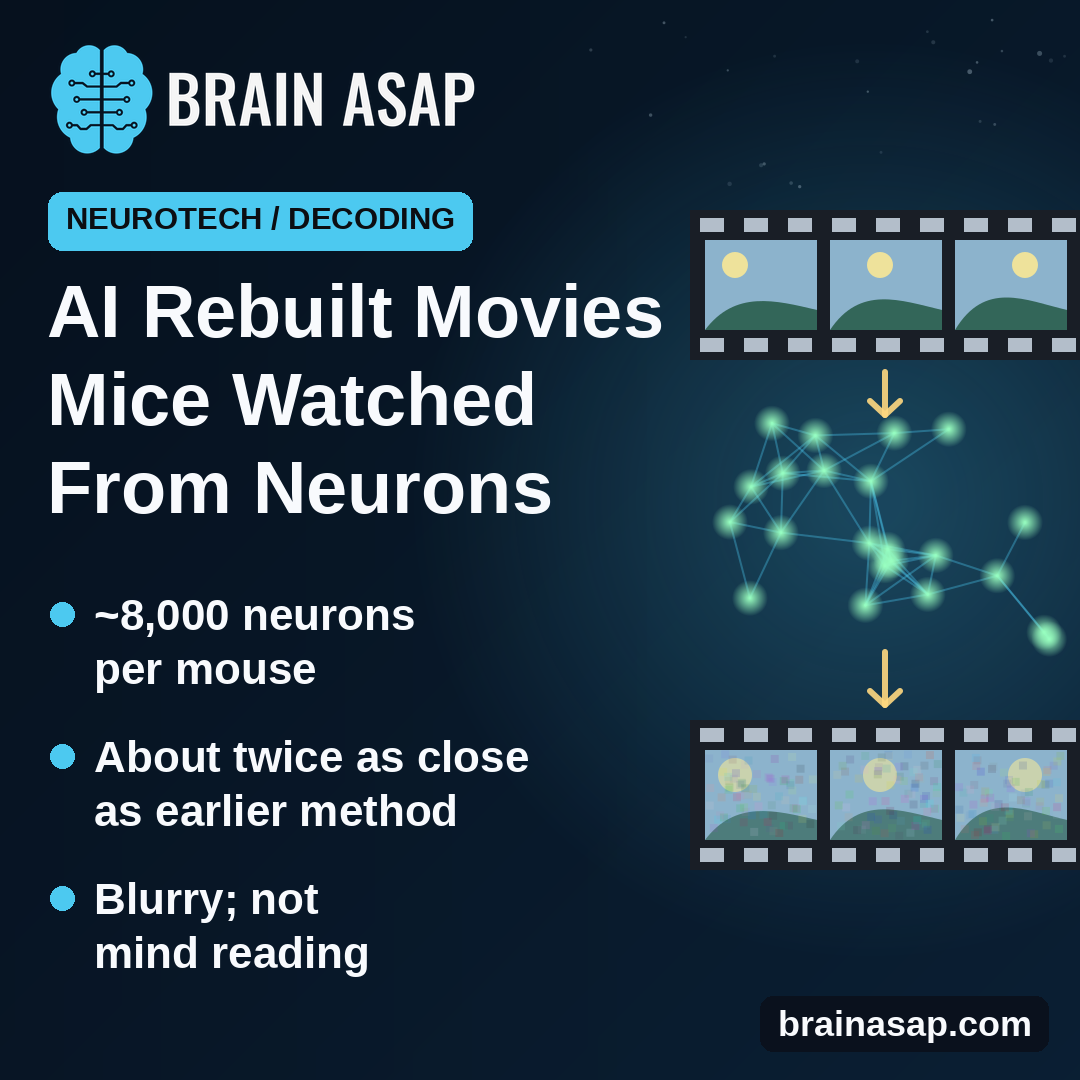
TL;DR: Researchers rebuilt 10-second movie clips that mice had watched, using only recordings from about 8,000 neurons in each mouse’s visual cortex. The blurry, low-resolution results matched the originals fairly well, but this is not mind reading.
Key Findings
- 50 clips rebuilt: Ten 10-second movies from each of 5 mice.
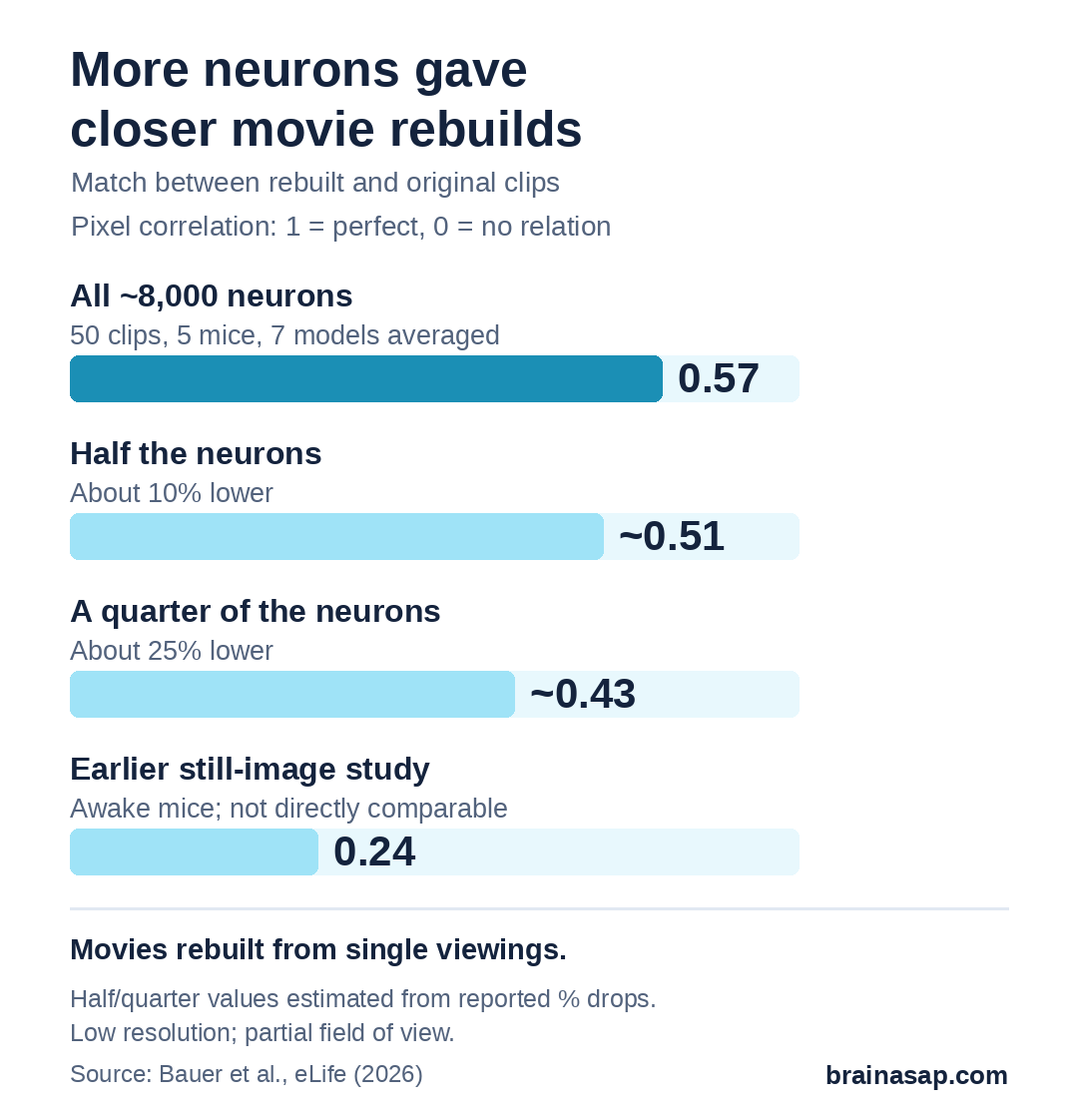
- Pixel match of 0.57: About double an earlier attempt with still images in awake mice.
- Averaging 7 AI models helped: 28% better than a single model.
- More neurons, better movies: Using a quarter of the neurons cut quality by about 25%.
- Fine detail lost: Sharp edges and very fast changes were not rebuilt well.
Source: eLife (2026) | Bauer, Margrie & Clopath
Can you work out what an animal is looking at just from its brain activity? Human studies have rebuilt rough images from brain scans, but scanners blur together millions of cells. Recording individual neurons should, in principle, give a sharper picture.
A team at University College London and Imperial College London used that approach to rebuild short movies that mice had watched, frame by frame.
Starting From Gray and Working Backward
The team used public data from a 2023 competition. Mice watched natural movie clips while a microscope recorded about 8,000 neurons in the primary visual cortex, the brain’s first stop for vision. Running speed and pupil size were recorded too.
The key tool was an AI model that predicts how those neurons will respond to any video. The researchers ran it in reverse:
- Start with a blank gray video.
- Predict neuron responses to it with the AI model.
- Compare with the real recorded responses.
- Adjust the pixels to shrink the gap, and repeat.
The movies used for testing were held out from the model’s training, so it could not simply recall them.
Recognizable Clips, About Twice as Close as Before
Across 50 rebuilt clips, the pixel-by-pixel match with the real movies averaged 0.57 on a scale where 1 is perfect and 0 is no relation. That was from a single viewing, not an average across repeats.
An earlier study that rebuilt still images from awake mouse visual cortex reached about 0.24. The authors caution that still images and movies are hard to compare directly.
More Neurons and More Models Helped
Two things mattered most:
- Averaging models: Seven copies of the AI model each rebuilt the movie, and averaging them improved the match by 28%. Two models alone gave a 13.7% gain.
- Neuron count: Dropping half the neurons cut quality by about 10%; dropping three quarters cut it by about 25%.
Quality also varied within each clip. Higher-contrast moments were easier to rebuild. The mouse’s running or pupil size did not clearly matter.
Blurry Edges and Limits
- Low resolution: Each pixel spans 3.4 degrees of view, about 3 times coarser than mouse eyesight.
- Fine detail fails: Patterns smaller than 1 pixel were not rebuilt.
- Partial view: Neurons covered about a fifth of the visual cortex, so only part of each frame could be rebuilt.
- Seen, not imagined: The method rebuilds movies shown on a screen, not dreams or thoughts.
- Mice only: Requires recording thousands of single neurons through a microscope.
A Window on What the Mouse Brain Emphasizes
The authors see this mainly as a research tool. Comparing a rebuilt movie with the original could show what the brain sharpens, ignores or expects, for example whether surprising parts of a scene come through more clearly.
Whether rebuilt movies will reveal those effects, and not just limits of the AI model, is the question for the next round of experiments.
Citation: DOI: 10.7554/eLife.105081. Bauer J, Margrie TW, Clopath C. Movie reconstruction from mouse visual cortex activity. eLife. 2025;14:RP105081 (Version of Record 10 March 2026).
Study Design: Computational reconstruction using a dynamic neural encoding model and gradient-based input optimization on public two-photon data.
Sample Size: 50 ten-second clips from 5 mice, about 8,000 V1 neurons each.
Key Statistic: Mean pixel correlation r = 0.569 (95% CI 0.542 to 0.596).
Caveat: Low spatial resolution; partial visual field; screen-presented movies only.