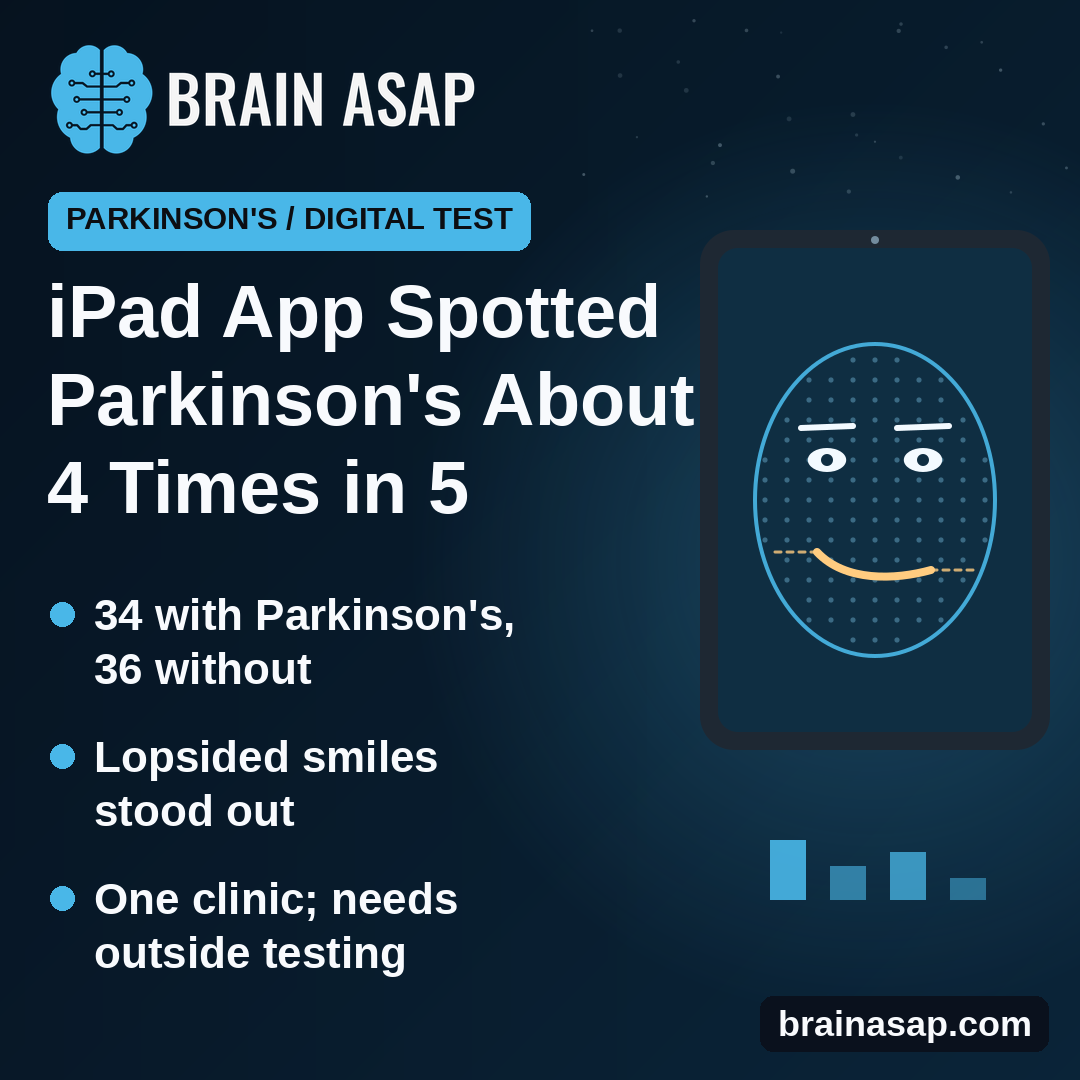
TL;DR: An iPad app that tracks 52 facial movements told apart people with Parkinson’s from people without it about 4 times in 5 in a 70-person study. Lopsided expressions mattered as much as smaller ones.
Key Findings
- 34 people with Parkinson’s, 36 without: Each made 53 cued faces in front of an iPad.
- Best model scored 0.83 out of 1: On a score for separating the 2 groups, where 0.5 is chance.
- Beat simpler checks: Movement size alone scored 0.75; age and sex alone, 0.68.
- Lopsided faces in Parkinson’s: Uneven mouth corners and weaker lower-lip movement stood out.
- Matched doctor ratings: One smile measure explained 42% of the variation in doctor-rated facial masking.
Source: npj Parkinson’s Disease (2026) | Koyak et al.
One of the earliest signs of Parkinson’s is a face that moves less: fewer blinks, a slower smile, a look that can come across as flat or uninterested. Doctors call it hypomimia, or “masked face.” Today it is judged by eye on a 0-to-4 scale, which varies between raters and misses small changes.
Researchers at the University of Bonn and the German Center for Neurodegenerative Diseases tested whether an iPad could measure it instead.
53 Facial Poses in Front of an iPad
The study included 34 people with Parkinson’s from a Bonn movement disorders clinic, mostly at early stages, and 36 people without the disease. Each sat 30 cm from an iPad Pro whose depth-sensing front camera, the kind used for Face ID, tracked their face.
An app called ExpressionTracker, built on Apple’s face-tracking software, asked them to hold a neutral face and then make 52 specific movements, like raising the outer brows, pulling the mouth left or lowering the lower lip. The whole test takes 5 to 10 minutes.
From these, the team built 261 measures, including:
- Size: How far each part moved from resting.
- Lopsidedness: Left side versus right side.
- Combinations: How two movements worked together.
Uneven Smiles and a Stiffer Lower Lip
Six measures clearly differed between the groups. People with Parkinson’s could lower the right side of their lower lip much less. Their mouth corners pulled down more unevenly. At rest, their outer eyebrows sat slightly higher, a pattern the authors say has not been described in Parkinson’s before and needs confirming.
Several of these were lopsidedness or combination measures rather than simple size. That fits the clinical observation that Parkinson’s often starts on one side of the body.
About 4 in 5 Correct, Beating Simpler Checks
Eight machine learning models were trained and tested on separate slices of the data, repeated many times. The best scored an AUC of 0.83, where 0.5 is a coin flip and 1.0 is perfect. At a standard cutoff, it was right about 79% of the time, catching 74% of people with Parkinson’s and correctly clearing 83% of those without.
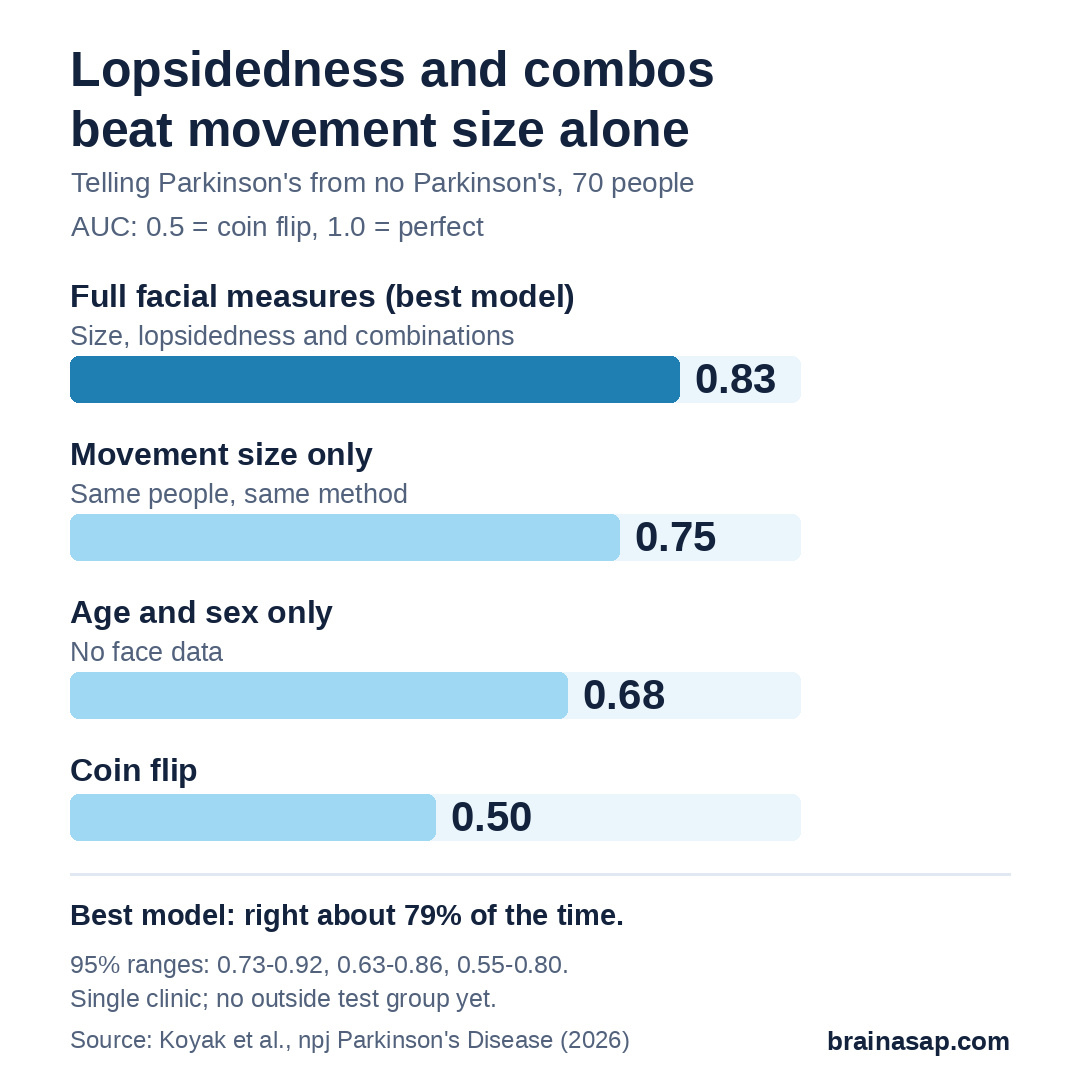
Using only movement size scored 0.75, and using only age and sex scored 0.68. So the lopsidedness and combination measures added real information.
Within the Parkinson’s group, a smile measure combined with pulling the mouth to the left explained 42% of the variation in doctors’ masked-face ratings.
Small, Single-Clinic and Not Yet Tested Elsewhere
- 70 people, one clinic: No outside group to confirm accuracy.
- Uneven groups: 71% of Parkinson’s participants were men versus 47% of the comparison group.
- One unblinded rater: All clinical scores came from one doctor who knew the diagnoses.
- Posed, not natural: Spontaneous expressions were not tested.
- Diagnosed patients only: Unknown whether it catches Parkinson’s before diagnosis.
- Black-box software: Apple’s face-tracking model was built for animation, not medicine.
Can It Spot Parkinson’s Before Diagnosis?
The app is not a diagnostic test. It may one day help track masked face in a clinic or in drug trials, with numbers instead of a rough 0-to-4 score.
The bigger question is whether it can detect changes years early, for example in people with a sleep disorder that often precedes Parkinson’s. The team’s ongoing study is following participants over time.
Citation: DOI: 10.1038/s41531-026-01579-2. Koyak B, Menzel T, Rodemann M, et al. Interaction- and asymmetry-aware facial blendshape analysis for objective quantification of Parkinsonian hypomimia. npj Parkinsons Dis. 2026;12:231.
Study Design: Cross-sectional baseline analysis of the AVERT-MD observational study; nested cross-validated machine learning.
Sample Size: 34 people with Parkinson’s, 36 healthy controls.
Key Statistic: Best model AUC 0.834 (95% CI 0.733 to 0.923).
Caveat: Small single-site sample; no external validation; posed expressions; unblinded single rater.