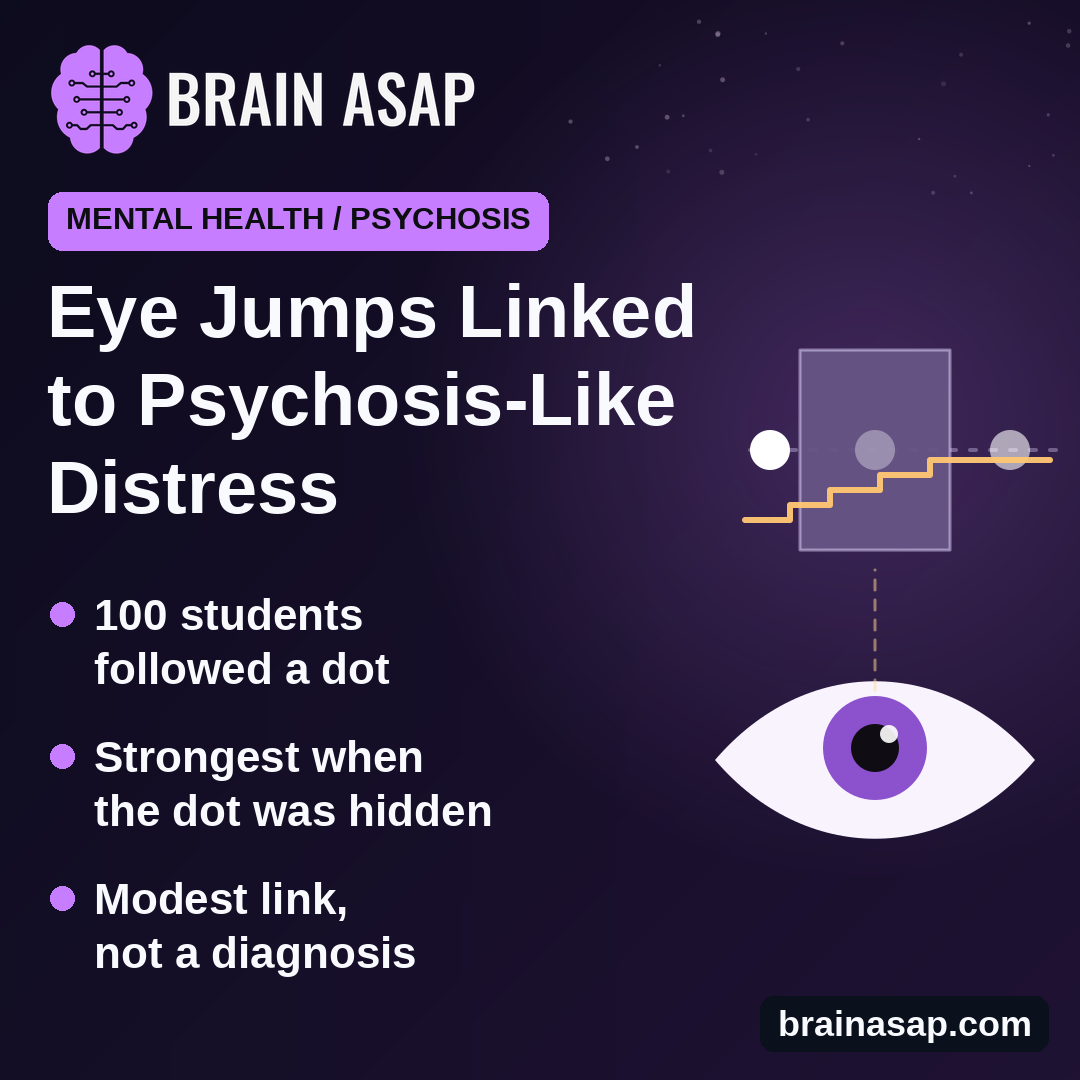
TL;DR: Among 100 college students, those more distressed by unusual experiences like odd perceptions or suspicious thoughts made more jerky “catch-up” eye jumps while following a moving dot. The link was modest, and it was strongest when the dot briefly disappeared.
Key Findings
- 100 students, average age 19: Recruited to span low to high distress from psychosis-like experiences.
- More distress, more catch-up jumps: r = 0.25 with a visible dot, 0.29 when it was hidden.
- Bizarre experiences showed the strongest link: r = 0.36 on the hidden-dot task.
- More lag behind the hidden dot with more distress (r = -0.23).
- No link with depression, anxiety or odd feelings about the self.
Source: European Archives of Psychiatry and Clinical Neuroscience (2026) | Fattal & Mittal
People with schizophrenia often struggle to follow a moving object smoothly with their eyes. Instead of gliding along, the eyes fall behind and jump to catch up. Researchers have long wondered whether this shows up, in milder form, in people who never develop psychosis but have brief psychosis-like experiences.
Those experiences are fairly common: hearing a voice no one else hears, feeling watched, or sensing that thoughts are not quite your own. A Northwestern University team tested whether distress from them tracks with how well the eyes follow a target.
Following a Dot That Sometimes Vanished
The researchers recruited 100 students, average age about 19, from a university volunteer pool. They deliberately picked people across the range of distress from psychosis-like experiences: 25 low, 30 moderate and 45 high, based on a standard questionnaire.
With their heads steady on a chin rest, participants watched a small black dot sweep back and forth across a screen while a high-speed eye tracker recorded their gaze. There were two versions:
- Visible dot: The dot stayed in view the whole time.
- Hidden-middle dot: A box covered the middle of the screen for almost 2 seconds per sweep, so people had to predict where the dot was.
The team counted catch-up jumps, quick eye movements made to re-catch the dot, and measured how far gaze lagged behind it.
More Distress Went With Jumpier Eyes
Students more distressed by psychosis-like experiences made catch-up jumps more often on both versions of the task. The link was stronger when the dot was hidden.
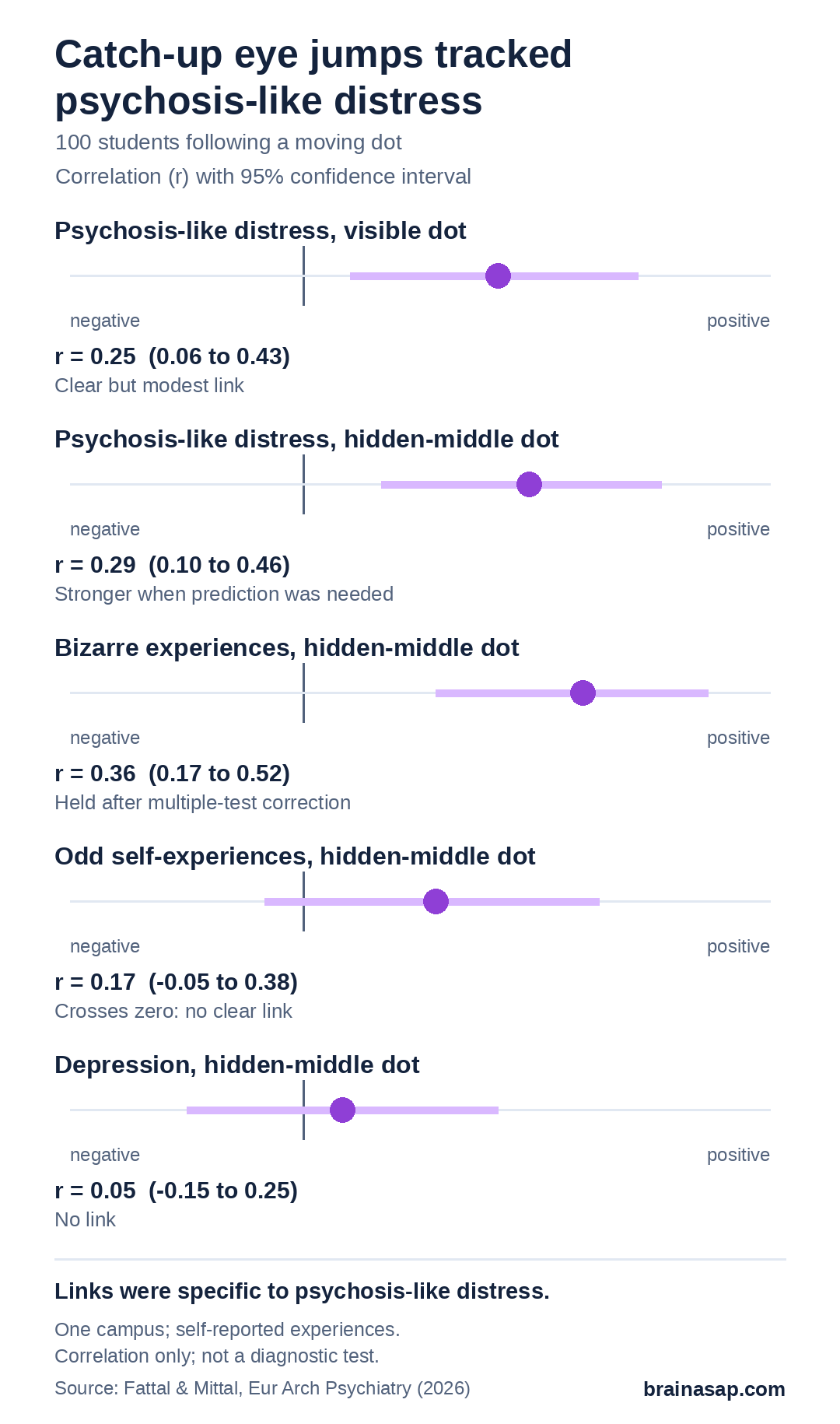
Among the types of experiences, distress over bizarre experiences, such as unusual perceptions or a sense that something strange is going on, showed the clearest link, and it held after correction for multiple tests. On the hidden-dot task, students with more distress also lagged further behind where the dot should have been.
Not Explained by Mood or Attention
Eye tracking did not relate to depression or anxiety scores. Lag on the hidden-dot task did relate to a test of attention and processing speed, but the links with psychosis-like distress held after accounting for that score.
The authors had expected eye tracking to also relate to odd experiences of the self, such as feeling detached from one’s body or actions. It did not.
A Modest Link in One Student Group
- Modest links: Correlations of 0.25 to 0.36 leave most of the variation unexplained.
- One campus: College students may not reflect the wider population.
- Self-reported experiences: No clinical interviews or diagnoses.
- Missing surveys: 26 people lacked at least one questionnaire.
- One-time snapshot: No follow-up to see who later developed problems.
Could a Simple Eye Test Flag Psychosis Risk?
The study adds to evidence that eye tracking quirks seen in schizophrenia may show up, faintly, in people with milder psychosis-like experiences. Having such experiences is common and does not mean someone will develop psychosis.
The open question is whether the hidden-dot test can predict who goes on to need care, which would take following people over years.
Citation: DOI: 10.1007/s00406-026-02390-z. Fattal J, Mittal VA. Associations between smooth pursuit, predictive pursuit, anomalous self-experiences, and psychotic-like experiences. Eur Arch Psychiatry Clin Neurosci. 2026.
Study Design: Cross-sectional eye-tracking study with enriched sampling across distress from psychotic-like experiences.
Sample Size: 100 university students (25 low, 30 moderate, 45 high distress at screening).
Key Statistic: Catch-up saccades on predictive pursuit vs bizarre-experience distress: r = 0.36 (95% CI 0.17 to 0.52; adjusted p = 0.002).
Caveat: Single campus; self-report; modest correlations; cross-sectional.