TL;DR: A 2026 longitudinal study in Personality and Individual Differences followed 346 Turkish young adults across two survey waves three months apart and found that childhood psychological abuse predicted lower adult relationship satisfaction, with a reduced sense of belonging acting as the statistical mediator linking the early adversity to the later romantic outcome.
Key Findings
- Higher childhood psychological abuse predicted lower adult relationship satisfaction: Across two waves three months apart, individuals who reported more childhood emotional mistreatment also reported less satisfaction in their current romantic relationships.
- Reduced belongingness mediated the link: Statistical analysis showed that childhood psychological abuse predicted a lower sense of belonging, which in turn predicted lower relationship satisfaction. The effect on adult romance ran through belongingness rather than directly.
- Two-wave longitudinal design: 346 Turkish young adults completed surveys in February 2025 and again in May 2025; pseudonyms plus phone-number and parent-name digits matched responses across waves while preserving anonymity.
- Sample composition: 213 women and 133 men aged 20-36, average age ~25, all university students at one Turkish university.
- Three validated questionnaires used: 12-item childhood psychological abuse scale, 7-item relationship satisfaction scale, and 12-item belongingness measure capturing social acceptance and rejection.
- Mediating mechanism is theoretical and partial: Researchers anchor the belongingness-as-mediator framework in attachment theory and object relations theory; other possible mediators (self-esteem, interpersonal trust) are not tested in this analysis.
Source: Personality and Individual Differences (2026) | İme
Childhood psychological abuse — constant criticism, emotional manipulation, intentional humiliation by a parent or caregiver — is harder to measure than physical or sexual abuse and has been comparatively understudied in the adult-relationship literature.
Attachment theory and Klein’s object relations framework both predict that the relational patterns formed in early childhood shape how a person experiences closeness in adulthood. The mechanism that has not been clearly tested is which specific psychological process carries the long-term effect.
This Turkish longitudinal study tested whether reduced sense of belonging is the linking mechanism between childhood emotional abuse and adult romantic dissatisfaction.
346 Turkish Young Adults Surveyed Across Two Three-Month-Apart Waves
The work was led by Yakup İme, an associate professor of counseling psychology at Necmettin Erbakan University in Konya, Türkiye.
The design:
- Sample: 346 university students (213 women, 133 men) aged 20-36; average age ~25.
- Wave 1: February 2025, in-person printed survey forms.
- Wave 2: May 2025, same format.
- Identifier matching: Pseudonyms plus the last three digits of phone numbers and the last few letters of parents’ names allowed matching across waves while preserving anonymity.
- Three measures: 12-item childhood psychological abuse scale, 7-item relationship satisfaction scale, 12-item belongingness scale measuring social acceptance and rejection.
The two-wave design lets the analysis test whether the mediation pattern holds over time, not just at a single snapshot. Three months is short for a longitudinal design but long enough to capture stability of the abuse-belongingness-satisfaction chain.
Why Belongingness Was the Hypothesized Mediator
İme’s choice of belongingness as the mediator came from two theoretical traditions:
- Klein’s object relations framework: Internalized representations of early caregiving relationships shape how a person experiences emotional closeness throughout life.
- Bowlby’s attachment theory: Early bonds with caregivers create the blueprint for future relationships, including how secure or rejected one feels in adult romantic contexts.
The study uses that framework to ask whether early parent-child relationships leave lasting marks on adult closeness and romantic satisfaction.
Belongingness — the general feeling of being accepted, valued, and supported — is the proposed bridge between childhood relational experience and adult romantic satisfaction.
Childhood Psychological Abuse Predicted Lower Adult Relationship Satisfaction
The direct association between early-life psychological abuse and adult romantic outcomes came out clearly in the data.
The headline pattern:
- Higher childhood psychological abuse scores were associated with lower adult relationship satisfaction.
- The pattern was consistent across the two waves three months apart, arguing against a one-time mood-driven artifact.
- Effect direction matched the theoretical prediction of attachment and object-relations frameworks.
The link itself is not new in the literature. The contribution of the study is the test of why the link exists.
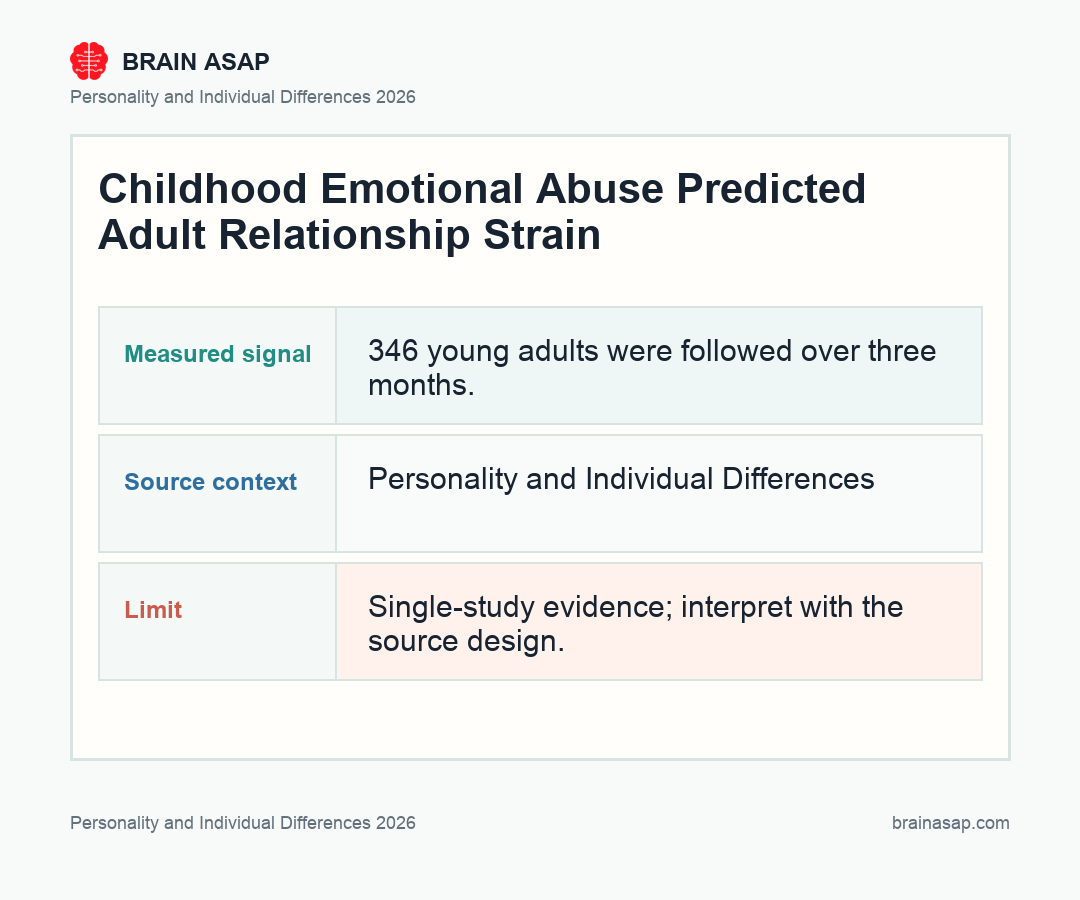
Belongingness Carried the Effect From Early Abuse to Adult Romance
The mediation analysis is the analytical centerpiece of the study. The pattern:
The interpretive framing: The clinical and developmental implications follow from the mediation finding:
- Belongingness-focused interventions for early-abuse adults: If belongingness carries the effect, therapy and support that explicitly rebuild the sense of being accepted and valued may be a high-leverage target for adults with early emotional-abuse histories.
- Childhood prevention is the most direct lever: İme’s broader framing emphasizes that protecting children from emotional mistreatment early prevents the cascade entirely.
- Multi-mediator analyses are the next research step: Adding self-esteem, interpersonal trust, and resilience to the mediation framework would clarify how much of the early-abuse-to-adult-romance link is uniquely belongingness-driven vs shared with related constructs.
- Cross-cultural and partner-reported replication: İme’s stated long-term plans include observational and partner-reported data plus broader cultural samples to strengthen the causal inference.
Citation: DOI: 10.1016/j.paid.2026.113744. İme Y. How early psychological abuse predicts decreased relationship satisfaction via belongingness in adulthood: A longitudinal study. Personality and Individual Differences. 2026.
Study Design: Two-wave longitudinal survey study with three-month interval; mediation analysis of belongingness as the linking mechanism between childhood psychological abuse and adult relationship satisfaction.
Sample Size: 346 Turkish university students (213 women, 133 men), aged 20-36, average age ~25.
Key Statistic: Higher childhood psychological abuse predicted lower adult relationship satisfaction; reduced belongingness statistically mediated the link; pattern was consistent across the two waves three months apart.
Caveat: Self-reported questionnaire data subject to social desirability bias; three-month follow-up is short; single-site Turkish university sample limits cultural generalization; other plausible mediators (self-esteem, interpersonal trust) not tested in this analysis.