TL;DR: In a 2026 mouse study, researchers injected a toxic chemical into the eyes of mice to kill the nerve cells that carry vision to the brain, then treated some eyes with tiny particles carrying myricetin, a plant compound. Treated mice kept more of these cells and did better on vision tests than untreated injured mice, though this quick injury model is not the same as glaucoma.
Key Findings
- More eye nerve cells survived: mice treated with myricetin particles had more retinal ganglion cells, the cells that form the optic nerve, than injured mice without treatment.
- Better vision tests: the retina’s electrical response to light and a test of how mice track moving stripes both improved.
- Calmer immune cells: microglia, the retina’s immune cells, were fewer and less activated, and inflammation genes such as TNF-α dropped.
- Help seemed indirect: in a dish, the particles protected nerve cells mainly by calming microglia, not by acting on the nerve cells themselves.
- No eye damage detected in 2 weeks: healthy eyes showed no damage 7 and 14 days after an injection.
Source: International Journal of Nanomedicine (2026) | Yang et al.
In glaucoma, the nerve cells that carry signals from the eye to the brain slowly die, and the vision they carried doesn’t come back. Today’s treatments lower eye pressure, but they don’t directly protect those cells.
A 2026 study in the International Journal of Nanomedicine, by eye researchers at the Aier Eye Institute in Changsha, China, tested a different approach in mice: protecting the cells by calming inflammation around them.
A Plant Compound That Needs a Ride
Myricetin is a natural plant compound, a flavonoid, that calms inflammation in lab studies. But it barely dissolves in water, which makes it hard to deliver inside the eye.
So the team packed it into nanoparticles about 67 nanometers wide, roughly a thousandth the width of a hair. Each particle has a shell coated with hyaluronic acid, a substance that naturally fills the eye and sticks to activated immune cells.
In lab tests, the particles released about 56% of their myricetin in the first 24 hours and about 75% by 96 hours.
Injured Eyes, Treated and Untreated
Young adult male mice were split into 3 groups:
- Healthy comparison mice: a harmless salt-water injection into the eye.
- Injured mice: an injection of NMDA, a chemical that overexcites retinal ganglion cells until they die, mimicking one way these cells are lost in glaucoma.
- Injured, treated mice: NMDA plus a single eye injection of myricetin nanoparticles.
Most measurements were taken 3 days later, with 3 to 6 mice per group for each test.
Did Treated Mice Keep More Vision?
The result? By every measure the team checked, yes.
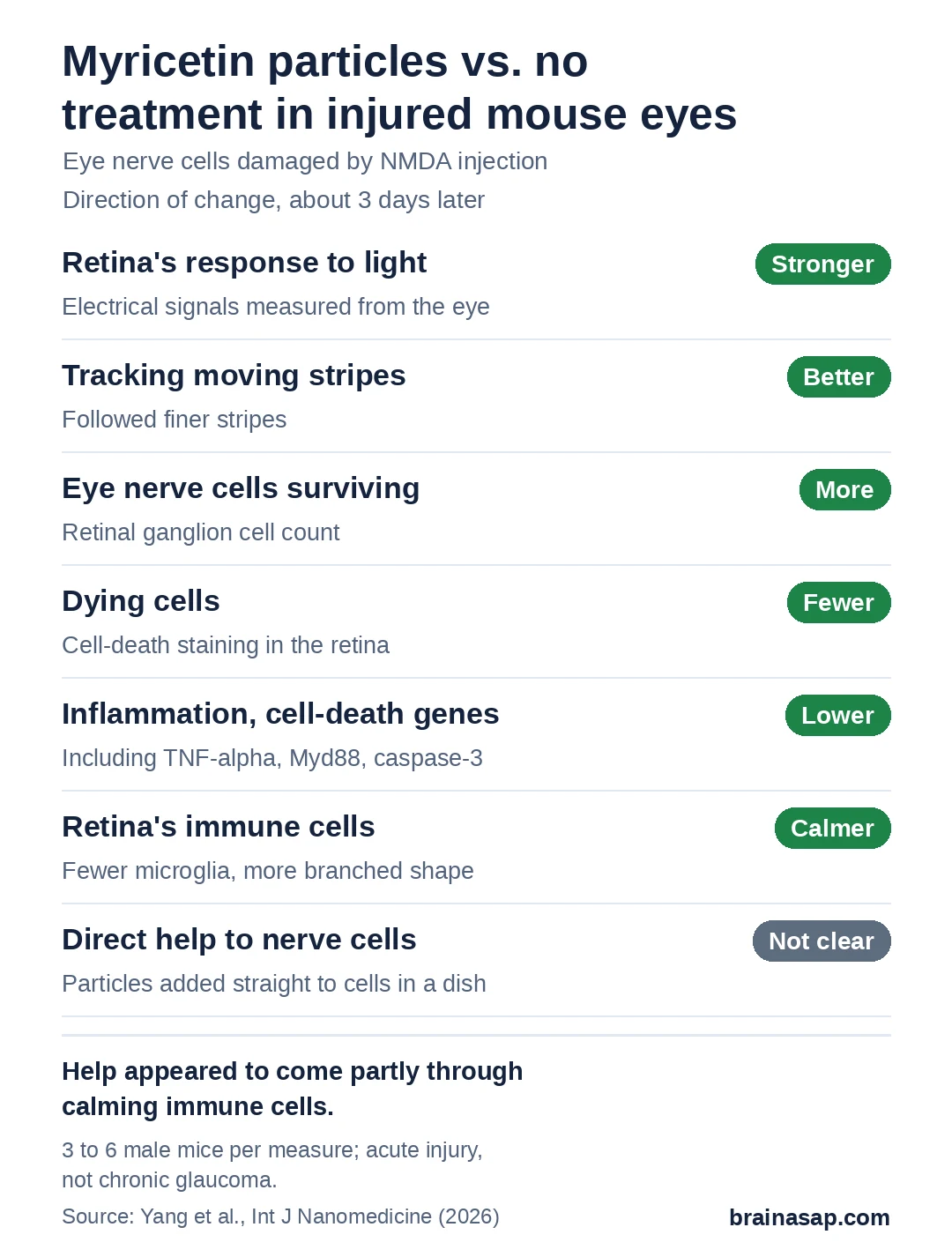
- Retina’s response to light: electrical signals measured from the eye were stronger than in untreated injured mice.
- Stripe-tracking test: mice turn their heads to follow moving stripes; treated mice could follow finer stripes.
- Cell counts: more retinal ganglion cells survived, and fewer cells showed signs of dying.
Calming the Retina’s Immune Cells
When nerve cells are injured, microglia rush in. Activated microglia swell, pull in their branches and release inflammatory chemicals that can harm nearby cells.
In treated mice, microglia were fewer, smaller and more branched, a calmer shape. Inflammation and cell-death genes, including TNF-α, Myd88 and caspase-3, were lower than in untreated injured mice.
Dish experiments helped sort cause from effect. Liquid from activated microglia killed retinal nerve cells, but liquid from activated microglia that had been treated with the particles did less damage. Adding the particles straight to nerve cells gave no clear protection.
That points to calming microglia as at least part of how the treatment works, though Yang and colleagues noted it may not be the only reason.
A Quick Injury Is Not Glaucoma
- Acute model: NMDA kills cells within days; glaucoma unfolds over years, usually with high eye pressure.
- No plain-myricetin group: it’s unclear how much the nanoparticle packaging itself helped.
- Short safety check: 14 days, single injection; repeated injections were not tested.
- Small groups: 3 to 6 mice per measurement, all male.
- One batch of particles: consistency between batches wasn’t tested.
Would It Work in a Slow, Glaucoma-Like Model?
This study shows that a plant compound, packaged to reach the retina, can protect eye nerve cells from a sudden chemical injury in mice, likely in part by calming inflammation.
A tougher test, which the team itself called for, would use a model where eye pressure rises slowly, as in human glaucoma, and compare the particles directly with plain myricetin.
Citation: DOI: 10.2147/IJN.S629654. Yang X, Xu J, Long L, Wang Q, Ji S, Tang S, Ma JH. Hyaluronic acid-PEG-PLGA nanoparticles encapsulating myricetin attenuate NMDA-induced retinal ganglion cell injury associated with microglia-related neuroinflammatory responses. Int J Nanomedicine. 2026;21:629654.
Study Design: Nanoparticle formulation study with an acute NMDA retinal injury model in mice plus microglia and retinal cell culture experiments.
Sample Size: 7-week-old male C57BL/6J mice; 3 to 6 per group per measurement.
Key Statistic: Nanoparticles 67.1 nm, about 7.4% drug loading; treated injured mice had higher ganglion cell density and better retinal function than untreated injured mice.
Caveat: Acute chemical injury model rather than chronic glaucoma; no free-myricetin comparison; short safety follow-up.