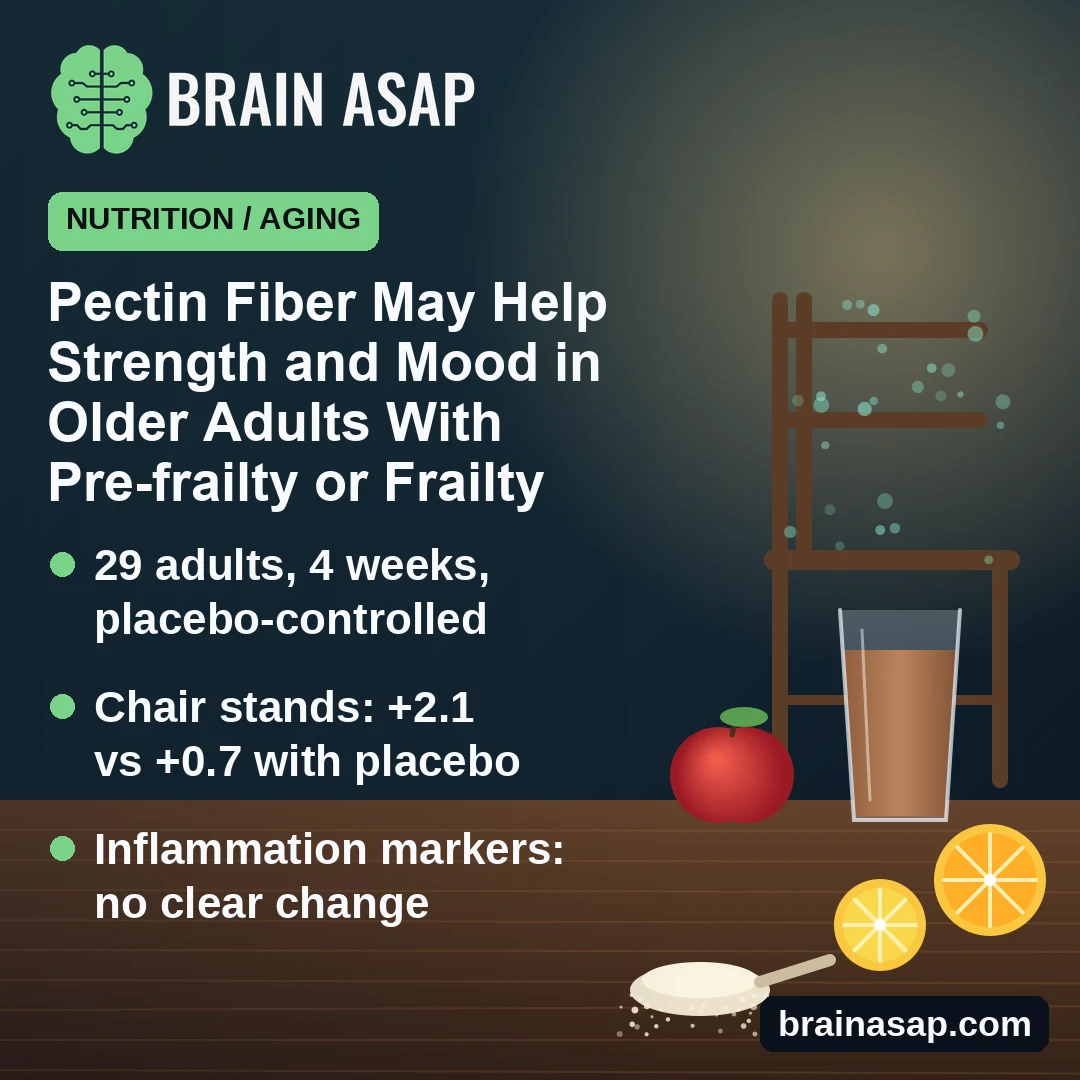
TL;DR: In a small trial of 29 older adults with pre-frailty or frailty, a month of daily pectin fiber led to more chair stands than placebo. The inflammation blood tests it targeted did not change, and it was too small to be conclusive.
Key Findings
- Main goal missed: Neither group showed a clear change in the three inflammation-related blood markers (TNF-alpha, IFN-gamma, zonulin) the trial was built around.
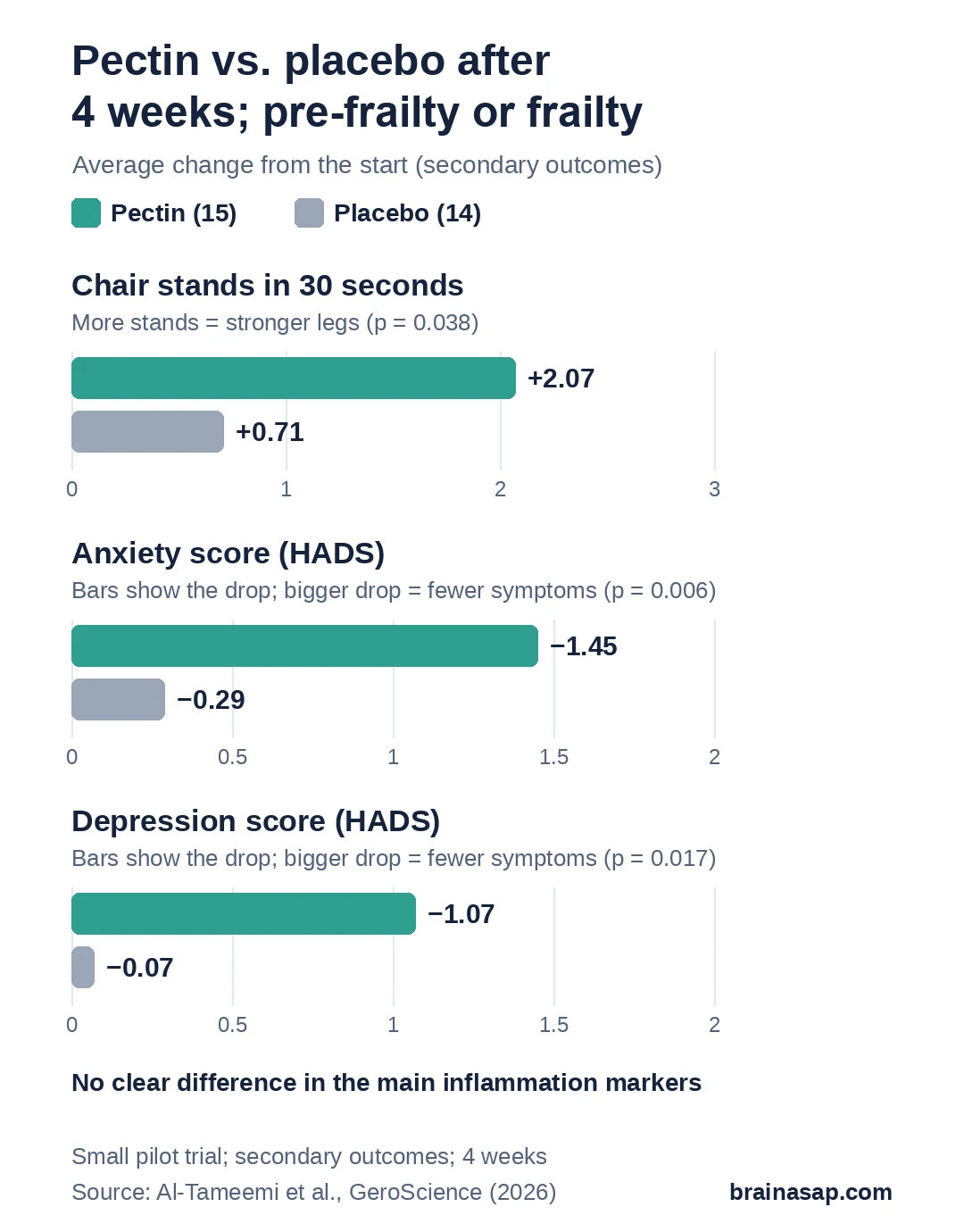
- Chair stands: Pectin group gained 2.07 stands in 30 seconds on average, versus 0.71 for placebo.
- Mood scores: Anxiety fell 1.45 points with pectin versus 0.29 with placebo; depression fell 1.07 versus 0.07.
- Walking test: Timed Up and Go did not differ clearly between groups.
- Gut bacteria: One acetate-producing species, Coprococcus comes, rose more with pectin. Exploratory.
Source: GeroScience (2026) | Al-Tameemi et al.
Can a month of a citrus-peel fiber help older adults with pre-frailty or frailty? The trial was built to test inflammation, and on that it came up empty. But the people who got the fiber stood up from a chair more often and reported less anxiety and depression than those who got a placebo.
Frailty is the slow slide in strength, energy, and resilience that can make a fall or a hospital stay much harder to bounce back from. It often travels with low mood and low-grade inflammation, and it may shift the bacteria in the gut. Fiber is an appealing target because gut bacteria feed on it.
This trial from the University of Nottingham tested low-methoxy pectin, a soluble fiber from citrus peel (the same family that makes jam set). Did a few weeks of it change inflammation, physical function, mood, or gut bacteria?
A month of pectin in milk versus the same drink without it
The researchers enrolled 31 adults aged 65 or older who scored as pre-frail or frail on a five-question screen (the FRAIL scale). Most were pre-frail. People with gut conditions, psychiatric illness, neurological conditions, or recent antibiotics, probiotics, or prebiotics were excluded. Participants were randomly assigned, and neither they nor the assessors knew who got what.
- Pectin group: 10 g of low-methoxy citrus pectin, mixed with 10 g of whey protein and 10 g of cocoa powder, stirred into 150 ml of milk daily.
- Placebo group: the same whey protein and cocoa drink with no pectin.
The drink lasted 4 weeks. Everyone was measured at the start and the end with blood tests, stool samples for gut-bacteria sequencing, a physical function check, and questionnaires. Participants were asked to keep their usual diet, but food intake was not tracked.
Twenty-nine people finished (15 in the pectin group, 14 in the placebo group). One of the two who left cited diarrhea, and the other gave no reason. No serious adverse events were reported, and people took nearly every scheduled dose.
What the trial measured
- Primary outcome: Three blood markers tied to inflammation and gut lining leakiness: TNF-alpha, IFN-gamma, zonulin.
- 30-second sit-to-stand test: Times you can stand fully from a chair in 30 seconds; a common check of leg strength.
- Timed Up and Go: Time to get up, walk 3 meters, turn, return, and sit.
- HADS: 14-item questionnaire scoring anxiety and depression separately; higher means more symptoms, so a drop is an improvement.
- SF-36: Quality-of-life survey covering eight areas, such as vitality and social functioning.
Results for inflammation, function, and mood
The primary result was flat. Inflammation markers did not change meaningfully in either group, and the two groups did not differ. The authors are careful to say that this does not prove pectin has no effect on inflammation. With so few people and only 4 weeks, small effects could easily be missed.
The secondary results looked better. The pectin group improved more than the placebo group on several measures:
- Sit-to-stand: +2.07 stands versus +0.71 (p = 0.038).
- Anxiety: −1.45 points versus −0.29 (p = 0.006).
- Depression: −1.07 points versus −0.07 (p = 0.017).
- Quality of life: Better physical functioning, vitality, mental health, and social functioning on the SF-36. Role limits from physical or emotional problems, bodily pain, and general health did not differ.
The Timed Up and Go improved slightly in both groups (0.54 seconds faster with pectin, 0.29 with placebo), with no clear difference between them. Stomach symptoms were low at the start and mostly unchanged, though reflux scores rose slightly in the pectin group and fell slightly in the placebo group (p = 0.019).
Gut bacteria: one species rose
Pectin is fermented by gut bacteria into short-chain fatty acids such as acetate, so the team looked specifically at acetate-producing species. One stood out: Coprococcus comes rose more in the pectin group than in the placebo group (interaction coefficient 1.14, p = 0.016, adjusted q = 0.13). The authors used a looser false-discovery cutoff of 0.20 for this targeted analysis, so it should be read as a lead.
People whose C. comes rose more also tended to show bigger drops in anxiety (Spearman’s rho = −0.40, p = 0.04) and bigger gains in self-reported physical functioning (rho = 0.46, p = 0.02). The depression link was similar but missed significance (rho = −0.38, p = 0.05). These are correlations across participants, and the study did not measure acetate itself, so it cannot say the bacteria caused any of the changes.
Limits of a small pilot
- Tiny: Sample size was built around the inflammation markers, not the outcomes that turned up positive. Authors call it a pilot.
- Many secondary outcomes: Testing many measures raises the odds a few look significant by chance.
- Only 4 weeks: Unknown whether change lasts or would grow. Sit-to-stand difference was not tested against a threshold for meaningful clinical change, the authors note.
- Complete-case analysis: The two who left were excluded from main results. A sensitivity analysis filling in their missing data did not change conclusions.
- Placebo not inert: Whey and cocoa can act on the body, but both groups got them, so the comparison isolates pectin as far as possible.
- Diet not tracked: Changes in background fiber intake cannot be ruled out.
- Narrow group: People with psychiatric or gut conditions excluded; most participants were pre-frail rather than frail.
Larger trials of pectin in older adults with pre-frailty or frailty are needed
This is not evidence that a fiber powder treats frailty or depression. It is a well-controlled first look: a plausible, cheap supplement, a real placebo, blinded assessors, and small hints in function and mood, alongside a null result on the inflammation markers the trial was designed for.
That mismatch is informative, since it suggests any effect may not run through blood inflammation. The question for the next study is whether the chair-stand and mood gains show up again in a larger, adequately powered trial that also measures gut metabolites and tracks diet.
Citation: DOI: 10.1007/s11357-026-02562-8. Al-Tameemi NK, Kouraki A, Kelly T, Grove JI, Rollins KE, Aithal GP, Valdes AM. The effect of pectin supplementation on geriatric individuals with frailty: a randomised placebo-controlled dietary intervention study. GeroScience. 2026.
Study Design: Single-centre, double-blind, randomized, placebo-controlled pilot trial (NCT06955975): 10 g/day low-methoxy citrus pectin plus whey and cocoa versus whey and cocoa alone for 4 weeks; primary outcomes were TNF-alpha, IFN-gamma, and zonulin.
Sample Size: 31 randomized adults aged 65 or older with pre-frailty or frailty; 29 analyzed (15 pectin, 14 placebo).
Key Statistic: 30-second sit-to-stand change +2.07 versus +0.71 stands (p = 0.038); anxiety change −1.45 versus −0.29 (p = 0.006); depression change −1.07 versus −0.07 (p = 0.017). No significant difference in the primary inflammatory markers.
Caveat: Small pilot, 4 weeks, positive results were secondary outcomes without stated multiplicity correction; gut-bacteria analysis exploratory and correlational.