TL;DR: A psychedelic drug that activates serotonin receptors dramatically amplifies slow 5-Hz brain oscillations in visual and memory regions, suggesting a mechanism for how hallucinogens distort perception by letting internal signals override external reality.
Visual perception feels stable, seamless, continuous. But that stability is an illusion orchestrated by your brain. What neuroscientists have long wondered is how a single drug—a psychedelic that floods the brain with serotonin—can shatter that illusion so completely, filling perception with visions that aren’t there. Now researchers have found a mechanism: a pattern of electrical oscillations in the visual cortex that psychedelics amplify roughly twofold.
Key Findings
- 5-Hz brain waves appear spontaneously and in response to visual input: Researchers detected spontaneous 5-Hz oscillations in mouse visual cortex at a rate of 0.025 episodes per second in the resting state, and also found these same oscillations reliably appeared after showing the mice a moving grating stimulus.
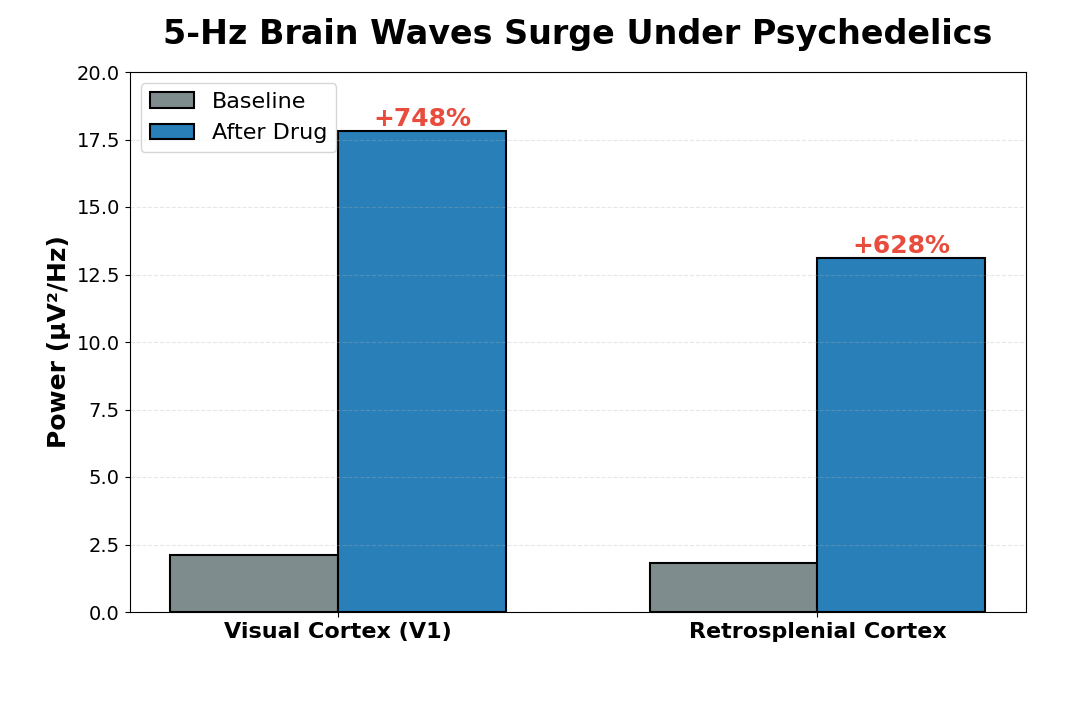
- Psychedelic drugs doubled the rate of spontaneous oscillations: After injecting a 5-HT2A receptor agonist (either DOI or TCB2), the rate of spontaneous 5-Hz episodes jumped from 0.025 to 0.05 episodes per second (p < 0.001), a significant 100% increase in occurrence.
- Evoked oscillations became longer and stronger: Visual stimulus-evoked 5-Hz oscillations nearly doubled in duration (from 480 ms to 1070 ms, p = 1.26e-9) and showed significantly increased power after drug injection, while spontaneous oscillations did not increase in power or duration.
- A second cortical region synchronized with visual cortex: The retrosplenial cortex (RSC), a brain region linking memory with visual input, showed 5-Hz oscillations that tightly co-occurred with visual cortex oscillations, with a consistent ~18 ms delay suggesting direct signal propagation between regions.
- The drug strengthened inter-regional communication: Before drug injection, oscillation duration correlated between V1 and RSC but power did not; after injection, power correlation emerged as well (R² = 0.692, p = 6.28e-04), indicating that psychedelics intensify the coupling between visual and memory-linked brain areas.
- Both psychedelic compounds produced consistent effects: Two different 5-HT2A agonists (DOI and TCB2) produced the same pattern of increased oscillatory activity, with TCB2 showing somewhat stronger effects, confirming that the phenomenon is specific to serotonin receptor activation rather than a drug artifact.
Source: Communications Biology (2026) | White, Azimi, Staadt et al.
The Brain’s Rhythm Problem Under Psychedelics
For years, neuroscientists knew that low-frequency oscillations—electrical waves rippling across cortical populations in the 0.5 to 7 Hz range—shape perception, attention, and memory. Theta rhythms, the heartbeat of the thinking brain, have been tied to encoding new memories and modulating how intensely we respond to sensory input. Yet one crucial question remained unanswered: what happens to these rhythms when psychedelics enter the picture?
The problem is that most prior studies relied on electroencephalography (EEG) or local field potential recordings, which capture brain activity from electrodes but lack spatial precision and cannot distinguish which cell types are firing. The team behind this new study decided to use a more direct approach: voltage imaging with genetically encoded indicators that let them see electrical activity across the entire dorsal surface of the mouse brain, selectively from pyramidal neurons—the main excitatory neurons in cortex.
How Researchers Watched Oscillations Come Alive
Awake mice were head-fixed but free to run on a treadmill while the team recorded using FRET optical imaging—a technique that simultaneously captures voltage signals and hemodynamic (blood flow) signals, then computationally removes the blood signal to isolate pure neuronal voltage. They first presented mice with a blank screen, then binocularly showed them a moving grating stimulus lasting 200 milliseconds, and repeated this 30 to 110 times.
What they found was striking: episodes of 5-Hz oscillations appeared spontaneously even without any stimulus, occurring at a median rate of 0.025 oscillatory bursts per second. When the visual stimulus appeared, the same 5-Hz rhythm would lock onto the stimulus timing—appearing reliably milliseconds after the grating was shown. The oscillation itself involved a phase of strong depolarization (electrical excitation) followed by hyperpolarization (electrical quieting) that swept across the entire population of visual cortex pyramidal neurons in a coordinated rhythm.
The Psychedelic Switch: Amplifying Internal Signals
Halfway through each experimental session, the team administered one of two 5-HT2A receptor agonists—either DOI or TCB2—and waited about 20 minutes for the drug to take effect. Then they resumed the same visual stimulus protocol and recorded what changed.
The results diverged for spontaneous versus evoked oscillations. Spontaneous oscillations surged in frequency: the rate more than doubled, from a median of 0.025 to 0.05 episodes per second. Yet the power and duration of these spontaneous bursts did not change—they were simply more frequent. This suggests that psychedelics lower the threshold for the brain to generate these oscillations on its own, independent of external input.
The evoked response told a different story. When the visual stimulus appeared after drug injection, the 5-Hz oscillations it triggered became substantially longer and more powerful. The median duration nearly doubled—from 480 milliseconds to 1070 milliseconds—and the power increased significantly. This tells us that psychedelics preferentially amplify the brain’s response to sensory input when that response is already initiated, essentially making the visual cortex more likely to ring at 5 Hz and ring for longer when visually stimulated.
A Bridge Between Vision and Memory
Because the researchers had cortex-wide imaging coverage, they could ask: do other brain regions oscillate at 5 Hz alongside visual cortex? They scanned the entire dorsal surface and found that only one region consistently showed 5-Hz activity: the retrosplenial cortex (RSC), a major hub connecting the hippocampus—the memory system—with sensory cortex.
The two regions did not oscillate independently. Visually evoked oscillations in RSC almost always co-occurred with V1 oscillations, with a consistent lag of about 18 milliseconds. Given that V1 and RSC are roughly 1.5 to 3.2 millimeters apart, this 18 ms delay translates to a propagation speed of 0.083 to 0.12 meters per second, a value perfectly consistent with unmyelinated long-range axonal conduction speeds observed across multiple species, from mouse to human.
This temporal pattern suggests that visual cortex initiates the oscillation, and milliseconds later, the retrosplenial cortex picks it up—as if V1 is sending a brief electrical pulse to RSC that triggers a sympathetic response. Before the drug, the oscillations in the two regions correlated in duration but not power. After psychedelic injection, power correlation emerged, indicating that the drug strengthened the functional coupling between these two regions.
The Top-Down Takeover
What does this amplification of 5-Hz oscillations mean for perception? The authors propose that enhanced 5-Hz activity reflects strengthened top-down control—internally driven signals overwhelming external sensory input. In normal perception, the brain integrates incoming sensory signals with predictions and memories, maintaining a balance between external and internal information. Psychedelics appear to tip that balance.
The involvement of the retrosplenial cortex is crucial here. RSC is implicated in integrating internally generated representations—memories, predictions, self-referential thoughts—with actual visual input. By amplifying the coupling between visual cortex and this memory hub, psychedelics may create a situation where internally stored associations become as powerful as, or more powerful than, the sensory input itself. The brain generates associations and predictions reflexively; when those signals surge through enhanced 5-Hz oscillations, the result is hallucination: perception driven not by the outside world but by the brain’s own stored or acutely generated associations.
What This Changes—And What Remains Open
One key limitation: the researchers worked with mice viewing abstract visual stimuli (gratings) rather than complex natural scenes. The mice were also passively viewing, not navigating or performing a task. This matters because attention, arousal, and behavioral state shape oscillatory activity in the cortex. The observed 5-Hz oscillations might reflect different mechanisms in an actively behaving animal facing naturalistic sensory complexity.
Additionally, while the study pinpoints 5-Hz oscillations as a correlate of altered perception, it does not yet establish whether these oscillations are necessary for hallucinations or merely associated with them. Optogenetic silencing of these oscillations during psychedelic administration would be needed to prove causation.
The cellular and circuit mechanisms also remain largely unknown. How exactly does 5-HT2A receptor activation shift the balance toward spontaneous 5-Hz oscillations? The authors speculate that psychedelics may modulate interneuron interactions or strengthen local circuits within visual cortex, but the precise wiring remains to be mapped.
Why This Matters for Understanding Altered States
This work bridges a gap between the molecular pharmacology of psychedelics and the large-scale brain dynamics that underlie consciousness and perception. We now know that a single receptor activation—5-HT2A—can cascade through cortical circuits to amplify a specific rhythm that links vision and memory. The result is a shift in how the brain weights internal versus external signals, a shift manifested in hallucinations that feel profoundly real.
Beyond psychedelics, these 5-Hz oscillations may prove relevant to other conditions marked by internal-signal dominance. Visual hallucinations appear in psychosis, Parkinson’s disease, and migraine, often accompanied by reduced sensory responsiveness. Understanding how oscillatory mechanisms support the balance between internal and external perception could eventually yield new therapeutic strategies for these conditions.
Citation: White CM, Azimi Z, Staadt R, Song C, Knöpfel T, Jancke D. Psychedelic 5-HT2A agonist increases spontaneous and evoked 5-Hz oscillations in visual and retrosplenial cortex. Communications Biology. 2026;9:216. DOI: 10.1038/s42003-025-09492-9
Authors’ affiliations: Optical Imaging Group and Monoaminergic Neuronal Networks & Diseases lab, Institut für Neuroinformatik, Ruhr University Bochum, Germany; Lee Kong Chian School of Medicine, Nanyang Technological University, Singapore; JC STEM Laboratory for Neuronal Circuit Dynamics, Hong Kong Baptist University, Hong Kong SAR, China.