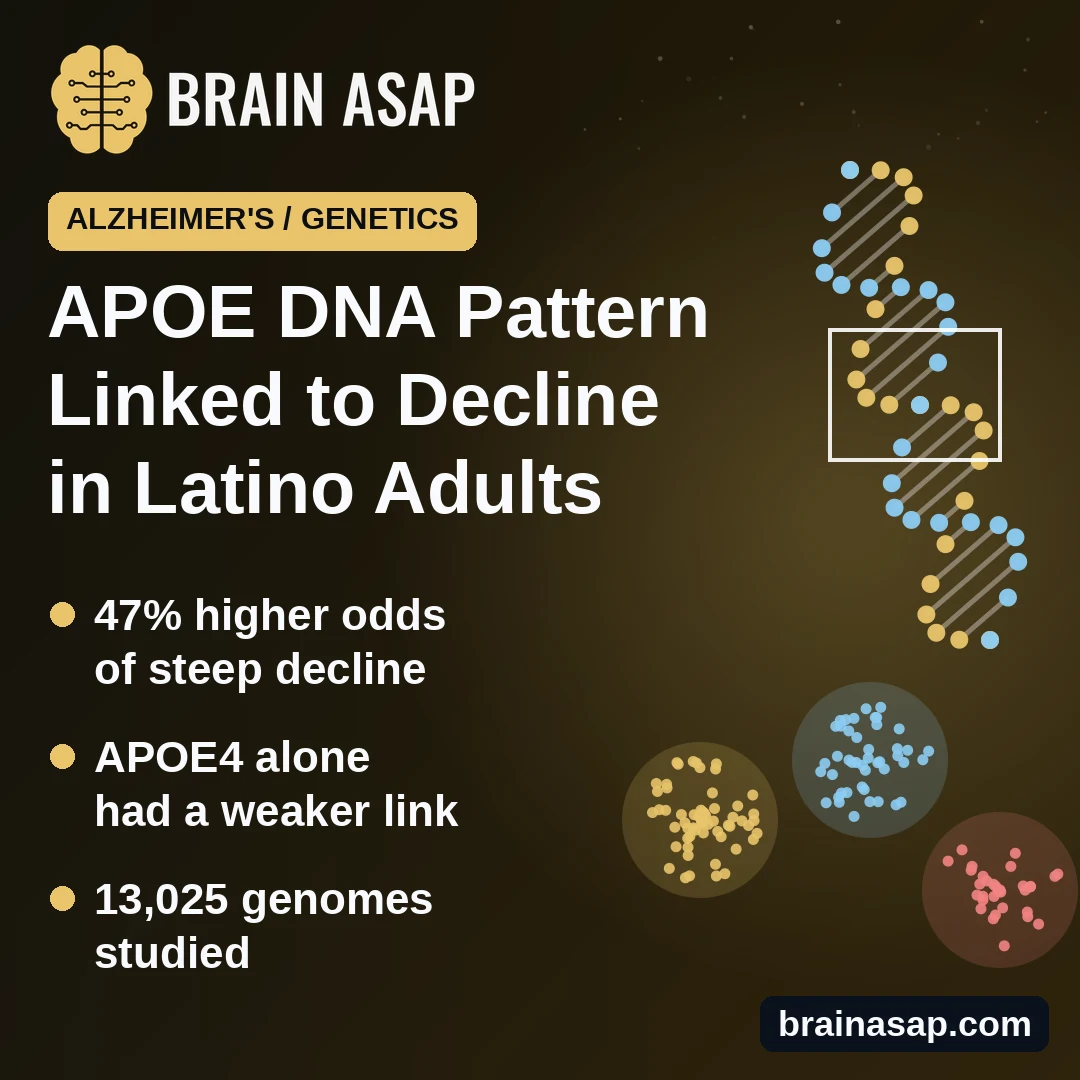
TL;DR: Among Hispanic and Latino adults in the U.S., people with one particular DNA pattern around the APOE gene were more likely to show steep thinking decline over about 7 years. The well-known APOE4 risk version had a weaker link in the same group. Key Find…
Read article ↗
TL;DR: A 2026 preprint in medRxiv analyzed plasma proteomics in Alzheimer’s disease and mild cognitive impairment and found that four continuous molecular axes described the data better than hard subtype labels. Key Findings 5,895-person AD/MCI sample: The dis…
Read article ↗
TL;DR: A 2026 preprint in medRxiv found that head-impact-related magnetoencephalography (MEG) changes in high-school football players were strongest in cortical regions matching specific neurotransmitter and gene-expression maps, especially norepinephrine, nic…
Read article ↗
TL;DR: A 2026 machine-learning study found that the final SNP-NF model in PLOS One reported mAUC 0.965, recall 0.929, and precision 0.929, while the study reported gains of about 3% in mAUC, 1% in precision, and 0.7% in recall versus their previous neural-proc…
Read article ↗
Alzheimer’s Treatment Needs More Than Amyloid TL;DR: A 2026 review in Science China Life Sciences argues that amyloid-beta antibodies such as lecanemab and donanemab are important progress, but Alzheimer’s treatment cannot stop at amyloid. The disease also inv…
Read article ↗
Blood Test Detects Alzheimer’s with 83% Accuracy TL;DR: A new blood test using three misfolded plasma proteins can identify Alzheimer’s disease with 83.44% accuracy, outperforming conventional biomarkers and offering a non-invasive screening tool years before…
Read article ↗
A new large genetics study has discovered new clues into how levels of a protein called apolipoprotein E (ApoE) in the blood may influence a person’s risk of developing Alzheimer’s disease. Key facts: Researchers found 9 new genetic variants that influence Apo…
Read article ↗