TL;DR: Among Hispanic and Latino adults in the U.S., people with one particular DNA pattern around the APOE gene were more likely to show steep thinking decline over about 7 years. The well-known APOE4 risk version had a weaker link in the same group.
Key Findings
- 3 DNA profiles: Short DNA sequences near APOE sorted 13,025 Hispanic/Latino adults into three groups.
- Group 3 declined more: 37% had steep thinking decline vs 29% in the largest group; 47% higher odds after adjustment.
- APOE4 weaker here: 17% higher odds per copy, not statistically clear (p = 0.08).
- Mild cognitive impairment: 33% higher odds for Group 3, not statistically clear (p = 0.08).
- Not a test yet: No specific gene variant identified; needs checking in other groups.
Source: Alzheimer’s & Dementia (2026) | Hrytsenko et al.
APOE4 is the best-known genetic risk factor for Alzheimer’s disease. But in Hispanic and Latino populations, and in people with more African ancestry, it predicts dementia less strongly than it does in white or East Asian populations. Nobody fully knows why.
A team led by researchers at Beth Israel Deaconess Medical Center and Harvard looked at the DNA around APOE in a new way to see if a different pattern tells more of the story.
Reading Short Stretches of DNA Instead of One Gene Version
The usual approach labels each person by their APOE versions: E2, E3 or E4. Instead, the researchers took whole-genome sequences from 13,025 adults in the Hispanic Community Health Study/Study of Latinos and counted short stretches of DNA, 21 letters long, across about a million letters surrounding APOE.
A clustering method then sorted people into three groups with similar DNA patterns in that region, numbered by size:
- Group 1: The largest group.
- Group 2: The second-largest group.
- Group 3: The smallest group; mostly African ancestry in this region (61%), and the most APOE4 and APOE2 copies.
Group 3 Had More Steep Thinking Decline
About 5,300 participants aged 50 and older took thinking tests at a first visit and again about 7 years later. The researchers flagged steep decline when a person’s overall thinking score fell more than expected for their starting point, by a set amount per year.
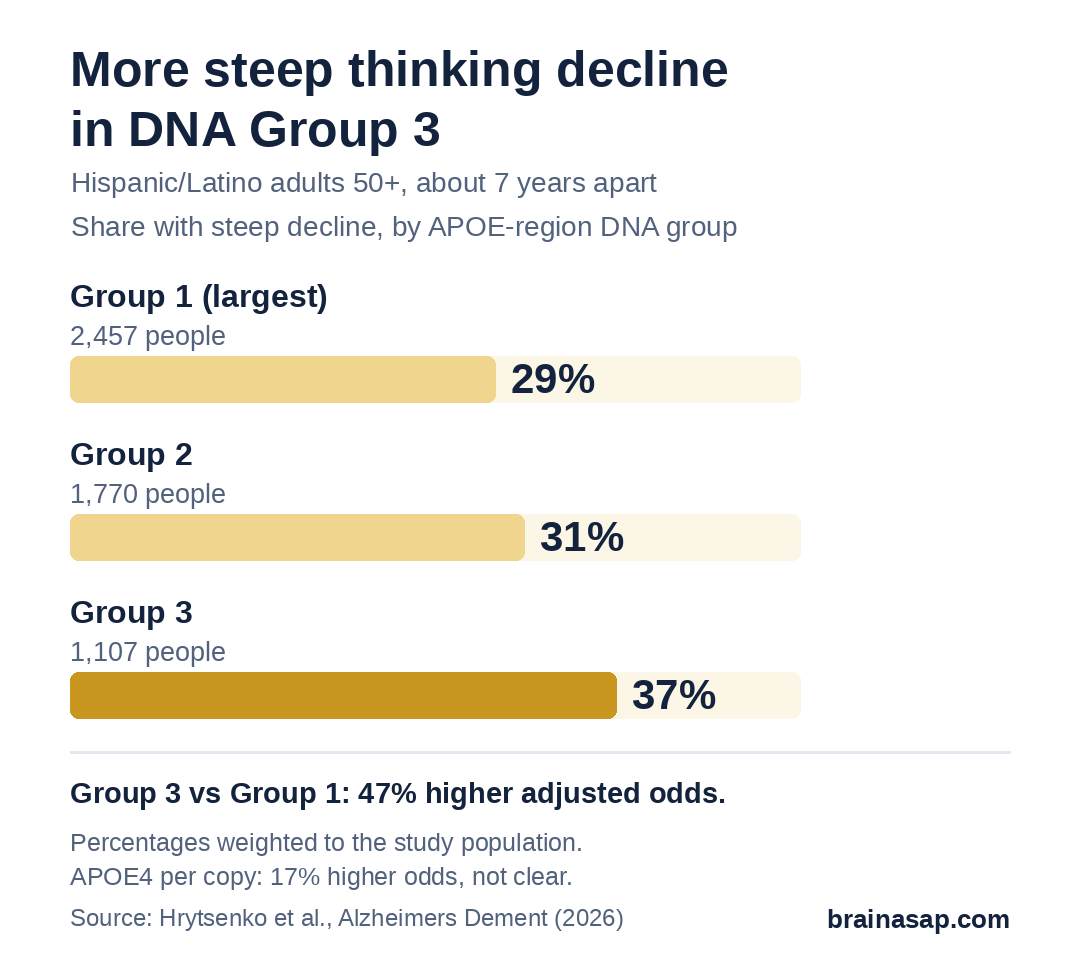
Weighted to represent the study’s target population, steep decline showed up in:
- 29% of Group 1
- 31% of Group 2
- 37% of Group 3
After adjusting for age, sex, education, study center, testing language and time between visits, people in Group 3 had 47% higher odds of steep decline than Group 1 (95% CI 1.18 to 1.84). Group 2 did not differ from Group 1.
The DNA Groups Beat APOE4 at Predicting Decline
In the same people, each extra copy of APOE4 was linked to only 17% higher odds of steep decline, and the range included no effect (95% CI 0.98 to 1.41). A statistical measure of model fit was also better for the DNA groups than for the usual APOE versions.
For a diagnosis of mild cognitive impairment at the later visit, Group 3 had 33% higher odds, but that result was not statistically clear (p = 0.08). APOE4 showed no link at all.
Adjusting for each person’s overall and APOE-region ancestry left the Group 3 result about the same size.
Promising Method, No Gene Variant Yet
- No culprit identified: The single DNA stretch that best defined the groups was not clearly linked to decline.
- Control regions: A stretch of DNA 4 million letters away also gave a weaker link (odds 1.33), so the signal may not be specific to APOE.
- Choices matter: Shorter DNA stretches (17 letters) weakened the result.
- Overlapping outcomes: Most people with mild cognitive impairment also counted as having steep decline.
- One cohort: No outside group was used to confirm the finding.
A Better Genetic Risk Map for Latinos Still Needs Work
This study suggests that APOE4 alone may miss part of the genetic risk for thinking decline in Hispanic and Latino adults, and that looking at the wider DNA neighborhood could capture more. It is not a test anyone can take, and DNA group is not destiny: most people in Group 3 did not have steep decline.
The next step is to pin down which DNA changes drive the Group 3 signal and to check whether it holds in other Hispanic and Latino cohorts and with Alzheimer’s biomarkers.
Citation: DOI: 10.1002/alz.71855. Hrytsenko Y, Purushotham Y, Li Z, et al. Novel genetic profile linked to cognitive decline in Hispanics/Latinos. Alzheimers Dement. 2026;22:e71855.
Study Design: Genetic association study using whole-genome sequencing (HCHS/SOL) and cognitive change in the SOL-INCA ancillary study.
Sample Size: 13,025 with sequencing; 5,317 in the cognitive decline analysis.
Key Statistic: Group 3 vs Group 1, steep cognitive decline: OR 1.47 (95% CI 1.18 to 1.84), p < 0.001; APOE4 per copy OR 1.17 (0.98 to 1.41).
Caveat: Observational; no replication cohort; specific variants behind the clusters not identified.