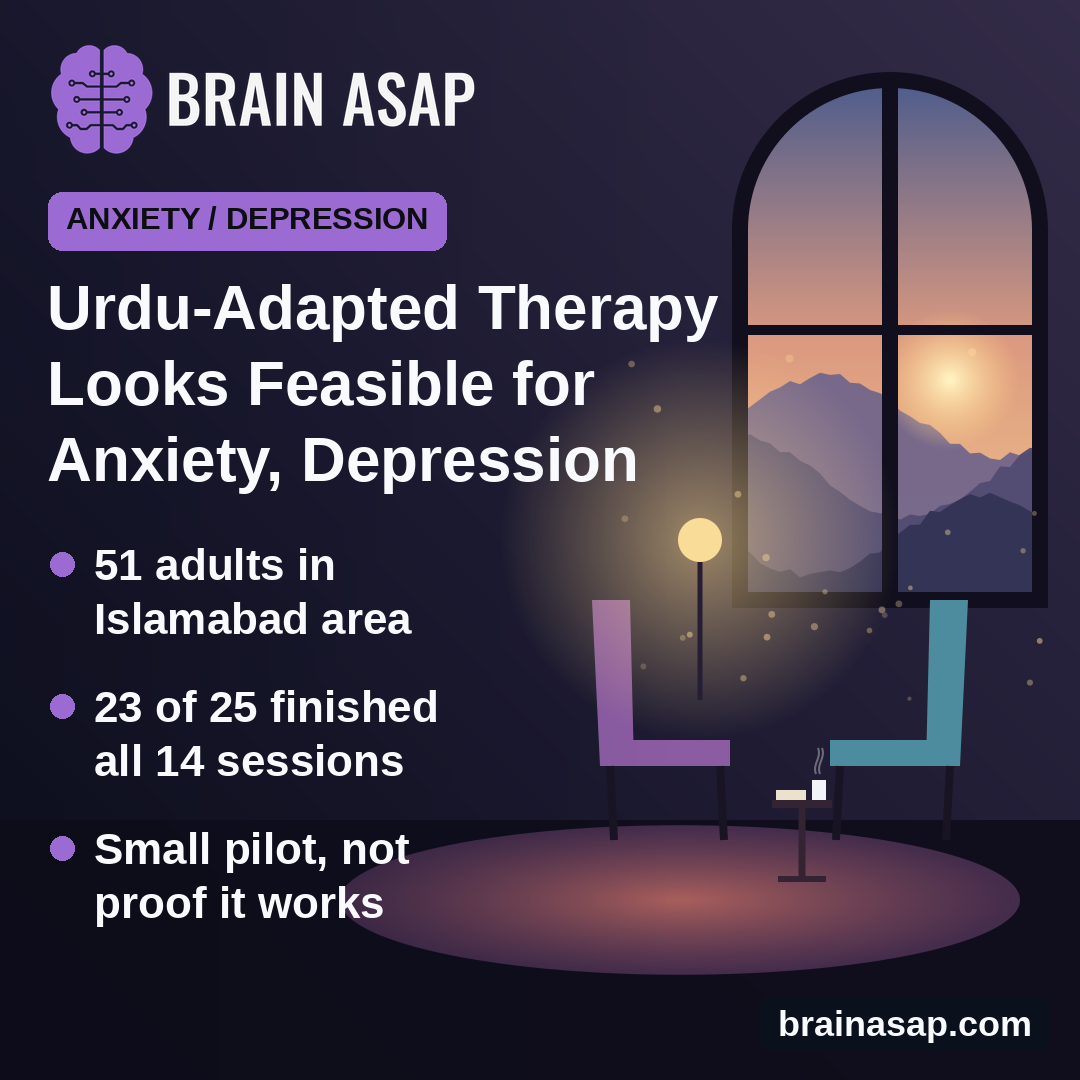
TL;DR: In a small Pakistan pilot, 23 of 25 adults given an Urdu version of a talk therapy for anxiety and depression finished all 14 weeks. The trial was too small to show the therapy works.
Key Findings
- Signed up and stayed: 51 adults were randomly assigned to therapy or a waitlist. 42 of 51 (82%) reached the final assessment.
- Therapy group: 23 of 25 completed the 14-week course. Both who left cited transportation.
- Homework: Participants completed 82% of assigned between-session tasks on average.
- Satisfaction: Average 29.65 out of 32 on a standard client satisfaction questionnaire.
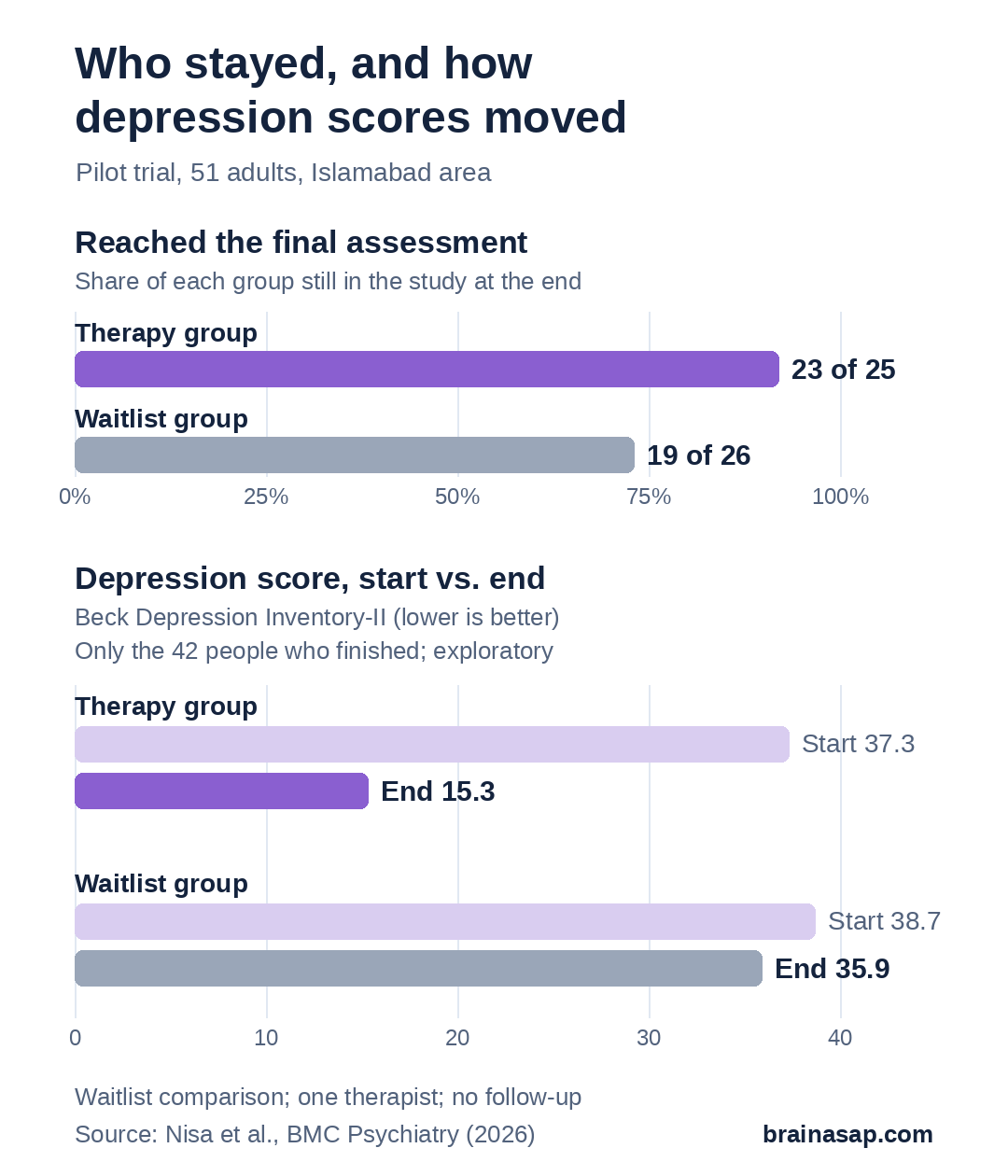
- Symptoms (exploratory): Among finishers, therapy group’s average depression score fell from 37.3 to 15.3; waitlist group’s went from 38.7 to 35.9.
Source: BMC Psychiatry (2026) | Nisa et al.
Before a therapy can be judged on whether it works, someone has to find out whether people will actually show up, do the homework, and stay to the end. That unglamorous question decides whether a bigger trial is even possible.
A pilot trial in Pakistan asked it about an Urdu version of a talk therapy for anxiety and depression. 51 adults were randomly assigned to therapy or a waitlist. 23 of the 25 people in the therapy group finished all 14 weeks.
The therapy and its Urdu adaptation
Anxiety and depression are among the most common mental health problems in the world, and in many countries there are very few trained clinicians to treat them. Pakistan is one of those places.
The treatment is called the Unified Protocol. Instead of a separate manual for each diagnosis, it is a form of cognitive behavioral therapy that targets what anxiety and depression have in common: strong emotional reactions and the habits people use to avoid or push down difficult feelings.
The approach is designed for people who have more than one diagnosis, which is the norm rather than the exception.
The research team translated and adapted it into Urdu (the Urdu-adapted Unified Protocol, or simply “the therapy”). All eight modules stayed in. What changed was the packaging: plainer Urdu terms, examples drawn from local life, visual aids, and audio and video materials people could choose from.
How the trial worked
The team recruited adults in Islamabad and Rawalpindi who had at least moderate anxiety and depression scores on two questionnaires and met diagnostic criteria for an anxiety or depressive disorder in a clinical interview. People already in therapy or taking psychiatric medication were excluded, as were people at acute risk of suicide (one person was excluded on those grounds and referred to urgent care).
51 adults were randomly assigned to one of two groups:
- The therapy group (25 people) had 14 weekly one-on-one sessions of 50 to 60 minutes at a university counselling center, with homework between sessions.
- The waitlist group (26 people) got no treatment during the 14 weeks and was given referral information afterward.
Participants were asked to fill out questionnaires at the start, at week 7, and at the end. Most participants were young (average age about 31), and roughly three in four were women. A single clinical psychologist, who was also the lead researcher, delivered all the sessions.
Feasibility results
Because this was a feasibility study, these were the main results the authors set out to measure.
- Recruiting: 63 people completed the online screening, 61 met the symptom cutoffs, and 54 of those completed the diagnostic interview (seven could not be reached again). One was excluded for acute suicide risk and two withdrew before randomization, leaving 51. Online flyers brought in the most people (33 of 63), followed by community outreach (18) and referrals from local therapists (12).
- Randomization: 51 adults were randomly assigned to therapy or a waitlist.
- Attendance: 23 of 25 people in the therapy group completed the full 14 weeks. Two withdrew because of transportation difficulties. Nobody received travel reimbursement.
- Homework: People completed 81.8% of assigned tasks on average. (The paper’s abstract says 79%; the results text gives 81.8%.) On a 4-point scale, ratings of how well they understood the tasks and why they were doing them were above 3.7, while ratings of difficulty and obstacles were low.
- Satisfaction: The average score on the eight-item client satisfaction questionnaire was 29.65 out of 32.
- Finishing the study: 42 of 51 people (82.4%) completed the final assessment. That was 23 of 25 in the therapy group but only 19 of 26 in the waitlist group.
What participants said
After treatment, the therapy group was interviewed by an independent psychologist. People described noticing their emotions more, using breathing and mindfulness skills to pause before reacting, and gradually facing situations they used to avoid.
Many said the early weeks were uncomfortable, especially the exposure exercises, and that it got easier with practice. Several described the therapist as patient and nonjudgmental. Some talked about family relationships, for example one participant said they had stopped withdrawing from in-laws during tense moments.
Those accounts came from people who stayed. They tell us why some found the therapy usable, and less about why others might not.
Symptom results (exploratory)
The authors also tracked symptoms as a secondary, exploratory measure. Among the 42 people who completed the study, the therapy group improved much more than the waitlist group on anxiety, depression, day-to-day functioning, and emotion regulation.
On the Beck Depression Inventory (a 21-item questionnaire where higher means worse), the therapy group’s average fell from 37.3 to 15.3. The waitlist group’s average went from 38.7 to 35.9.
On the Beck Anxiety Inventory, the therapy group fell from 31.6 to 16.9, and the waitlist group from 33.1 to 31.0. The authors report large effect sizes, such as 1.18 for anxiety and 1.15 for depression.
Those are eye-catching, but several things argue for restraint, and the authors say so themselves:
- The figures include only people who finished, and the waitlist group lost more people.
- Waitlist controls do not get any attention or expectation of benefit, so some of the gap could reflect that rather than the specific therapy.
- One therapist, who was also the study’s lead researcher, treated everyone.
- Nobody was followed after treatment ended, so we do not know whether the gains lasted.
- Some values differ slightly between the paper’s tables and text, which is one more reason to read the exact numbers loosely.
What a 51-person pilot cannot show
- Whether the therapy works: With 51 people, the trial was sized to test procedures, not effectiveness. Authors call for a fully powered trial.
- Whether it works outside a university: Everyone treated at one urban university center. Online recruits in Islamabad or Rawalpindi may not resemble rural people or those seeking help through primary care. Group was also more educated than the general Pakistani population; 63% were unemployed.
- Whether it beats usual care: Comparison was doing nothing, not another treatment.
- Whether other therapists can deliver it: Only one did; delivery quality not independently rated.
- Registration: Registered retrospectively, August 2023.
A fully powered trial is the next step
The one recurring obstacle was getting to sessions in person: both people who left the therapy group cited transportation. That suggests travel support or remote options are worth building into a larger trial.
The pilot does not show that the therapy beats other approaches. It shows that a bigger, better-controlled trial is realistic.
Citation: DOI: 10.1186/s12888-026-08345-x. Nisa A, Siddiqui S, Ametaj AA. Feasibility and acceptability of the Unified Protocol for anxiety and depression in Pakistan: a pilot randomized controlled trial. BMC Psychiatry. 2026;26:739.
Study Design: Single-site pilot randomized controlled trial with a mixed-methods design (14 weekly individual sessions of the Urdu-adapted Unified Protocol versus a waitlist; questionnaires at baseline, week 7 and post-treatment; post-treatment interviews with the therapy group). Registered retrospectively (NCT06002087).
Sample Size: 51 adults randomized (25 therapy, 26 waitlist); 42 completed the final assessment.
Key Statistic: 23 of 25 therapy participants completed treatment; 51 adults were randomized; homework completion 81.8%; mean client satisfaction 29.65 of 32.
Caveat: Feasibility pilot; clinical outcomes are exploratory, reported for completers only, against a waitlist, with a single therapist who was also the lead researcher and no follow-up.