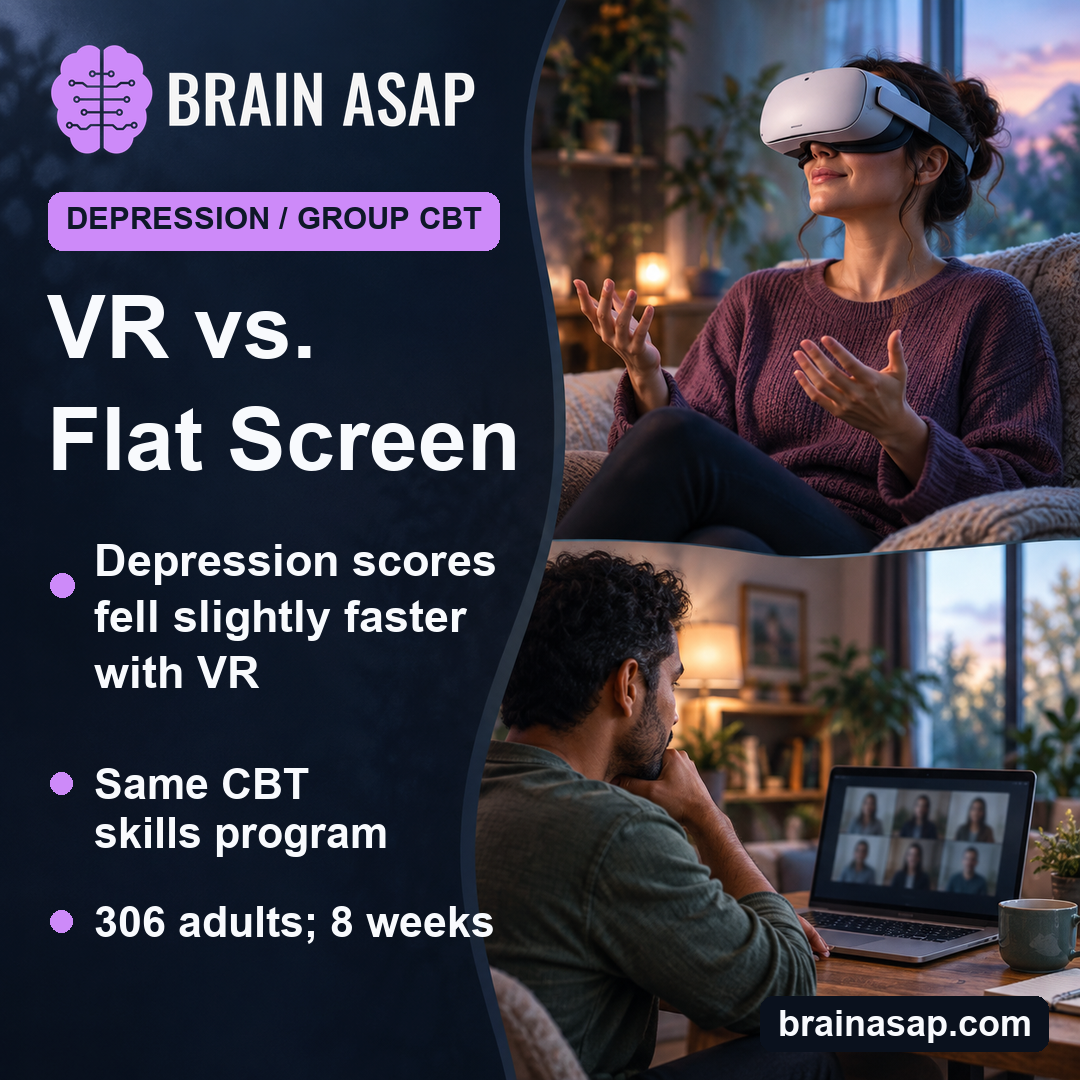
TL;DR: A 2026 randomized trial in Journal of Medical Internet Research gave adults with elevated depression symptoms the same coach-led group skills program through either a VR headset or a flat screen. Depression scores fell slightly faster in the VR group over 8 weeks.
Key Findings
- The VR group improved a little faster: Depression scores fell about 0.21 points more per week than in the flat-screen group—roughly 1.9 points over the study’s 8-week program.
- Both groups received the same skills program: Coaches led weekly online group sessions. The main difference was how participants entered the virtual meeting space: a headset or a flat screen.
- Anxiety scores also fell faster with VR: The difference from the flat-screen group was about 0.20 points per week. The study did not establish a clear difference in depression remission.
- Longer-term and practical questions remain: Depression gains in the VR group were broadly maintained over 6 months, but follow-up was incomplete and the trial did not test whether headsets are worth their extra cost and setup.
Source: Ezawa et al., Journal of Medical Internet Research (2026).
Could a headset change the benefit of an online depression skills group when the teaching and coaches stay the same? This trial tested that question directly. It compared two ways of joining the same program, rather than comparing VR with no support at all.
The Same Group Skills Program, Delivered Two Ways
Researchers enrolled 306 US adults with elevated depression symptoms and randomly assigned 102 to each of three groups: VR, flat screen, or delayed access to the program. Participants qualified through a depression questionnaire; the study did not require a formal depression diagnosis.
The program taught skills drawn from cognitive behavioral therapy (CBT), an approach that helps people notice and change patterns of thinking and behavior that can sustain depression. Trained coaches led eight 1-hour online group sessions over 8 weeks. Participants attended about five sessions on average in both active groups.
The VR group received a headset and entered a shared digital setting. The flat-screen group entered the same setting through a computer or other flat-screen device. People in the delayed-access group waited until the 8-week comparison period ended.
Participants and coaches knew which format they were using. That matters because expectations about a new device could affect how people rate their own symptoms.
Depression Scores Fell Slightly Faster in the VR Group
The main outcome was the Patient Health Questionnaire-9 (PHQ-9), a nine-question depression-symptom scale scored from 0 to 27. Higher scores mean more symptoms. The average starting score was about 16 in each group.
Over the program, the VR group’s score fell 0.21 points per week faster than the flat-screen group’s score. The researchers estimated that this added up to about 1.9 points over the 8-week intervention. The uncertainty range for the weekly difference was 0.02 to 0.40 points, so the measured advantage was modest and imprecise.
Compared with delayed access, the VR group’s score fell 0.31 points per week faster. The flat-screen group did not show a clear difference from delayed access on this measure: its estimated difference was 0.09 points per week, with an uncertainty range that included no difference.
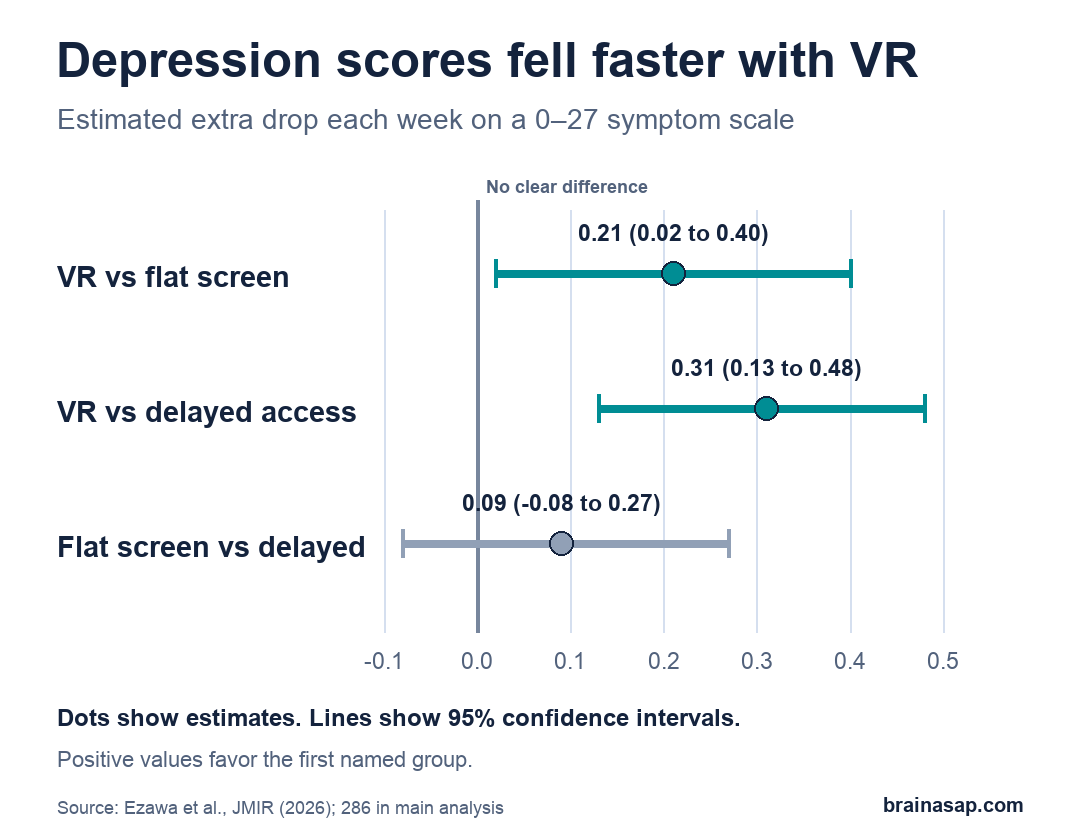
Researchers used repeated symptom surveys to estimate the pace of change. That analysis included 286 participants who completed at least two surveys: 98 in VR, 86 on flat screens, and 102 in delayed access. A total of 220 participants completed the final survey.
The result concerns average questionnaire scores. It does not mean every VR participant felt better, or that a 1.9-point difference would matter the same way to every person.
Anxiety Improved More With VR; Remission Was Less Certain
Researchers also measured anxiety with a seven-question scale. Anxiety scores fell about 0.20 points per week faster in the VR group than in the flat-screen group during the intervention.
By the end of treatment, 48% of the VR group, 33% of the flat-screen group, and 34% of the delayed-access group had cut their depression scores at least in half. The overall test across all three groups did not establish a clear difference in that response measure.
The same caution applies to remission, defined here as a depression score of 5 or less. The figures were 25% for VR, 14% for flat screen, and 20% for delayed access, but the overall comparison was uncertain. Those percentages should not be read as proof that VR led to more remissions.
The VR group’s symptom improvements were largely maintained during the 6-month follow-up. Some participants missed later surveys, however, and the delayed-access group began the program after the initial 8 weeks. That makes longer-term comparisons harder to interpret.
The Trial Leaves Headset Cost and Expectation Effects Open
The trial supports a small advantage in self-reported symptom scores for VR delivery of this particular coached group program. It does not show that a headset alone treats depression or that VR works better than other forms of CBT.
Participants had elevated symptoms, but researchers did not confirm diagnoses through clinical interviews. Other treatment could continue during the study and was not systematically tracked. Coaches’ delivery of the program was not independently rated for fidelity.
People in VR reported feeling more physically present in the digital space. That feeling was statistically associated with the depression result, but presence and symptoms were measured at the same time. The study cannot show that the feeling caused the improvement.
A VR headset also adds equipment, setup, and support needs. This trial did not compare costs or show whether the small symptom-score advantage justifies them. It reported no serious adverse events, but a study this size cannot settle every safety or accessibility question.
One researcher was employed by XRHealth, the company that owned the program used in the trial. The trial was registered after enrollment began, although researchers said the protocol and outcomes were set before the first participant enrolled. Those details matter when weighing a small, self-reported difference.
Citation: DOI: 10.2196/92347. Ezawa et al. (2026). Cognitive Behavioral Immersion for Depression: Randomized Controlled Trial Comparing Virtual Reality and Flat-Screen Delivery. Journal of Medical Internet Research.
Study Design: Three-group randomized trial of VR versus flat-screen delivery of the same coach-led cognitive behavioral skills program, with a delayed-access comparison.
Sample Size: 306 adults assigned; 286 included in the main repeated-survey analysis.
Key Statistic: Depression scores fell 0.21 PHQ-9 points per week faster with VR than with flat-screen delivery (95% confidence interval 0.02 to 0.40; P=.03).
Caveat: Outcomes were self-reported in an unblinded trial, and the measured advantage was small. The trial did not establish a clear remission difference or the cost-effectiveness of VR.