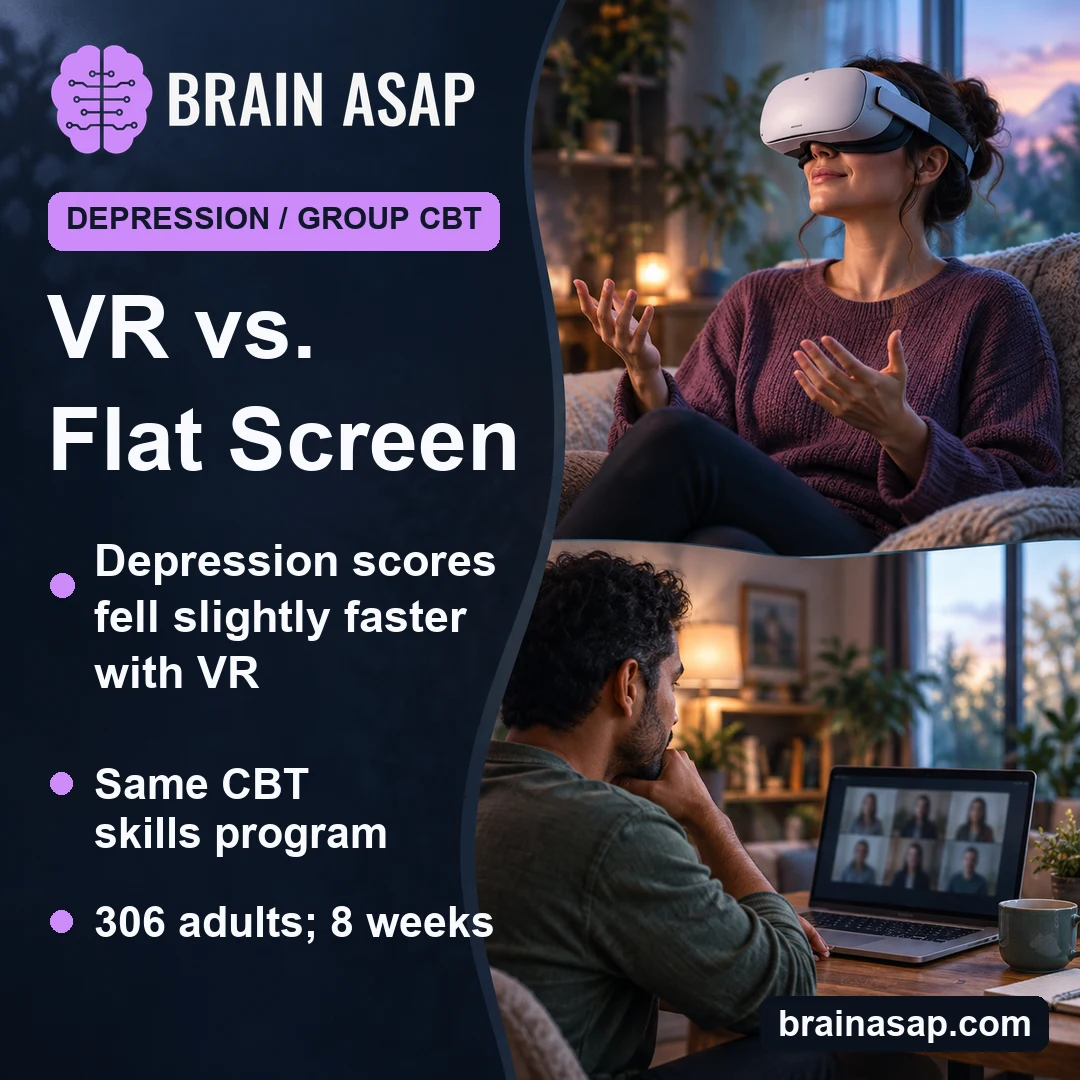
TL;DR: A 2026 randomized trial in Journal of Medical Internet Research gave adults with elevated depression symptoms the same coach-led group skills program through either a VR headset or a flat screen. Depression scores fell slightly faster in the VR group ov…
Read article ↗
TL;DR: A 2026 study in Journal of Medical Internet Research found that psychology trainees were generally open to artificial intelligence-based precision mental health technologies (AI-PMHTs), but fear, perceived risk, resistance to change, and reliability con…
Read article ↗
TL;DR: A 2026 randomized trial in JMIR mHealth and uHealth found that a 7-session CBT-based online self-help group reduced depression symptoms, with the average Beck Depression Inventory-II score moving from the moderate range to the mild range after the progr…
Read article ↗
TL;DR: A 2026 meta-analysis in Journal of Medical Internet Research did not find a statistically significant reduction in Patient Health Questionnaire-9 (PHQ-9) depression scores with AI-driven chatbots, but emotionally responsive, structured, and frequent int…
Read article ↗
TL;DR: A 2026 randomized trial in JMIR Mental Health found that a 4-week executive-function training app reduced depression and anxiety symptoms at 12-week follow-up, while a self-guided CBT app mainly improved workplace well-being. Key Findings Workplace app…
Read article ↗
TL;DR: A 2026 medRxiv review found that mental-health AI agents are moving quickly toward large-language-model chatbots, but most systems still rely on text self-report, narrow depression/anxiety/suicide use cases, and offline tests rather than prospective cli…
Read article ↗
TL;DR: A 2026 study in Journal of Affective Disorders used interpretable machine learning to predict who completed more prompts during a 14-day mindfulness app trial for generalized anxiety disorder. Key Findings Trial size: A two-arm randomized trial included…
Read article ↗
TL;DR: A 2026 uncontrolled pilot study in BJPsych Open found that SMART, a personalized text-message program for metabolic health in people with schizophrenia spectrum disorders, improved patient activation, diabetes self-management confidence, health literacy…
Read article ↗
TL;DR: A 2026 secondary randomized-trial analysis in Journal of Medical Internet Research found that both online MBCT formats reduced psychological distress and improved well-being through 9 months, while people with fewer psychological resources appeared to g…
Read article ↗
TL;DR: A 2026 randomized feasibility trial in JMIR Mental Health found both a structured AI therapy chatbot and ChatGPT reduced PHQ-9 depression scores versus assessment-only control, but neither AI condition improved anxiety significantly or beat the other. K…
Read article ↗