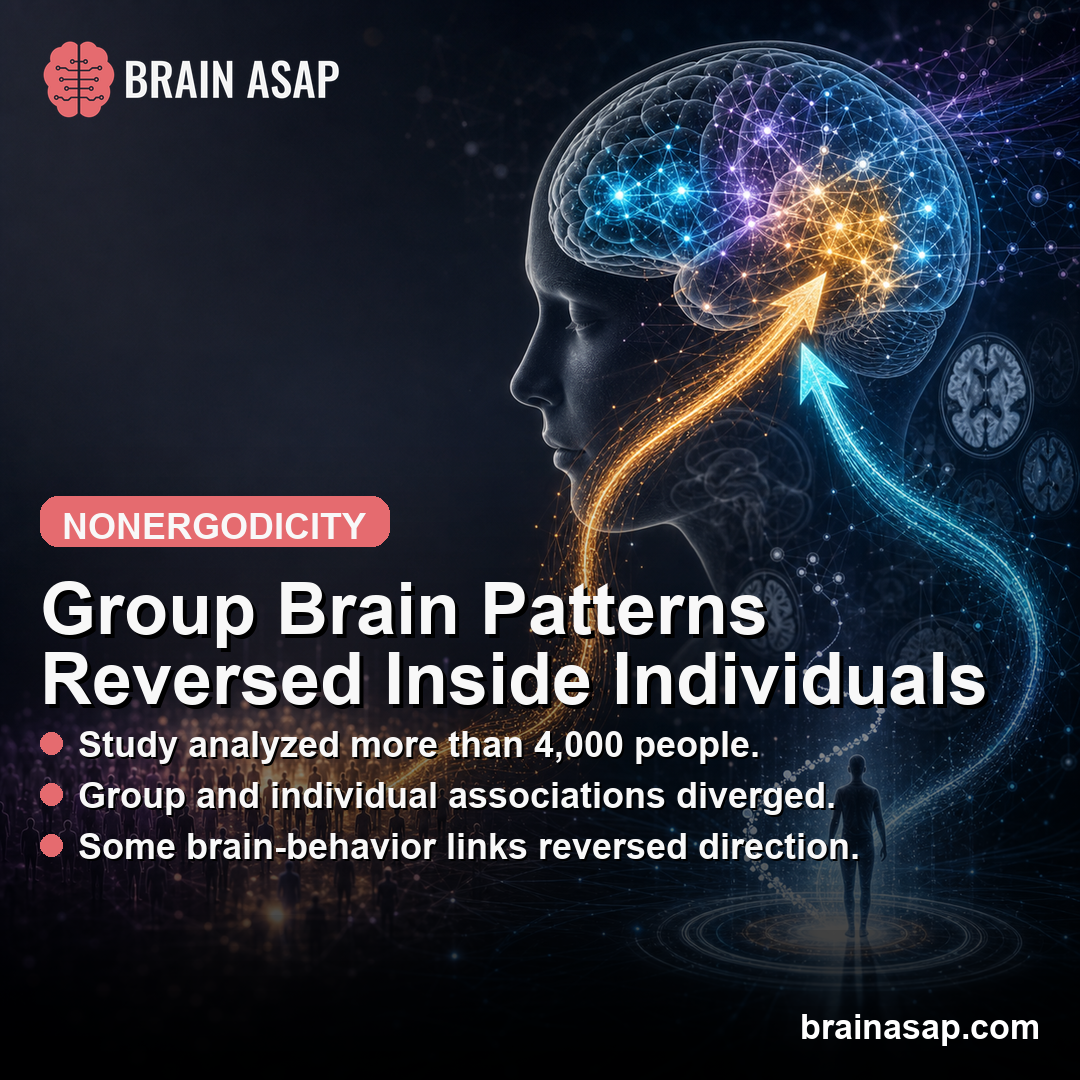
TL;DR: Across 4,000+ people, the relationship between brain activity and cognitive control flipped direction depending on whether researchers compared people to each other or tracked the same person over time. The finding is called nonergodicity — and it means decades of group-level brain studies may have been telling us the opposite of what’s true inside any specific individual.
Key Findings
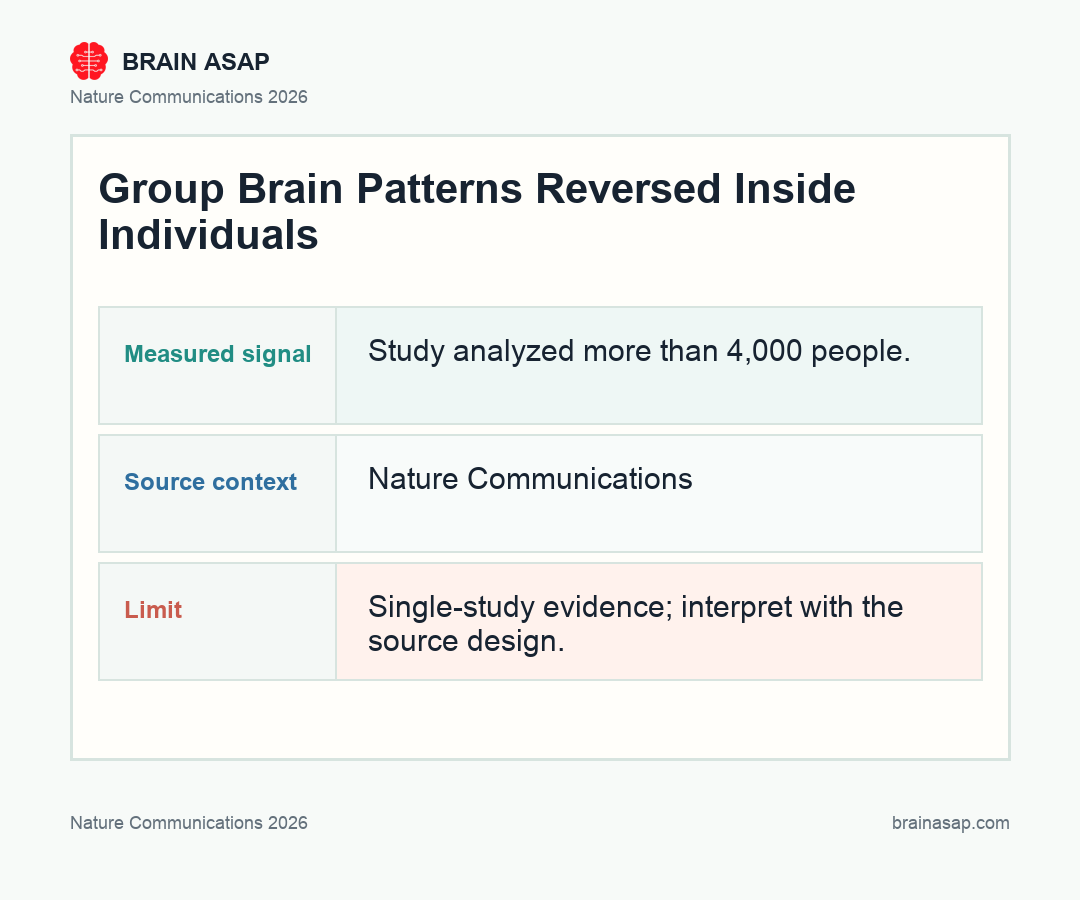
- Brain-behavior associations reversed across levels of analysis: Group-level patterns disagreed with individual-level patterns and often pointed the opposite direction — pervasive nonergodicity in over 4,000 participants.
- Reactive and proactive control dissociated within individuals: Within-person analyses revealed distinct neural representations for reactive (in-the-moment) versus proactive (planned-ahead) control that group analyses had blurred together.
- Adaptive vs maladaptive regulators looked nothing alike: People who used cognitive control flexibly versus rigidly showed different brain-behavior signatures — invisible without within-person analysis.
- Bayesian computational modeling of cognitive dynamics: The team built a generative model of moment-to-moment control behavior, allowing trial-level inference rather than averaged endpoints.
- 4,000+ individuals with brain imaging plus behavior: One of the largest within-vs-between subjects comparisons attempted in cognitive neuroscience.
- Implications for personalized intervention: Treatments based on group-level brain markers may target features that don’t operate the same way (or at all) inside individual patients.
Source: Nature Communications (2026) | Mistry et al.
Cognitive neuroscience runs on a hidden assumption: that what we learn from comparing 1,000 people in a brain scanner generalizes to what happens inside any one of those people across their own life. A 2026 Nature Communications study from Mistry and colleagues stress-tested that assumption — and showed it cracks.
When the team analyzed brain-behavior associations between subjects (across the 4,000+ individuals) and within subjects (the same person tracked across many trials), the patterns didn’t just differ. They sometimes reversed direction. The same brain region that predicted “better cognitive control” at the group level predicted “worse cognitive control” inside individuals.
Why “Ergodicity” Matters and Why Most Neuroscience Quietly Ignores It
The word “ergodic” sounds like physics jargon, but it captures a question every brain scientist relies on. If a system is ergodic, the average across a population at one moment equals the average of one individual followed across time. In other words: the group average tells you about the individual.
If the system is nonergodic, those two averages can diverge — and in extreme cases, they can point in opposite directions.
Most cognitive neuroscience studies are between-subjects: scan 100 people once, correlate brain activity with behavior, publish the group result. The unspoken assumption is that the result reflects how brain and behavior are linked inside any individual. The Mistry paper is the first large-scale demonstration that this assumption fails for cognitive control.
What the Within-Subjects Analysis Revealed That Groups Missed
When the team zoomed in on individuals tracked across many cognitive-control trials, two findings emerged that pure between-subjects analysis had hidden:
- Reactive vs proactive control dissociated. Group studies had treated cognitive control as one construct. Within individuals, distinct neural representations supported in-the-moment reactive control versus advance proactive control. Same person, different brain signatures depending on which kind of control was active.
- Adaptive vs maladaptive regulators looked different. People who flexibly adjusted control to match task demands (adaptive) had different brain-behavior associations than people whose control patterns stayed rigid (maladaptive). This split is invisible if you only ever average across people.
What This Means for Personalized Brain-Based Treatment
If brain-behavior relationships are genuinely different between groups and within individuals, then:
- Group-level biomarkers may misdirect personalized care. A brain feature that predicts “good cognitive control” across a population may predict the opposite inside the patient sitting in the clinic.
- Cognitive enhancement protocols based on group findings need within-person validation. A target chosen because it correlates with control in 100 people may not be the right target for any specific person.
- Many psychiatric biomarkers might be ergodically broken. The same logic applies beyond cognitive control to depression, anxiety, attention, and memory — wherever brain-behavior relationships have been built from group averages alone.
The Methodological Move That Made This Visible
The Mistry team didn’t just collect more data — they built a Bayesian computational model of cognitive dynamics that operates at the trial level rather than averaging across blocks. That allowed them to estimate brain-behavior associations within an individual’s own ongoing performance, not just across a static group snapshot.
This is the difference between asking “do tall people walk faster than short people?” (between-subjects) and “does the same person walk faster on days when they’re feeling taller?” (within-subjects). Both are valid questions, but they have separate answers — and neuroscience has been treating them as the same question for decades.
What This Result Earns and What It Doesn’t
The careful claim is methodological, not nihilistic. Group-level brain-behavior findings aren’t wrong — they’re answering a different question than personalized neuroscience needs to answer. Population-scale patterns still inform public health, clinical screening, and our understanding of broad cognitive architecture.
But when a treatment depends on aiming at a specific brain feature in a specific patient, the within-subjects pattern is what matters. The Mistry paper shows that for cognitive control, the within-person pattern can be the opposite of the group pattern. Other domains likely face the same problem and haven’t yet been audited at this scale.
The implication for the next decade of cognitive neuroscience is concrete: the field needs more within-person designs, not just bigger between-person samples. A study with 100,000 participants scanned once each cannot answer ergodicity questions a study of 100 participants scanned 100 times each can.
Citation: Mistry et al. Nonergodicity and Simpson’s paradox in neurocognitive dynamics of cognitive control. Nature Communications. 2026. DOI: 10.1038/s41467-026-71404-0
Study Design: Combined brain imaging and behavioral data from over 4,000 individuals; Bayesian computational modeling of trial-level cognitive control dynamics; comparison of between-subjects and within-subjects brain-behavior associations.
Sample Size: 4,000+ individuals.
Key Result: Group-level (between-subjects) and individual-level (within-subjects) brain-behavior associations frequently disagreed in direction; reactive and proactive control dissociated within individuals; adaptive and maladaptive cognitive-control patterns produced different brain signatures.
Caveat: Methodological demonstration of nonergodicity in cognitive control specifically; whether the same severity of group-vs-individual divergence applies across other psychiatric and cognitive domains requires domain-specific replication.