TL;DR: A 2026 mouse study in Communications Biology found that loss of MGAT5B, a brain-enriched enzyme that branches O-mannose sugars on proteins, widened nodes of Ranvier—the intervals between myelin segments that organize axon signaling—and delayed callosal spike timing. Neuron-targeted MGAT5B shifted pooled node widths lower, but the rescue compared only 2 treated with 3 control mice and did not test conduction or behavior.
Key Findings
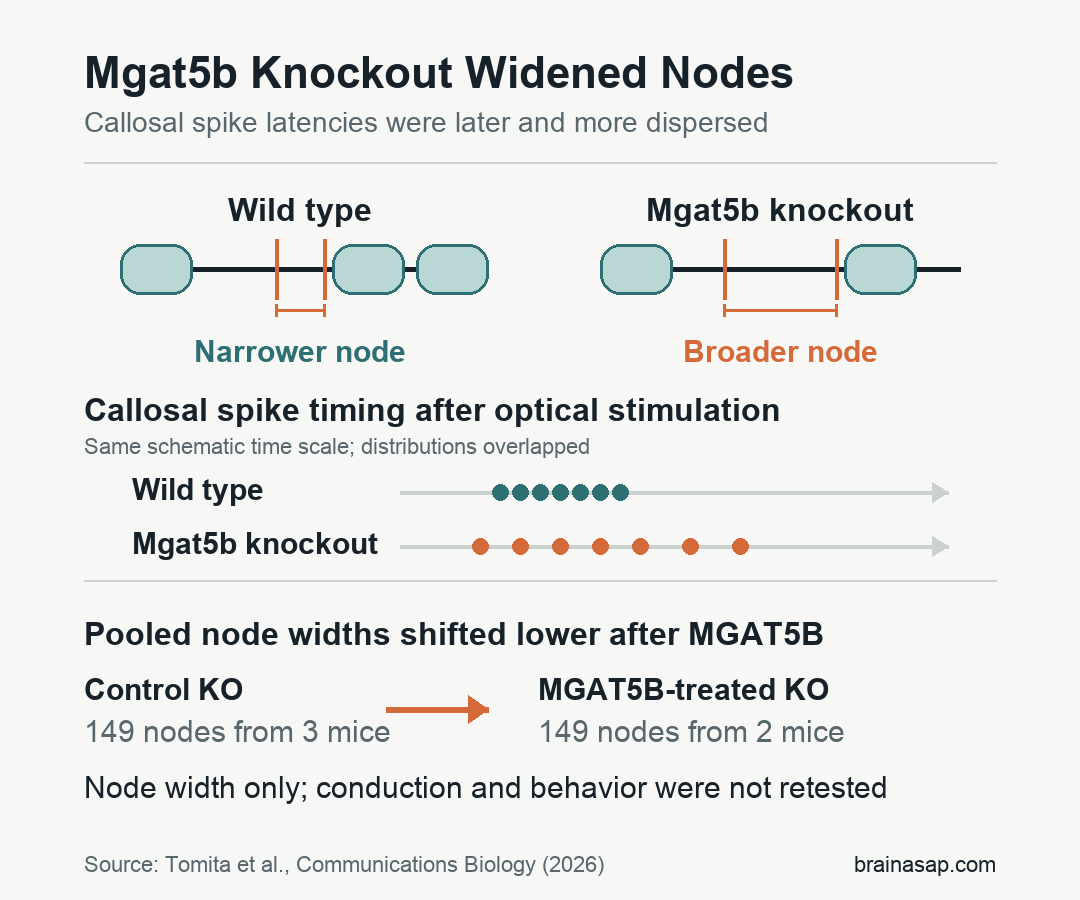
- Wider nodes: In each of 4 cerebral white-matter regions, each genotype distribution pooled 60 nodes from 3 mice. Nodal widths were greater in Mgat5b knockout mice.
- Later, more dispersed spike timing: Mean callosal spike latency was longer in 6 knockout mice than in 7 wild-type mice, with greater dispersion across simultaneously recorded spikes.
- Altered NF186–Contactin 1 association: MGAT5B branched O-mannose glycans on the node-organizing protein neurofascin 186 (NF186). Without the enzyme, more Contactin 1 was pulled down with NF186.
- Small structural rescue: Pooled node widths shifted lower after restoring MGAT5B in 2 treated knockout mice versus 3 controls, but conduction and behavior were not retested.
Source: Tomita et al., Communications Biology (2026).
Myelin insulates axons, but short unmyelinated intervals interrupt that insulation at regular spacing. These nodes of Ranvier concentrate sodium channels and help action potentials travel efficiently along myelinated fibers.
Proteins at each node carry attached sugar structures called glycans. Researchers tested whether MGAT5B, an enzyme enriched in the brain, helps maintain node organization by adding a branch to O-mannose glycans.
MGAT5B Loss Widened Nodes Across 4 White-Matter Regions
Researchers compared C57BL/6N Mgat5b knockout mice with wild-type controls. Because the knockout was present throughout the animals’ lives, the experiments measured the combined result of development and ongoing MGAT5B loss.
Researchers stained brain sections for Nav1.6, a sodium channel concentrated at nodes, and Caspr, a protein marking the flanking paranodes. They measured the distance between the Caspr-positive edges in 4 cerebral white-matter regions.
Nodal widths were greater in all 4 regions in knockout mice. For each region and genotype, the plot represented 60 nodes pooled from 3 mice, so the node count should not be read as 60 independent animals.
Most behavioral measures did not show statistically significant group differences:
- Open field: No statistically significant group difference was detected in distance traveled or time in the center among 11 wild-type and 13 knockout mice.
- Y-maze: No statistically significant group difference was detected in alternation count or rate in the same 11 versus 13 animals.
- Rotarod: Knockout mice fell sooner from the accelerating rod than controls, using 14 wild-type and 16 knockout mice.
The rotarod result is consistent with impaired motor coordination. It does not establish that the wider nodes caused the behavioral difference, because morphology and behavior came from separate cohorts.
Callosal Spikes Arrived Later Across a Wider Timing Range
To isolate axonal timing from synaptic transmission, researchers expressed channelrhodopsin-2 in layer 5 motor-cortex neurons. They stimulated callosal axon terminals in the opposite hemisphere and recorded antidromic spikes returning to the original motor cortex.
The final dataset contained 1,806 spikes from 146 recordings in 7 wild-type mice and 1,533 spikes from 120 recordings in 6 knockout mice.
Mean spike latency was longer in the knockout group at both the spike and animal levels. Within-recording standard deviation and coefficient of variation were also higher, indicating greater dispersion across simultaneously recorded spikes.
These measurements support delayed and more dispersed transmission along the tested motor-cortex callosal projection. They did not calculate conduction velocity or measure trial-to-trial reliability in an individual axon.
NF186 Glycan Branching Changed Contactin 1 Association
Neurofascin 186 (NF186) is a neuronal surface protein that helps organize nodes of Ranvier. MGAT5B adds a beta-1,6-linked N-acetylglucosamine branch to O-mannose glycans carried by proteins including NF186.
Engineered HEK293 C1GALT1-knockout cells, a human embryonic-kidney-derived laboratory line, expressed a soluble NF186 fragment with or without MGAT5B. Glycoproteomics detected 2 NF186 glycopeptides with linear glycans only without MGAT5B and 3 with branched glycans only with it.
The researchers noted that detailed quantitative comparison of the glycan structures was technically difficult. The experiment therefore identifies condition-specific glycopeptides but does not measure the native abundance of each NF186 glycan in mouse brain.
NF186 protein levels, Nfasc messenger RNA, and the overall amounts of Caspr, Contactin 1, and myelin-associated glycoprotein did not differ significantly by genotype. NF186 still reached the node in knockout mice, although its positive band within the node was narrower.
In a 12-mouse analysis, mouse-brain co-immunoprecipitation, a protein-association pull-down assay, found more Contactin 1 associated with NF186 after Mgat5b loss. In 5 cultures of the same engineered cell line expressing soluble NF186 and Contactin 1, adding MGAT5B reduced that association.
A structural model suggested that bulky branched glycans could interfere with the protein interface. That model used the related neurofascin 155 (NF155)–Contactin 1 crystal structure as a proxy, so steric interference remains a proposed explanation rather than direct structural proof.
Pooled Node Widths Were Lower After MGAT5B in 2 Treated Mice
Researchers injected an adeno-associated virus carrying MGAT5B into layer 5 motor-cortex neurons of knockout mice. A control virus carried only the fluorescent marker mScarlet.
After 3 weeks, the node-level analysis compared pooled distributions: 149 nodes from 3 control mice and 149 nodes from 2 MGAT5B-treated mice. The treated group’s node-width distribution shifted lower.
This small structural experiment supports a possible neuronal contribution to node geometry. Without a wild-type comparator, normalization was not tested; researchers also did not test whether the intervention corrected spike timing or rotarod performance.
Separate Cohorts Did Not Link NF186 Changes to Motor Behavior
Because the outcomes came from separate cohorts and assays, the data do not show that altered NF186 association widened nodes, delayed spikes, and impaired motor coordination in sequence.
- Global lifelong knockout: Developmental compensation, non-neuronal MGAT5B, or other glycoprotein substrates could contribute to the results.
- Few mice, many measurements: Many nodes, spikes, and recordings came from relatively few mice. Animal-level electrophysiology helps, but node-level tests still require caution.
- Separate cohorts: Morphology, physiology, behavior, and rescue were not linked within the same animals.
- No human evidence: The work did not study people, neurological disease, dietary sugar, blood glucose, or a treatment.
The researchers also called for Mgat5b knockouts limited to specific cell types or started at defined times. Testing NF186 glycosylation sites directly, measuring Contactin 1 distribution, and repeating functional rescue would clarify which steps are causal.
Citation: DOI: 10.1038/s42003-026-10622-0. Tomita et al. Branching of O-mannose glycans regulates node of Ranvier organization and saltatory conduction. Communications Biology. 2026;9:940.
Study Design: Global Mgat5b knockout mouse study with white-matter imaging, behavioral testing, optogenetic callosal spike recording, biochemical assays, engineered-cell glycoproteomics, structural modeling, and neuron-targeted rescue.
Sample/Model: Multiple mouse cohorts; electrophysiology used 7 wild-type and 6 knockout mice, while structural rescue used 3 control and 2 MGAT5B-treated knockout mice.
Key Statistic: Knockout mice had longer mean callosal spike latency and greater within-recording dispersion; in each of 4 white-matter regions, each genotype distribution pooled 60 nodes from 3 mice.
Caveat: The global knockout and clustered measurements do not establish the full NF186-to-conduction pathway, and the small rescue assessed node width without retesting conduction or behavior.