TL;DR: A 2026 randomized training study in Nature Communications found that sensory-guided joint learning—a combination of performance-triggered wrist vibration, Copy/New strategy cues, and an adaptive electroencephalography (EEG) decoder—produced a 19.0-percentage-point improvement in motor-imagery brain-computer interface (BCI) accuracy in healthy BCI-naïve adults, versus 6.3 and 3.0 points in two control groups.
Key Findings
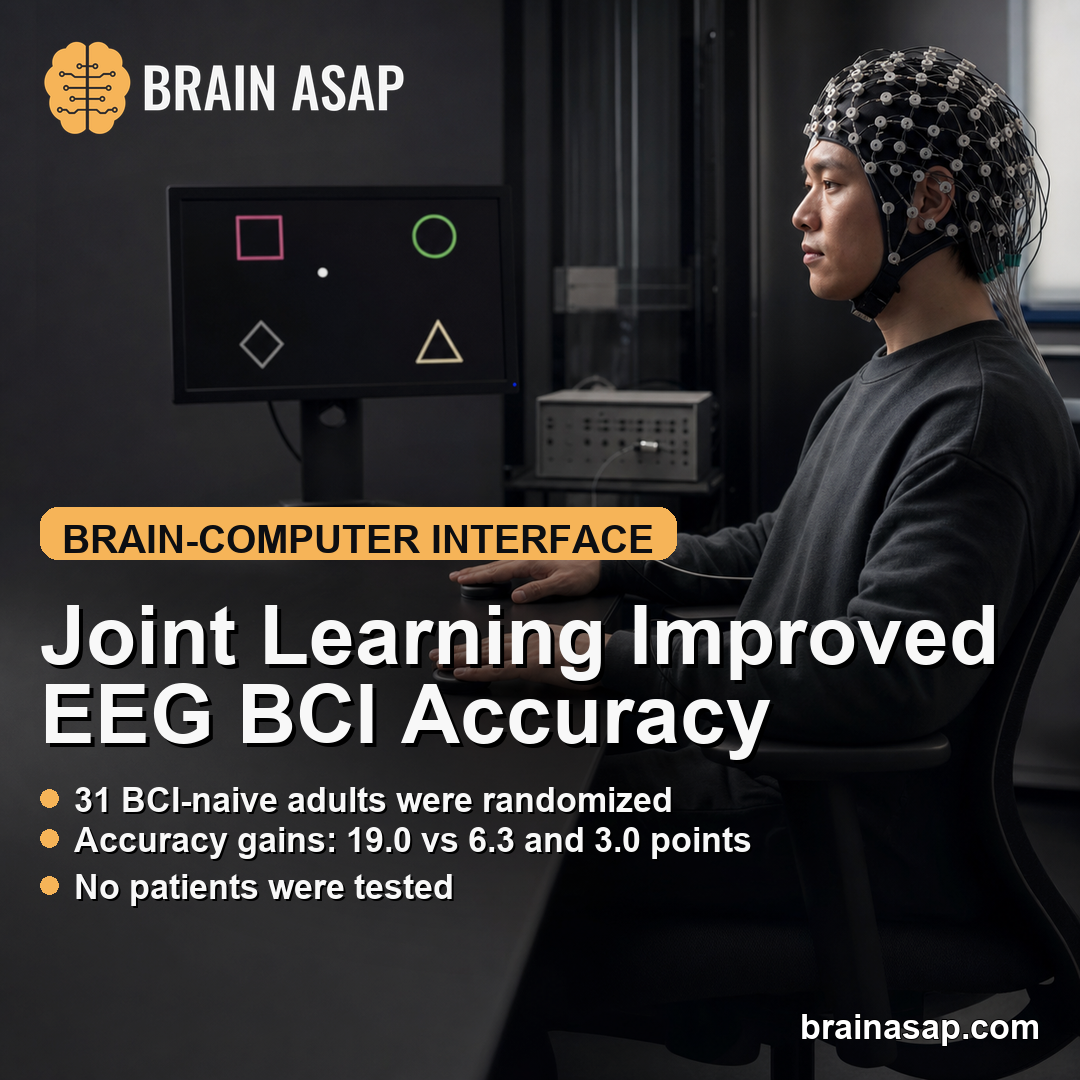
- Thirty-one healthy adults were randomized: 15 received the joint-learning package, eight received vibration on every training trial, and eight completed standard BCI2000 training.
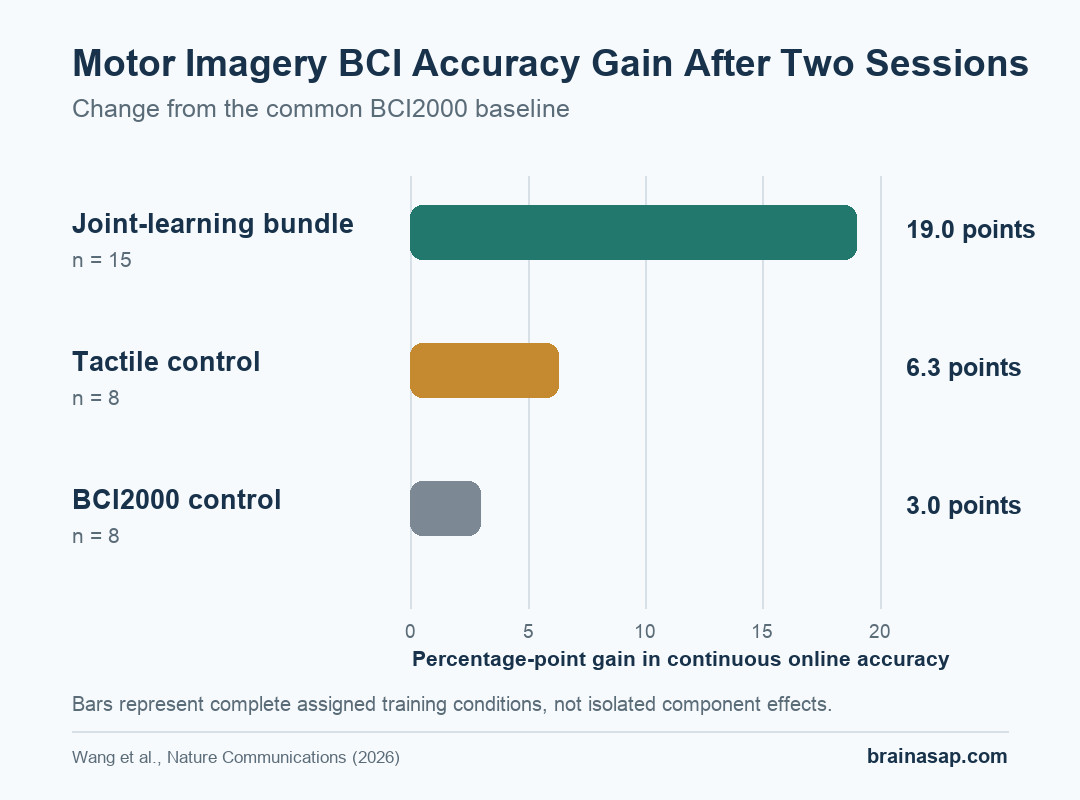
- Early learning was larger with joint learning: Left/right online accuracy improved by 19.0 percentage points after two sessions, compared with 6.3 points for the tactile control and 3.0 points for BCI2000.
- Peak continuous accuracy depended on task difficulty: The joint group reached 77.5% in the mixed one-dimensional session and 66.9% in the first two-dimensional session.
- The full package drove the comparison: Randomization supports the combined intervention, but the study did not independently isolate wrist vibration, Copy/New instructions, trial pairing, and decoder reweighting.
- Clinical benefit was not tested: Participants were young, able-bodied BCI novices performing laboratory cursor tasks; only 16 returned for testing more than two months later.
Source: Wang et al., Nature Communications (2026).
Motor imagery means imagining a movement without physically performing it. An EEG-based BCI classifies the resulting electrical activity and translates the classification into cursor movement, but a new user must learn to produce repeatable patterns while the decoder learns how to recognize them.
Researchers recruited 31 able-bodied, BCI-naïve adults from the Pittsburgh area; 18 were women, and the mean age was 23.8 years. Participants were randomly assigned to joint learning (n = 15), tactile control (n = 8), or BCI2000 control (n = 8).
Joint Learning Produced a 19-Point Accuracy Gain After Two Sessions
Everyone first completed the same left/right BCI2000 baseline run. After two left/right training sessions, mean online accuracy had increased by 19.0 percentage points in the joint group, versus 6.3 points with vibration on every trial and 3.0 points with standard BCI2000.
A repeated-measures analysis found a group effect (p = .00002, partial η² = .72) and a group-by-session interaction (p = .00003, partial η² = .70). Pairwise comparisons favored joint learning over tactile control (p = .03, r = .45) and BCI2000 (p = .007, r = .56).
Within sessions, accuracy improved more in the joint group between the unstimulated tests before and after training (group effect p = .0007, partial η² = .57). The conditions differed in coordinated ways, so the comparison estimates the complete joint-learning package, not vibration or one decoder feature alone.
Copy-or-New Cues Were Coupled to Adaptive EEG Decoder Updates
Each session included calibration, an unstimulated test, three training runs, and a final unstimulated test after a five-minute rest. Left/right training runs contained 60 trials; two-dimensional runs contained 64.
Joint-learning trials came in matched pairs. A 70% online-accuracy threshold determined the second trial:
- Copy: After an accurate first trial, the participant was asked to repeat the same imagery strategy without wrist stimulation.
- New: After a below-threshold first trial, the participant was asked to try a new strategy while a wrist actuator delivered direction-specific vibration.
- Decoder update: Between runs, a weighted EEGNet model gave more influence to EEG windows considered reliable and learnable as the training set expanded.
Tactile-control participants received vibration on every training trial, without performance-contingent Copy/New instructions. BCI2000 participants received no vibration and used a fixed autoregressive decoder during the main six-session protocol.
An additional, separately recruited group of eight adults used a conventional adaptive EEGNet decoder without tactile guidance, paired trials, or sample reweighting. Their learning gains resembled the tactile group and remained below the joint group, which argues against decoder architecture alone explaining the difference.
Continuous Accuracy Reached 77.5% in 1D and 66.9% in 2D
The primary behavioral measure, continuous online accuracy, counted the proportion of correct cursor movements across overlapping one-second EEG windows. The joint group reached a peak session mean of 77.5% in the mixed one-dimensional session and 66.9% in the first two-dimensional session.
Percent valid correct (PVC), which excludes trials where the cursor reached no target, was 86.0% in 1D and 77.5% in 2D. Forced percent total correct (fPTC), which assigns aborted trials to the nearest target, was 84.2% and 75.2%.
Those three measures are not interchangeable. The 86.0% headline value is not continuous accuracy, and all six numbers are peak session means rather than averages across the full training period; numeric confidence intervals were not tabulated in the main article.
All 31 participants completed the first four sessions, but only 21 completed Sessions 5 and 6. The four-direction task also used active imagery for left, right, and up while defining down as rest, so its classes were physiologically asymmetric.
Long-term testing more than two months later included only 16 people: six joint, five tactile, and five BCI2000 participants. The six joint participants maintained two-dimensional performance and improved on left/right control, but that small returning subgroup cannot establish durable performance for the original randomized sample.
EEG Changes and Decoder Alignment Supported Co-Adaptation
Researchers compared changes in participants’ EEG representations with the direction of decoder updates. Mean projection onto the decoder gradient was 0.46 with joint learning versus 0.19 in tactile controls; cosine similarity was 0.62 versus 0.49.
Sensorimotor event-related desynchronization (ERD)—a reduction in rhythmic EEG power during movement imagery—was also stronger in the joint group. Alpha-band ERD averaged −18.71% versus −2.52%, and beta-band ERD averaged −24.07% versus −11.31%.
These comparisons used repeated session- or run-level observations, not hundreds of independent participants. EEG rhythm changes and model-gradient alignment support coordinated adaptation, but they do not prove that the brain “rewired,” that the algorithm reached a global optimum, or that either mechanism caused the full behavioral gain.
Small Healthy Samples and Bundled Components Limit Translation
Random assignment strengthens the comparison of the three main training conditions, but group sizes were small and unequal. The intervention combined tactile timing, strategy instructions, paired trials, and weighted decoder updates, so a factorial study would be needed to estimate each component’s contribution.
The study measured no patient or rehabilitation outcome: healthy young adults controlled a laboratory cursor rather than an assistive device or communication system. Palmar vibration may work differently when sensation, attention, or sensorimotor organization is impaired.
Hyperparameters were optimized offline, haptic feedback was not personalized, and the main article did not describe blinding or detailed missing-data handling. Figure-level sample counts sometimes pool sessions or trials, so very small mechanistic p-values do not represent equally large independent cohorts.
NIH grants supported the research. Hanwen Wang and Bin He are co-inventors on a provisional patent covering the joint-learning, co-adaptive, and sample-reweighting techniques.
Within this laboratory sample, the coordinated sensory and decoder training system improved early motor-imagery BCI learning more than the assigned controls. Balanced trials in people with motor impairment are still needed before the method can support rehabilitation or everyday assistive-use claims.
Citation: DOI: 10.1038/s41467-026-75435-5. Wang et al. Sensory-guided human-machine joint learning accelerates the acquisition of motor imagery brain computer interface control. Nature Communications. 2026;17:6177.
Study Design: Randomized six-session laboratory comparison of a sensory-guided adaptive EEG training package, tactile control, and BCI2000 control, with an additional separately recruited EEGNet control.
Sample Size: 31 randomized adults (15 joint, eight tactile, eight BCI2000); 21 completed extended 2D sessions, 16 completed long-term testing, and eight additional adults formed the EEGNet control.
Key Statistic: Left/right online accuracy improved by 19.0 percentage points after two sessions with joint learning, versus 6.3 points with tactile control and 3.0 points with BCI2000.
Caveat: The small, unequal groups included only healthy BCI novices, and the bundled intervention did not isolate tactile guidance, strategy cues, and decoder reweighting.