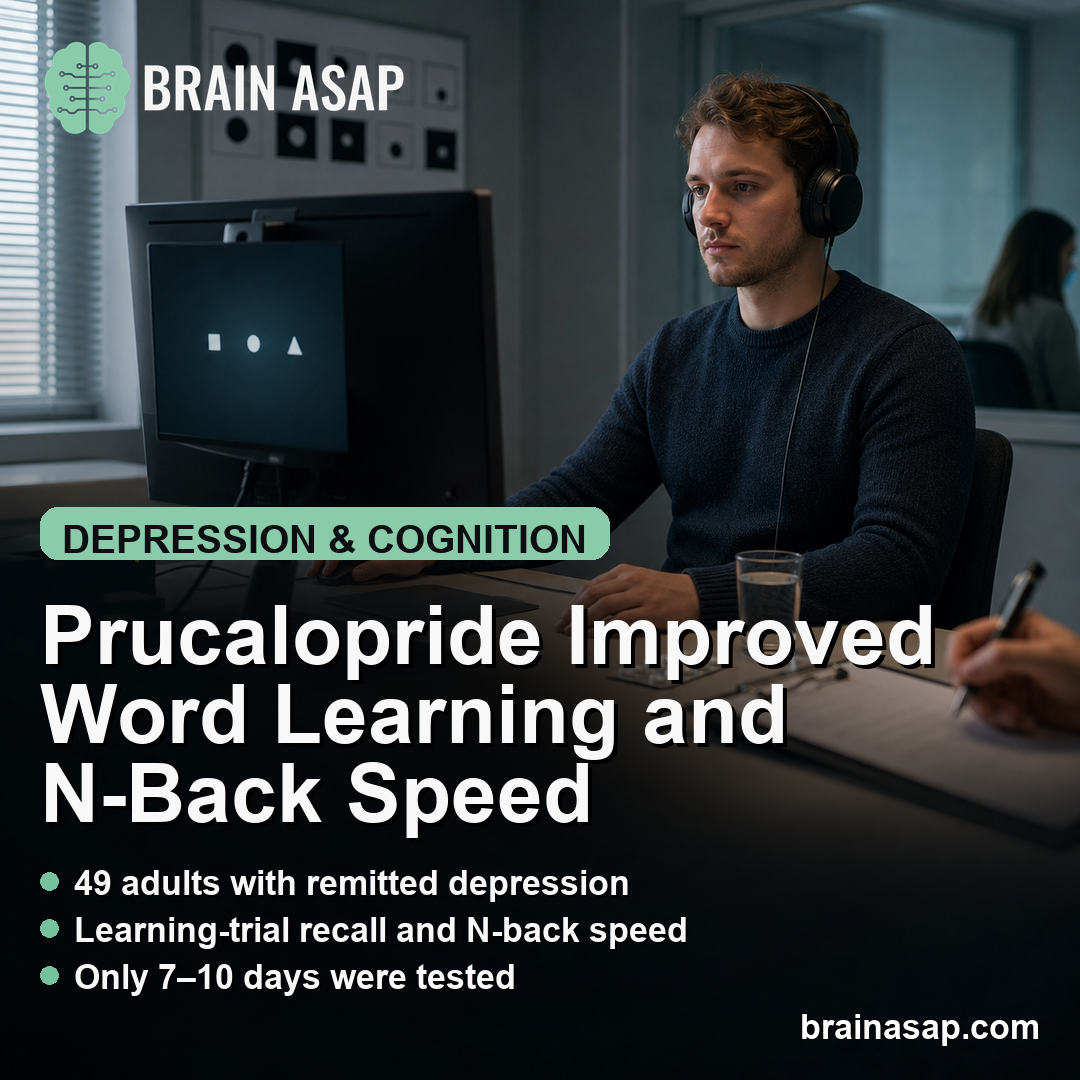
TL;DR: A 2026 randomized study in Psychological Medicine reported that 7–10 days of prucalopride improved word-learning recall and working-memory response speed versus placebo in adults with remitted recurrent depression, but the 49-person analysis did not test durability, daily functioning, or relapse prevention.
Key Findings
- Short randomized exposure: Researchers analyzed 49 adults ages 18–40 after 7–10 days of placebo or prucalopride, titrated from 1 mg to 2 mg.
- Better word learning: Prucalopride improved recall across five learning trials on the Auditory Verbal Learning Test (AVLT), but short- and long-delay recall did not differ from placebo.
- Faster working-memory responses: Prucalopride participants responded faster across N-back task difficulty levels, while the accuracy difference was not statistically significant.
- Face-task tradeoff: Facial-expression identification was more accurate but also slower with prucalopride, and a combined speed-accuracy measure did not differ from placebo.
Source: de Cates et al., Psychological Medicine (2026).
Cognitive problems can persist after mood symptoms resolve in major depression. The experiment tested whether activating the serotonin 4 (5-HT4) receptor could change objective task performance without the confounding effects of an active depressive episode or current psychotropic medication.
Prucalopride is a selective 5-HT4 receptor agonist. Earlier human experiments had reported memory effects in healthy volunteers, but this trial focused on people with recurrent depression who had been in remission for at least six months.
Prucalopride Was Tested for 7–10 Days in 49 Adults
Participants were ages 18–40, had experienced at least two major depressive episodes, and had a current Patient Health Questionnaire-9 score below 10. They had no current major psychiatric disorder and were taking no medication other than contraception.
Researchers randomized 50 adults equally to prucalopride or lactose placebo in a double-blind design. One prucalopride participant was excluded before unblinding because of data-quality concerns, leaving 25 placebo and 24 prucalopride participants in the analysis.
Prucalopride participants took 1 mg for the first two days and 2 mg for another five to eight days. The groups had similar exposure durations, averaging 7.08 days with placebo and 7.25 days with prucalopride.
Non-emotional tests were the prespecified primary cognitive domain. The battery measured repeated word learning, working memory, processing speed, and executive function; separate tasks assessed facial expressions, emotional memory, attention to emotional faces, and response inhibition.
Participants were not required to have objective cognitive impairment. Baseline self-reports indicated mild-to-moderate cognitive difficulties on average, so the experiment tested task performance in remission rather than treatment of a diagnosed cognitive disorder.
Word Learning Improved, but Delayed Recall Did Not
The AVLT presented 15 spoken words over five consecutive learning trials. Prucalopride participants recalled more words on average across those trials than placebo participants, with a statistically significant group effect and a moderate-to-large partial eta-squared value (F(1,226)=8.12, p=.005, partial η²=.16).
The improvement applied to repeated acquisition, not every memory outcome: short-delay recall after an interference list did not differ between groups (p=.90), and recall after about 20 minutes was also similar (p=.33). Intrusions, repetitions, and recall of the interference list were unchanged.
That distinction narrows the result: prucalopride improved how many words participants produced while repeatedly learning the list, but the experiment did not demonstrate better retention after a delay.
Working-Memory Responses Were Faster Without Clear Accuracy Gains
In the N-back task, participants judged whether each symbol matched one shown zero, one, two, or three positions earlier. Prucalopride participants responded faster across difficulty levels (F(1,179)=8.56, p=.004, partial η²=.06).
Accuracy did not significantly differ overall (p=.15). A combined speed-accuracy analysis also fell short of significance (p=.082), and one prucalopride participant lacked N-back data.
Other executive-function results were null. Prucalopride did not improve the Digit Symbol Substitution Test or either trail-making measure, so the faster N-back responses should not be generalized to all forms of processing speed or executive function.
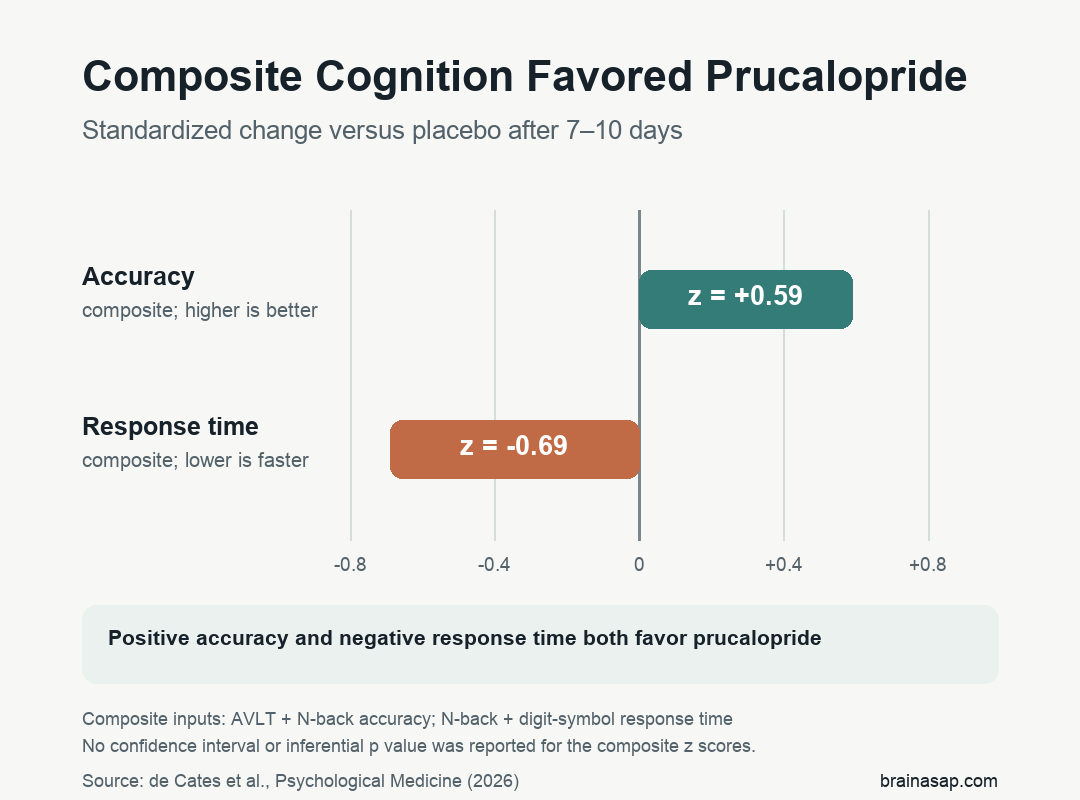
Researchers calculated an additional composite from the prespecified non-emotional domain, combining AVLT and N-back accuracy and combining N-back and digit-symbol response times. Compared with placebo, the prucalopride group had an accuracy z score of +0.59 and a response-time z score of −0.69, where a negative time score indicates faster responses.
The report did not provide confidence intervals or an inferential p value for these composite z scores.
Facial-Expression Accuracy Came With Slower Responses
On a task using briefly presented facial expressions, the prucalopride group was more accurate across emotions (p<.002, partial η²=.05) but responded more slowly (p<.001, partial η²=.13). Neither effect depended on whether the face showed anger, fear, happiness, or another emotion.
A combined inverse-efficiency analysis, which accounts for both speed and accuracy, was null (p=.41). Prucalopride participants also made fewer errors in which emotional faces were labeled neutral, but most other emotional-processing outcomes did not differ between groups.
Emotional categorization, emotional recall, emotional recognition memory, attentional vigilance, response inhibition, choice impulsivity, and decision bias did not differ between groups. Depression symptom scores did not significantly change (p=.20), while positive affect was borderline higher with prucalopride (p=.05).
Adjusting for baseline mood or self-reported cognitive difficulty did not materially alter the cognitive results.
A 65-Person Trial Did Not Test Daily Function or Relapse
Total side-effect reports did not differ between groups. Decreased appetite was the exception: 12% of each group reported it at baseline, compared with 24% after prucalopride and 4% after placebo, producing a treatment-by-time interaction (p=.024).
Main limitations: The analysis included only 49 adults, task-level missing data reduced some denominators, and many outcomes were tested. Participants were under 40, roughly two-thirds were women, about half were White, and they averaged nearly 18 years of education.
Placebo participants correctly guessed their allocation more often than prucalopride participants, creating some uncertainty about blinding. Exposure lasted no more than 10 days, and the trial did not measure whether the cognitive changes persisted after treatment stopped.
Randomization supports a short-term effect of prucalopride on specific laboratory tasks in this selected sample. It does not establish lasting cognitive benefit, improved daily functioning, antidepressant efficacy, or reduced relapse risk.
Proposed hippocampal, neuroplasticity, and gut-brain mechanisms were not tested.
Citation: DOI: 10.1017/S0033291726104450. de Cates et al. Pro-cognitive effects of 5-HT4 receptor agonism in individuals with remitted depression. Psychological Medicine. 2026;56:e178.
Study Design: Double-blind, randomized, placebo-controlled experimental-medicine study lasting 7–10 days.
Sample Size: 50 adults with remitted recurrent depression were randomized; 49 were analyzed.
Key Statistic: Prucalopride improved acquisition recall across five word-learning trials (p=.005) and reduced N-back response time across task loads (p=.004).
Caveat: The small, selected, under-40 sample and short exposure cannot establish durable cognitive or real-world clinical benefit.