TL;DR: In an online survey of 126 mothers of toddlers in Taiwan, mothers who reported more depressive symptoms also tended to describe their toddler’s sleep as more of a problem and to report longer times to fall asleep. The link with perceived sleep problems showed up in families where the toddler shared a sleeping surface with a parent (co-sleeping), but not clearly in families where the toddler slept on a separate surface or in another room. Because everything was reported at one point in time, the study cannot say which came first, or whether sleeping arrangements changed anything.
Key Findings
- Common symptoms: 1 in 3 mothers (33.3%) scored above the questionnaire’s cutoff for depressive symptoms.
- Perceived sleep problem: Higher depression scores went with higher ratings of the toddler’s sleep as a problem, after accounting for the child’s health, family income, and the mother’s education.
- Falling asleep: Each extra point on the depression scale went with about 0.9 more minutes for the toddler to fall asleep.
- Co-sleeping families vs. separate-sleeping families: The link with perceived sleep problems was clear in co-sleeping families and about zero in separate-sleeping families.
- Bedtime routines: How consistent the routine was did not change the picture.
Source: Nature and Science of Sleep (2026) | Wu et al.
A toddler’s bedtime can stretch on, the child wakes up, and the next day is harder for everyone. Depression can make those nights harder still. A natural question is whether a mother’s mood and her toddler’s sleep are connected, and whether the way a family sleeps changes that connection.
This study looked at both questions in Taiwanese families. It is worth saying up front that a link between depressive symptoms and a child’s sleep is not a judgment on anyone. Sleep trouble and low mood can feed into each other, and the study was not built to sort out which pushes which.
What the Researchers Did
Between November 2022 and March 2023, mothers were invited through parenting forums, pediatric clinics, and childcare centers to fill out an online questionnaire. The final sample included 126 mothers of toddlers aged 1 to 3. On average, mothers were 33 years old and their toddlers were about 1.8 years old.
Three things were measured:
- Depressive symptoms: The Beck Depression Inventory-II is a 21-question checklist scored from 0 to 63. A score above 13 was used as the cutoff for “depressive tendency.” This is a screening tool, not a diagnosis.
- Toddler sleep: Mothers answered a standard infant sleep questionnaire about the past week. The paper looked at how much of a sleep problem the mother considered it (from “not a problem” to “serious,” scored 0 to 4), how long the child took to fall asleep, how often the child woke at night, and how long the child slept at night.
- Sleep habits: Where the toddler slept most of the night, and how many nights per week the family followed the same bedtime routine.
Two Groups, Defined
The comparison at the heart of the paper is about where toddlers sleep, so the names matter.
- Co-sleeping families (65 of 126): The toddler slept in the same room and on the same surface as the parent.
- Separate-sleeping families (61 of 126): The toddler slept on a different surface in the same room (46 families) or in a different room (15 families). The researchers combined these two because so few toddlers slept in their own room.
Bedtime routines were split at five nights per week. Families with a routine on more than 5 nights were counted as consistent; 5 nights or fewer counted as low consistency (45.2% of families).
What They Found
The overall picture
About 1 in 3 mothers (42 of 126) scored above the depression cutoff. On the toddler side, 15 of 126 mothers (11.9%) rated their child’s sleep as a moderate or serious problem. Even so, about half of the toddlers (64 of 126) took longer than 45 minutes to fall asleep, and 44 of 126 (34.9%) woke at least twice a night.
Mood and sleep: two links
Higher depression scores were associated with a higher perceived sleep problem rating, and with a longer time to fall asleep. These held after the researchers accounted for the child’s health, family income, and the mother’s education. For falling asleep, the estimate was about 0.87 minutes longer per extra point on the depression scale, so roughly 9 minutes longer for a 10-point difference.
Two other measures did not hold up. Night waking was linked to maternal depression in a simple comparison, but the link disappeared once the child’s health was taken into account (the child’s health was the clearer factor). And total nighttime sleep showed no link to maternal depression in the paper’s main analysis.
Where the toddler sleeps seemed to matter
The researchers then asked whether sleeping arrangement changed the link between mood and perceived sleep problems. It did, statistically. Within co-sleeping families, higher depression scores went with a higher perceived problem (about 0.05 points on the 0-to-4 scale per depression point, roughly half a point for a 10-point difference). Within separate-sleeping families, there was essentially no link (0.00).
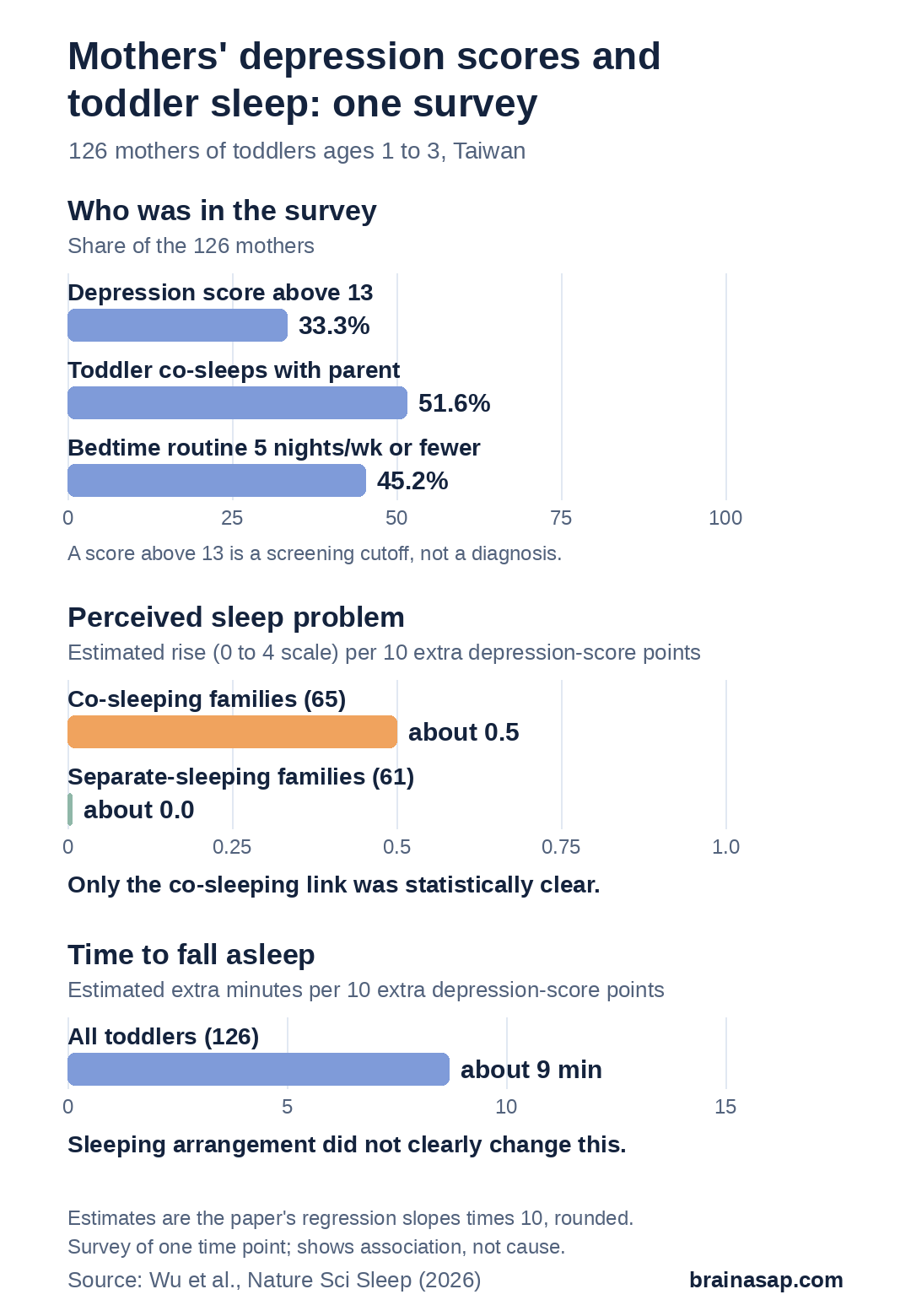
The link with falling asleep did not clearly differ by sleeping arrangement, and neither did the bedtime routine measure change any of the links.
How to Read This
The authors suggest that when parent and child share a sleeping surface, a mother’s restlessness or stress may spill over to the child more easily. They also note another possibility: when a child is close by all night, every stir gets noticed, and a mother with depressive symptoms may be more likely to see her child’s sleep as a problem. The study cannot tell these ideas apart. The effect showed up in the perceived problem rating, which reflects how a mother judges the sleep, not something measured directly.
The authors go further and suggest that encouraging separate sleeping might help buffer families where a mother has more depressive symptoms. That is a hypothesis to test, not something this survey shows. Nobody was moved from one arrangement to another. Families choose how they sleep for many reasons, including culture, housing, work schedules, and breastfeeding, and those reasons could also relate to mood and sleep.
What This Study Can’t Tell Us
- One snapshot: Everything was measured at the same time, so the study cannot show which comes first. A child who sleeps poorly can wear a parent down and worsen mood, just as low mood can shape how sleep is experienced.
- Reports from mothers only: Both depressive symptoms and toddler sleep came from the same mother. There was no sleep tracker or second observer.
- A small, self-selected sample: 126 mothers who chose to complete an online survey may not represent Taiwanese families, let alone families elsewhere.
- Much left out: Child temperament, fathers, and the couple’s relationship were not measured. Toddlers from 1 to 3 years old were grouped together despite big developmental differences.
- Several tests, few positives: Of four checks for a sleeping-arrangement or routine effect, one was statistically clear. Small studies can turn up such results by chance. The survey questionnaire’s Chinese version had also not been formally validated.
Why It Matters
This survey adds a data point to an uneven research field: earlier studies disagree on whether maternal depression is linked to toddler sleep. Here, mothers reporting more depressive symptoms also reported more sleep trouble, and about 1 in 3 scored above the cutoff. The authors suggest that pediatric sleep consultations could include a light check-in about the mother’s own mental health.
If a toddler has sleep trouble and a parent has low mood, both are worth raising with a doctor or nurse. Neither is anyone’s fault. This one small survey is not a reason to change how a family sleeps. Follow-up studies that track families over time will show whether sleeping arrangements truly change the picture.
Citation: DOI: 10.2147/NSS.S615753. Wu H-Y, Shieh P-L, Liu Y-C. Maternal Depressive Symptoms and Toddler Sleep: Moderating Effects of Sleep Parenting Practices. Nature and Science of Sleep. 2026;18:615753.
Study Design: Cross-sectional online survey (November 2022 to March 2023) analyzed with hierarchical regression and moderation (interaction) analyses.
Sample Size: 126 mothers of toddlers aged 1 to 3 years in Taiwan.
Key Statistic: Maternal depression (BDI-II) was associated with perceived toddler sleep problem (B = 0.02, p < 0.05) and sleep latency (B = 0.87 minutes per point, p < 0.01). Sleeping arrangement moderated the sleep-problem link (interaction B = −0.05, p < 0.05): B = 0.05 (p < 0.01) in co-sleeping families and 0.00 (p > 0.05) in separate-sleeping families.
Caveat: Cross-sectional design; mother-reported depression and sleep; small online convenience sample; only one of four moderation tests was significant.