TL;DR: In a pooled review of 8 studies of 980 people with depression and sleep problems, sleep tests showed more deep sleep and less light sleep after taking trazodone than before. Compared with placebo, though, the deep-sleep gain was not clear, and drowsiness and dizziness were more common.
Key Findings
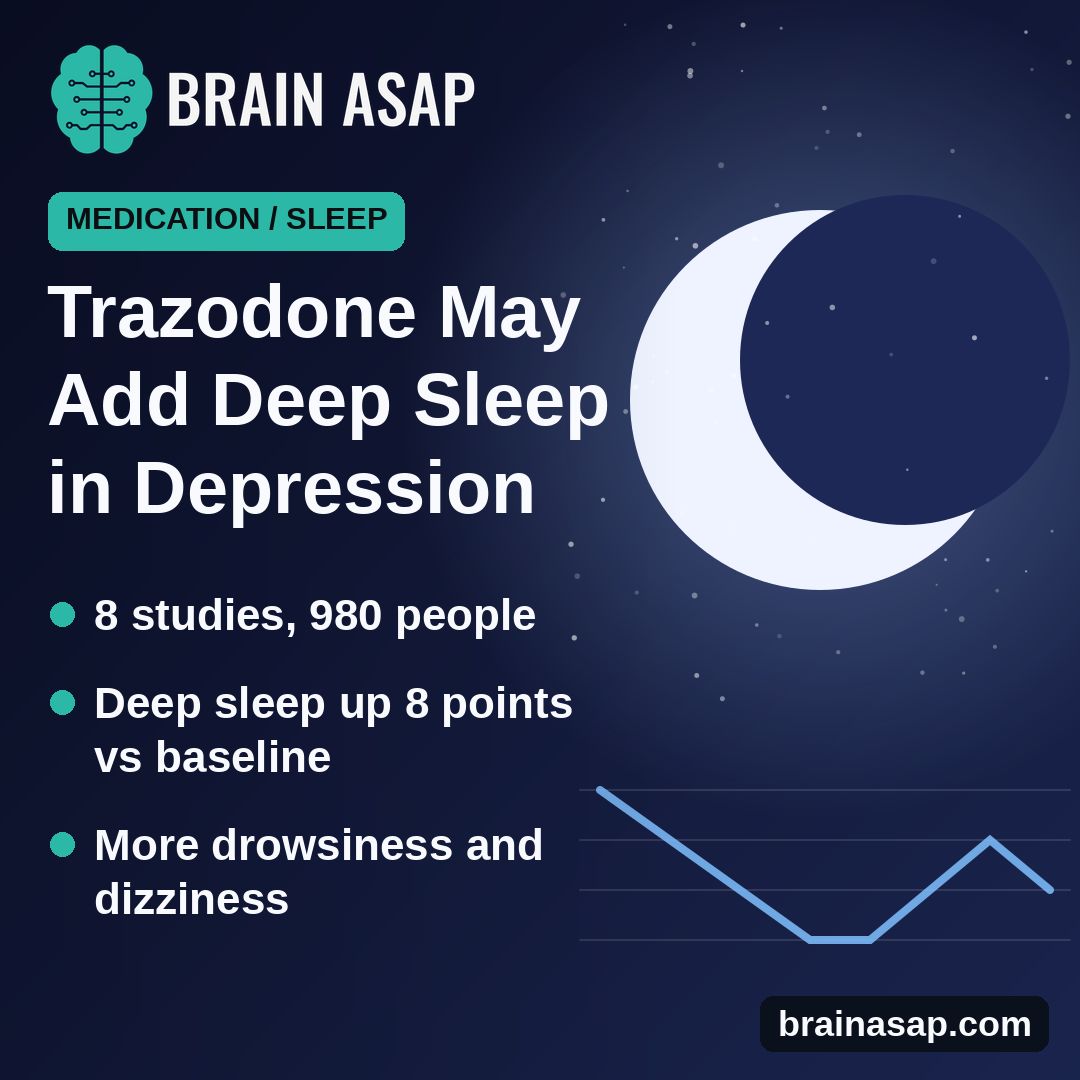
- 8 studies, 980 people: 5 randomized trials and 3 single-group studies.
- More sleep than baseline: About 51 more minutes of sleep and a 6.9-point gain in sleep efficiency after treatment.
- Deep sleep up 8 points: Share of the night in slow-wave sleep rose 8 percentage points versus before treatment (95% CI 3.4 to 12.7).
- REM sleep unchanged: No clear change in REM share.
- Side effects: Somnolence was about 4 times as common as with placebo (RR 3.82).
Source: Frontiers in Psychiatry (2026) | Meng et al.
Trazodone is an old antidepressant that doctors often prescribe at bedtime because it makes people drowsy. But does it just knock you out, or does it change the structure of sleep itself?
That matters because different sleep stages do different jobs. Deep sleep and REM sleep are tied to memory and emotional regulation. A team in Weifang, China, pooled the sleep-lab studies to see what trazodone does to them.
Eight Studies With Overnight Sleep Tests
The researchers searched seven databases through October 2025 and found 8 studies with 980 patients who had depression and sleep problems: 5 randomized, double-blind trials and 3 single-group studies with no comparison group. Trazodone doses ranged from 50 to 400 mg, and treatment lasted from one night to six weeks.
The key sleep data came from polysomnography, an overnight lab recording of brain waves that sorts sleep into stages. Only 4 studies reported stage data for the main analysis: 1 randomized trial and 3 single-group studies.
Two Different Comparisons Give Different Answers
This distinction matters. Most of the headline results compare people with themselves before treatment. That can’t separate trazodone from other changes over time, like the natural variation in depression or the novelty of a sleep lab.
The other comparison is against placebo, which only the randomized trials allow. Here are the two results side by side:
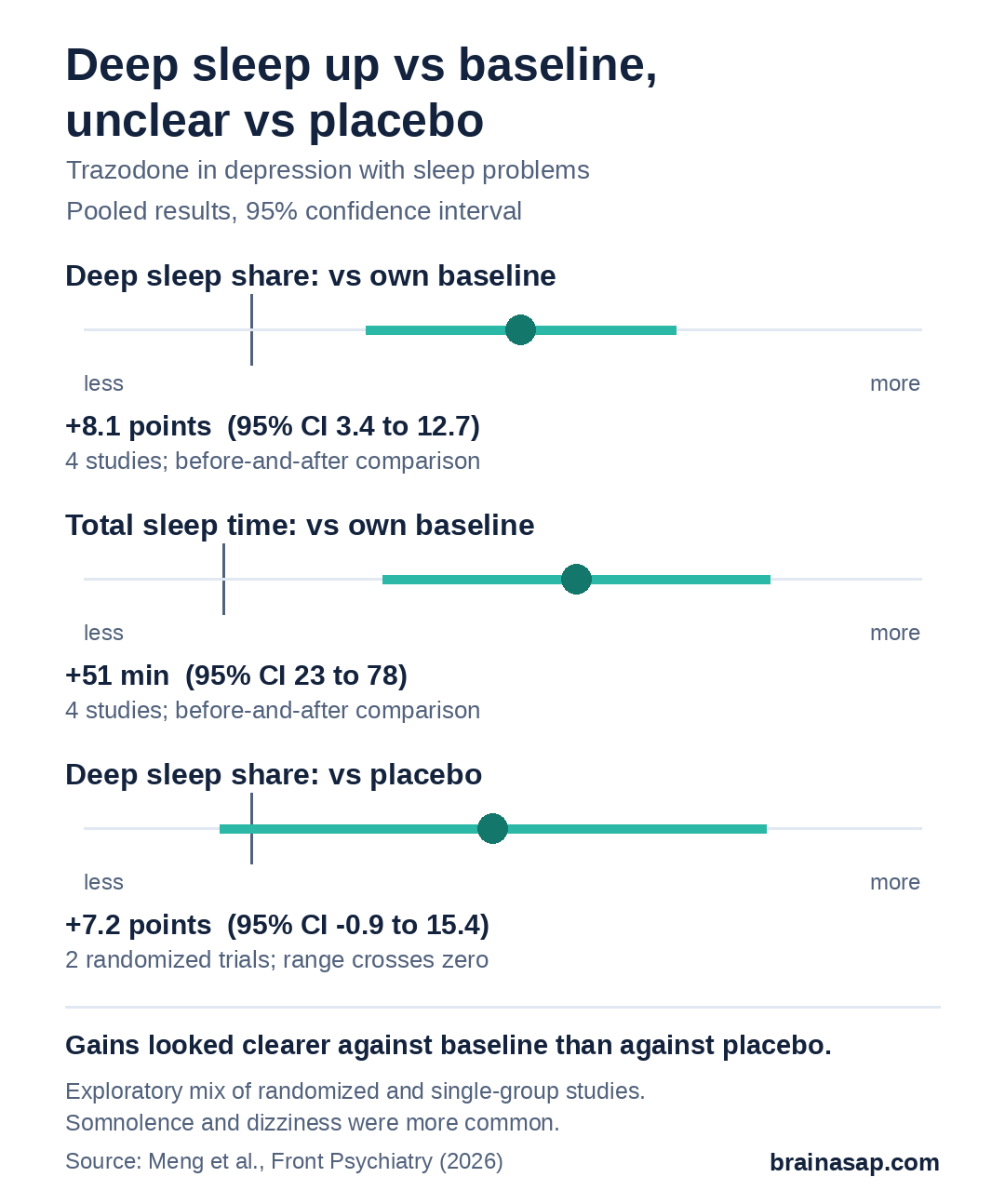
- Versus own baseline (4 studies): Total sleep time +51 minutes (95% CI 23 to 78), sleep efficiency +6.9 points, time to fall asleep −15 minutes, deep sleep +8 points, stage 2 (light) sleep −9 points
- Versus placebo (2 randomized trials): Total sleep time +27 minutes (95% CI 5 to 48), sleep efficiency +6.1 points, time awake at night −20 minutes (95% CI −30 to −9), but no clear change in sleep stages
Deep Sleep Rose but Only Versus Baseline
Compared with baseline, deep sleep (slow-wave sleep) made up 8 points more of the night (95% CI 3.4 to 12.7), while stage 2 sleep fell by 9 points (95% CI −16.6 to −1.6). REM sleep, stage 1 sleep, and time to reach REM did not change clearly.
Against placebo, the deep-sleep difference was similar in size (+7.2 points) but had a wide range (95% CI −0.9 to 15.4) that included no change, from only two trials. The authors note this may just reflect low statistical power. The stage 2 result was also fragile: it depended heavily on one older study that used a high dose.
Drowsiness and Dizziness Came With the Benefits
Three randomized trials found bigger drops in depression scores (HAMD-17) with trazodone than placebo, and two found higher response rates (RR 1.44, 95% CI 1.24 to 1.68). Side effects were also more common:
- Somnolence: RR 3.82 (95% CI 1.68 to 8.71)
- Dizziness: RR 2.80 (95% CI 2.02 to 3.88)
- Dry mouth: RR 2.09 (95% CI 1.49 to 2.91)
- Any side effect: RR 1.66, not clearly different (95% CI 0.89 to 3.08)
Why This Is Only a First Look
- Mixed designs: Single-group studies can’t control for confounders, so the authors call the analysis exploratory.
- Few studies: Each outcome drew on fewer than 10 studies, too few to test for publication bias.
- Short treatment: Some sleep-lab data came after one night or one week.
- Doses varied: From 50 to 400 mg, and the review could not tell which dose does what.
- Sleep stages are not thinking skills: The paper did not show that changed sleep stages improve cognition.
Larger Placebo-Controlled Sleep Lab Trials Are the Next Step
The fairest summary is that trazodone probably lengthens sleep in people with depression, and may shift time toward deep sleep. Whether that beats placebo, and whether it helps thinking or mood beyond the drug’s other effects, is still unanswered. Trazodone is a prescription drug, and dose or use decisions belong with a prescriber.
The next studies need longer, placebo-controlled sleep-lab trials at set doses that track both sleep stages and daytime function.
Citation: DOI: 10.3389/fpsyt.2026.1889208. Meng L, Ji J, Zhang H, et al. Effects of trazodone on polysomnographic sleep architecture in patients with depression and sleep disorders: a systematic review and exploratory meta-analysis. Front Psychiatry. 2026.
Study Design: Systematic review and exploratory meta-analysis of 5 randomized trials and 3 single-arm studies (PROSPERO CRD420251173354).
Sample Size: 8 studies, 980 patients; 4 studies contributed sleep-stage data.
Key Statistic: Slow-wave sleep +8.05 percentage points versus baseline (95% CI 3.42 to 12.68); stage 2 sleep −9.09 (95% CI −16.60 to −1.59).
Caveat: Exploratory, mixed designs; main stage results are within-person changes; in the 2 randomized trials alone the sleep-stage differences were not significant.