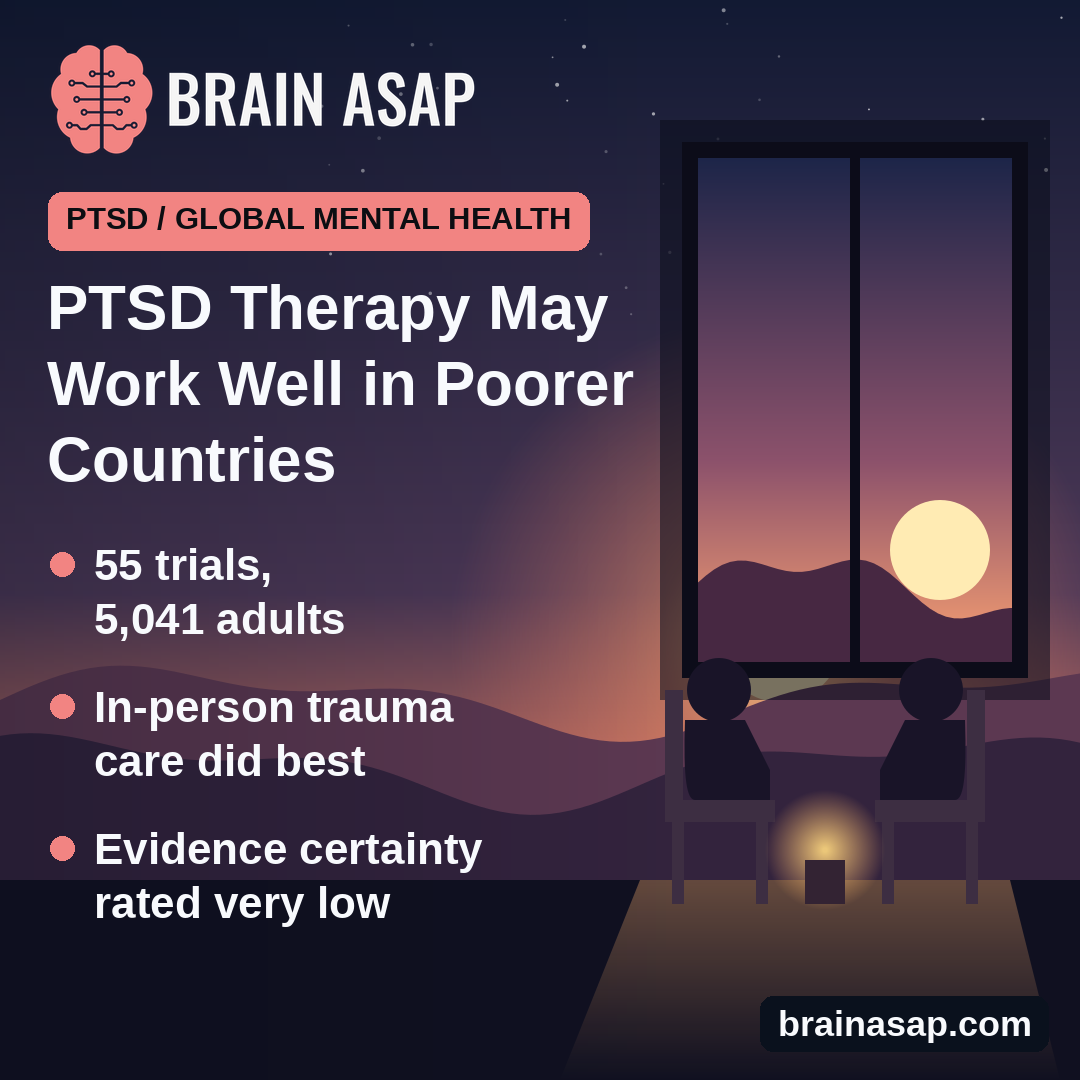
TL;DR: Across 55 trials in low- and middle-income countries (5,041 adults), people who got therapy had much lower PTSD symptoms than people on a wait-list or other comparison. The evidence was very low certainty because many trials were weakly run.
Key Findings
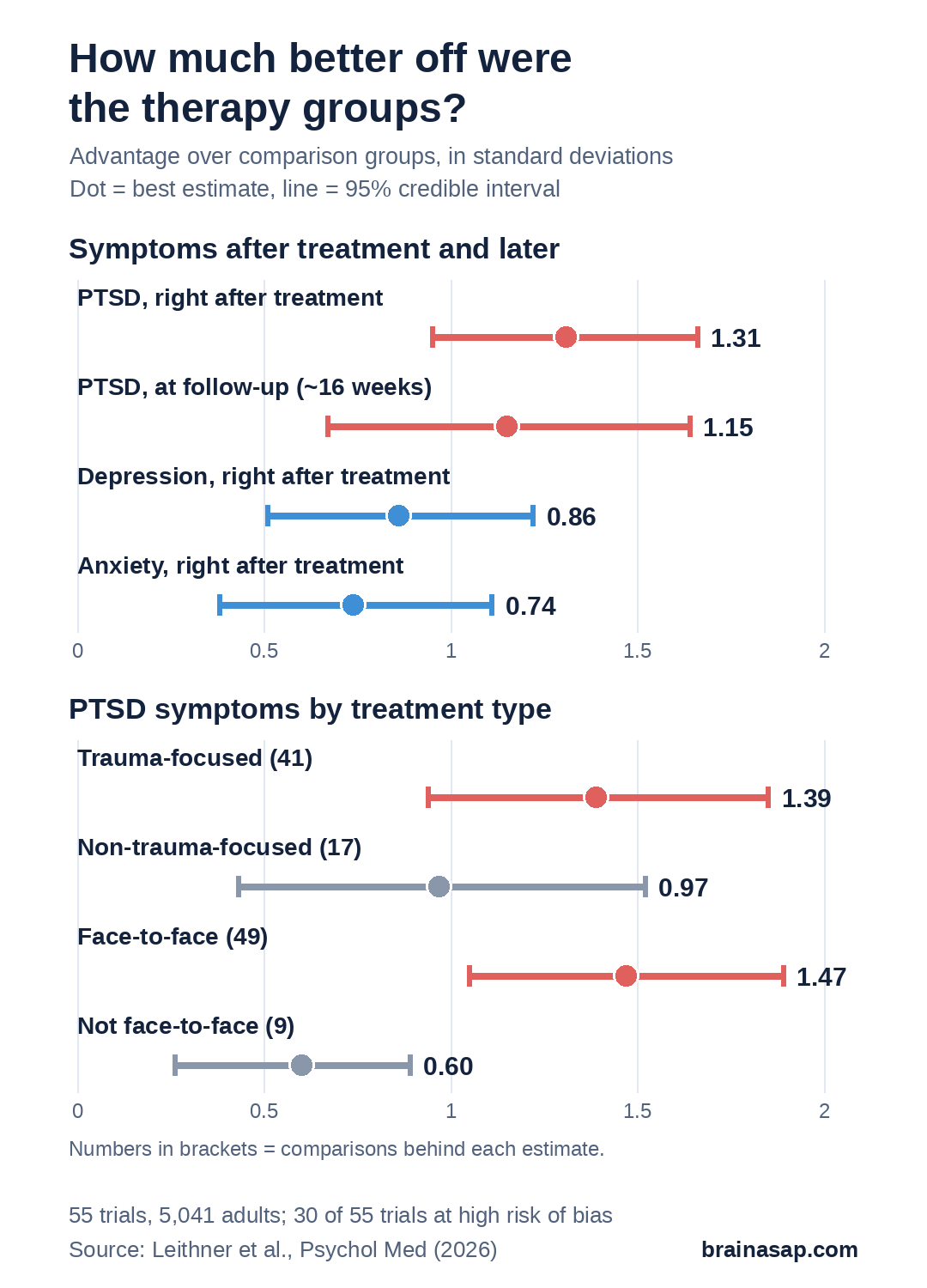
- Big gap after treatment: PTSD symptoms 1.31 standard deviations lower in therapy groups than comparison groups (95% credible interval 0.95 to 1.66).
- It lasted: At follow-up, about 16 weeks after treatment on average, gap was 1.15 (0.67 to 1.64).
- Mood and worry too: Depression differed by 0.86 and anxiety by 0.74 standard deviations, both favoring therapy groups.
- Trauma-focused and in-person looked best: Trauma-focused therapy (1.39) higher than non-trauma-focused (0.97); in-person (1.47) higher than websites, apps and texting programs (0.60). Ranges are wide.
- Trust cautiously: 30 of 55 trials high risk of bias, only 3 low. Authors saw signs unfavorable studies may be missing.
Source: Psychological Medicine (2026) | Leithner et al.
Most of what we know about treating PTSD comes from trials in wealthy countries. Does therapy work where war, disaster and displacement are common and treatment is scarce?
Across 55 randomized trials, people who got therapy ended up with far lower PTSD symptoms than people in comparison groups. The catch is that many of those trials were weakly run, and the authors rate the evidence very low certainty.
How the trials were pooled
PTSD is common in low- and middle-income countries (LMICs), yet treatment is rare there: the paper cites only 4.1% of people with PTSD as receiving adequate treatment, versus 17.8% in high-income countries. So a fair question is whether therapies built and tested elsewhere actually work in LMICs. A team at LMU Munich pooled every eligible randomized trial they could find.
The team searched a public PTSD trial database plus Embase, Medline, PsycINFO and PTSDpubs for trials published up to June 2025. To count, a trial had to:
- randomly assign adults (16 and older) who had PTSD symptoms,
- test a psychosocial treatment aimed mainly at PTSD (talk therapy, counseling, exposure therapy, relaxation training and similar),
- take place in a country the World Bank classed as low- or middle-income,
- use a validated PTSD symptom measure.
That left 55 trials with 5,041 participants and 66 treatment groups.
Most trials ran in upper-middle-income countries (38), with 9 in low-income and 8 in lower-middle-income countries. China, Iran and Turkey supplied 22 of them. About two-thirds of participants were women, and the average age was about 36.
The two groups being compared are:
- Therapy groups: people randomized to a psychosocial PTSD treatment.
- Comparison groups: people randomized to something else. In 29 trials that was a wait-list, in 8 it was usual care, and in 15 it was another active option.
What “standard deviations” and “Bayesian” mean here
Each trial measured PTSD on a different questionnaire, so the researchers converted every result into a common yardstick called Hedges’ g. It expresses a difference in standard deviations, which is roughly how far apart the two groups’ averages are compared with how much people normally vary.
Researchers often call 0.8 or more “large.” A bigger positive number means a bigger advantage for the therapy groups. (The paper prints these as negative numbers because lower symptoms are better.)
The word “Bayesian” in the title is about how the numbers were estimated. In plain terms:
- Start with a mild assumption. Bayesian analysis begins with a “prior,” a rough starting guess about what the answer might look like. Here the priors were weakly informative, meaning loose enough that the trials, not the guess, drive the result.
- Update with the data. The trials’ results reshape that guess into a range of plausible answers.
- Read the range directly. The 95% credible interval is the range that, given the data and the model, holds the true effect with 95% probability. When it sits well away from zero, as it does here, a real difference is very likely.
- Check that the guess did not matter. The authors reran the analysis with different priors, and the conclusions held.
The models were also “three-level.” That means a trial with two therapy groups is not counted as two independent studies, and the model separately allows for variation between trials. The researchers argue a Bayesian approach suits data with small samples inside each trial.
PTSD symptoms after treatment and at follow-up
Right after treatment, the therapy groups had much lower PTSD symptoms than the comparison groups, by 1.31 standard deviations (95% credible interval 0.95 to 1.66, from 58 comparisons). Across 33 comparisons with follow-up data, collected about 16 weeks after treatment on average, the gap was 1.15 (0.67 to 1.64).
Secondary outcomes moved the same way. Depression differed by 0.86 (0.51 to 1.22) and anxiety by 0.74 (0.38 to 1.11) right after treatment. Both gaps were still present at follow-up, though smaller for anxiety (0.44).
Differences by treatment type
The researchers compared subgroups of treatments. The figures below are for PTSD symptoms right after treatment.
- Trauma-focused: These therapies, such as prolonged exposure, cognitive processing therapy, EMDR and narrative exposure therapy, directly work through the traumatic event and its memories, thoughts and feelings. They made up 46 of 66 treatment groups and showed a gap of 1.39 (0.94 to 1.85). Approaches that did not process the trauma directly, such as supportive counseling or relaxation training, showed 0.97 (0.43 to 1.52). The authors’ direct comparison of change within treated groups favored trauma-focused care, with a difference of 0.81 (0.11 to 1.53).
- In person: Face-to-face treatment (57 groups) showed 1.47 (1.05 to 1.89). Remote treatment (9 groups), mostly self-guided websites, apps and text-message programs, showed 0.60 (0.26 to 0.89). The direct comparison of within-group change had a difference of 1.08 (0.08 to 2.09), a wide range because so few treatment groups were remote.
- Older participants: Trials with older participants tended to show bigger gains, by roughly 0.05 standard deviations per extra year of average age. That is a pattern across trials, not a prediction for any one person, and the authors offer only possible explanations, such as younger adults dropping out of therapy more often.
Several things the authors checked did not clearly matter: how many sessions were given, how long they lasted, and whether the population was civilians or refugees. Trials in low- or lower-middle-income countries (1.22) and upper-middle-income countries (1.29) looked similar, although the group of low- and lower-middle-income countries was small.
Limits of the evidence
An effect of 1.3 is large, and the authors say plainly that it is larger than in earlier reviews of LMIC trials that looked only at refugees or survivors of mass violence, and comparable to or above reviews from high-income countries. The authors point to reasons for caution:
- Trial quality: 30 of 55 trials had a high risk of bias, 22 had some concerns, and only 3 were rated low risk. Overall certainty of the evidence was rated very low (GRADE).
- Publication bias: A funnel plot and a statistical test both suggested less favorable studies may be underrepresented.
- Comparison care may be weaker: Against active comparison groups, pooled gap was 1.11, far above 0.47 in an earlier review including high-income countries. Authors suggest usual care in LMICs may be thinner, but say this is not settled.
- Averages, not guarantees: Trials varied widely; the pooled number does not say how any one person will respond.
- Diagnosis not always confirmed: Only about 60% of trials reported formal PTSD diagnosis for every participant; trauma exposure not separately verified.
- Uneven geography: Most trials from upper-middle-income countries, so findings apply less confidently to low- and lower-middle-income settings.
- Trained providers: Trauma-focused therapy mostly delivered by specialists (39 groups), rarely by basic-trained helpers (4 groups), so little on task-shifting to community workers.
- Limited cultural adaptation: Only 17% of treatment groups were culturally adapted.
- Missing outcomes: Fewer than 10 trials measured daily functioning or quality of life.
- Tiny subgroups: Non-face-to-face delivery (9) and trials banning psychiatric medication (7) rest on few comparisons.
Better-run trials are needed, especially in the poorest countries
Across 55 trials, therapy groups consistently did better than comparison groups, and the pattern matched what guidelines in wealthier countries recommend. The authors conclude that trauma-focused, in-person treatment should be first-line where trained providers are available.
What the pooled result cannot say is how big the benefit really is. That needs better-run trials, which the authors call urgently needed.
Citation: DOI: 10.1017/S0033291726105807. Leithner C, Gerst S, Niyaz R, Heusler L, Terhorst Y, Ehring T, Semmlinger V. Psychosocial interventions for posttraumatic stress disorder in low- and middle-income countries: a Bayesian meta-analysis. Psychological Medicine. 2026;56:e280.
Study Design: Systematic review and three-level Bayesian random-effects meta-analysis of randomized controlled trials (PROSPERO CRD42024584333); trials published 1980 to 23 June 2025; risk of bias by Cochrane RoB 2, certainty by GRADE.
Sample Size: 55 randomized trials, 5,041 participants, 66 treatment groups.
Key Statistic: Between-group Hedges’ g for PTSD symptoms after treatment 1.31 (95% CrI 0.95 to 1.66, 58 comparisons) and 1.15 at follow-up (0.67 to 1.64); depression 0.86 and anxiety 0.74.
Caveat: GRADE certainty very low; 30 of 55 trials at high risk of bias; signs of publication bias; few trials from low- and lower-middle-income countries.