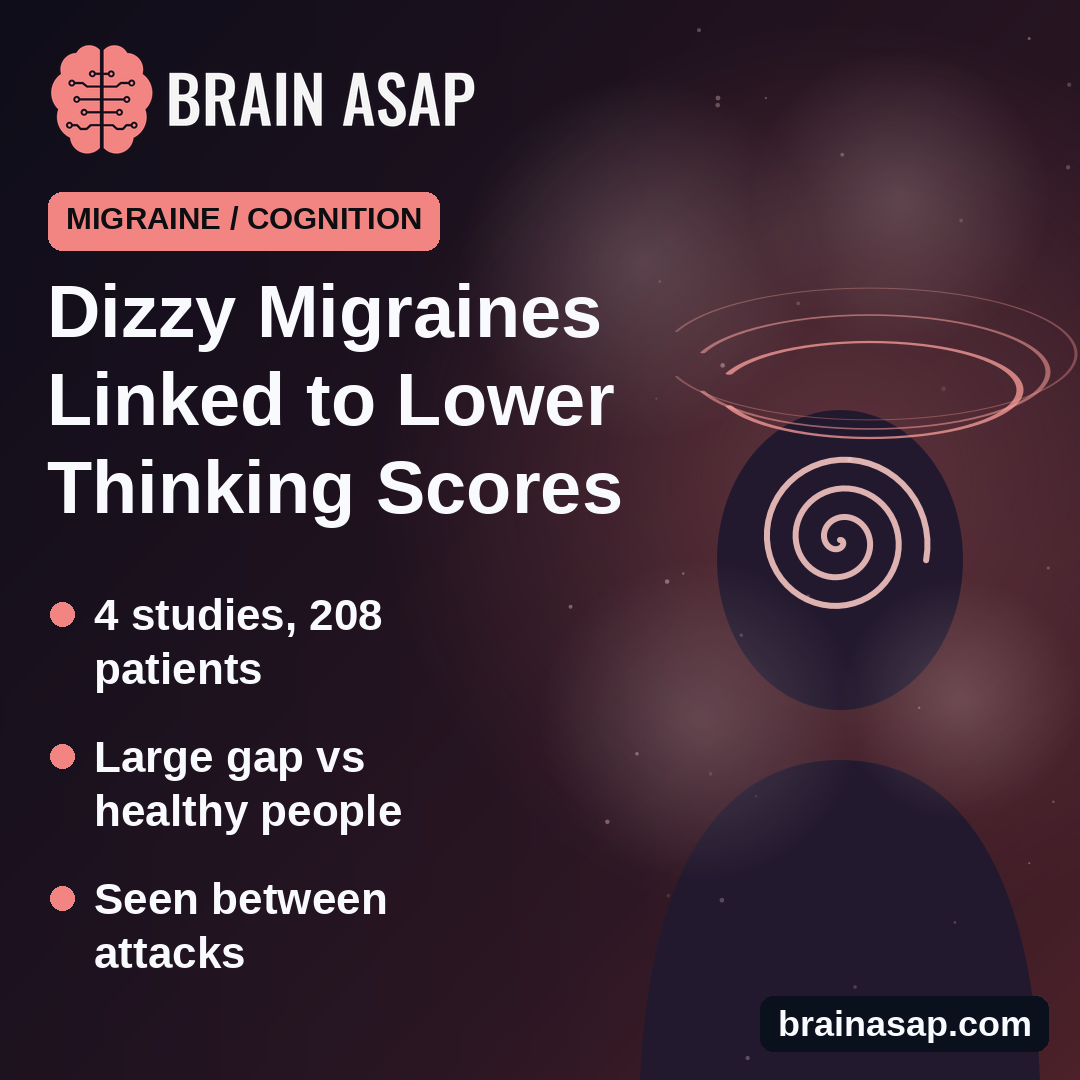
TL;DR: Across four small studies, adults with vestibular migraine, a type that causes dizzy spells, scored noticeably lower on thinking tests than healthy people, even between attacks. The review was small and could not rule out anxiety, poor sleep or medicines as causes.
Key Findings
- 6 studies found; 4 pooled: 208 people with vestibular migraine, 180 healthy people.
- Lower overall thinking scores: Large gap, consistent across studies.
- Slower on a focus test: Large gap, but only 2 studies that measured it differently.
- About 3 in 4 flagged: In two clinic groups, most scored below an impairment cutoff.
- Tested between attacks in most studies.
- Searched one database only.
Source: Frontiers in Neurology (2026) | Di et al.
Vestibular migraine is one of the most common causes of repeated vertigo. Besides dizzy spells, many people describe “brain fog”: slow thinking, trouble concentrating and forgetfulness.
Those complaints are easy to dismiss. This review from China asked whether they show up on objective thinking tests.
A Migraine That Makes the World Spin
In vestibular migraine, migraine affects the balance system. Attacks bring vertigo, unsteadiness or motion sensitivity, sometimes with headache and sometimes without. Doctors diagnose it with international migraine and balance-disorder criteria.
The researchers searched PubMed for studies from 2010 to 2025 that tested thinking in adults with vestibular migraine. They found six. Four compared patients with healthy volunteers of similar age, and those were pooled. Most came from clinics in Turkey and China, and most tested people between attacks.
Scores Were Clearly Lower Than in Healthy People
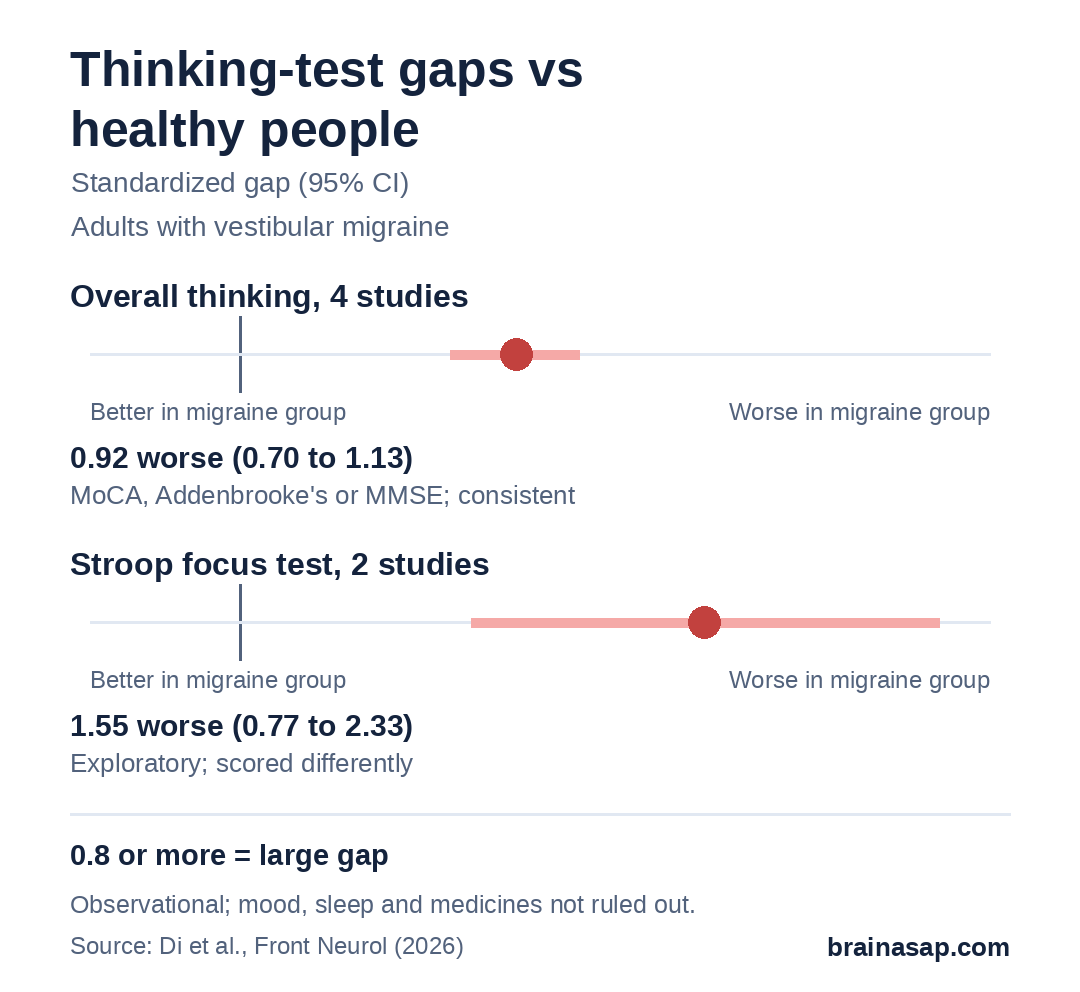
The main measure was overall thinking, using screening tests such as the Montreal Cognitive Assessment (MoCA) and Addenbrooke’s Cognitive Examination.
- Overall thinking: A standardized gap of 0.92 in favor of healthy people, which counts as large. All four studies pointed the same way.
- Focus and self-control: On the Stroop test, where people name ink colors while ignoring the printed word, patients did worse with a gap of 1.55. Only 2 studies, measured differently, so the authors call this exploratory.
Three in Four Scored Below a Cutoff
Two clinic-based groups reported how many patients fell below an impairment cutoff on Addenbrooke’s test. Pooled, it was 74%, about 3 in 4.
That number needs care. It comes from only two groups, the cutoffs differed (83 and 86), and screening scores are affected by education and culture. It describes patients at specialty clinics, not everyone with vestibular migraine, and screening below a cutoff is not the same as a dementia diagnosis.
What Else Could Explain the Gap
- Mood and sleep: Anxiety, depression and poor sleep are common in vestibular migraine and can lower test scores. Studies rarely adjusted for them.
- Medicines: Some migraine-prevention drugs can dull thinking.
- Migraine itself: The pooled comparisons were with healthy people, not people with other migraines, so the gap may not be specific to the vestibular type.
- Snapshots: Mostly one-time comparisons, not follow-up over time.
- One database: Searching only PubMed may have missed studies.
Brain Fog Deserves a Closer Look
For people with vestibular migraine, these results suggest that thinking complaints are real and measurable, not imagined. The authors suggest doctors consider a quick thinking screen as part of routine care.
What remains unclear is why. Studies that track the same patients over time, compare them with other migraine types and account for mood, sleep and medicines would show whether the dizziness disorder itself drives the gap.
Citation: DOI: 10.3389/fneur.2026.1818747. Di M, Hu L, Li C, Yin X, Gui S, Han L. Cognitive impairment in vestibular migraine: a PubMed-based systematic review and meta-analysis. Front Neurol. 2026;17:1818747.
Study Design: PubMed-only rapid systematic review and meta-analysis of observational studies (INPLASY2025100115).
Sample Size: 6 studies; 4 pooled for global cognition (208 VM, 180 controls).
Key Statistic: Global cognition SMD -0.92 (95% CI -1.13 to -0.70; I² = 8%).
Caveat: Small observational evidence base; confounding by mood, sleep and medication; Stroop and prevalence estimates exploratory.