TL;DR: Across 10 studies and 13,110 stroke patients, ambulances carrying their own CT scanner got clot-busting treatment started about 26 minutes sooner than regular ambulances. The review found no clear difference in recovery or safety, though it may have been too small to see one.
Key Findings
- 10 studies, 13,110 patients: 4 randomized, 6 not, mostly in Germany, China and Norway.
- 26 minutes faster: From emergency call to clot-busting drug.
- 35 minutes faster: From stroke onset to clot-busting drug.
- Remote vs onboard neurologist: No clear difference in time savings.
- Recovery scores: No clear difference.
- Brain bleeds and deaths: No clear difference.
Source: Frontiers in Neurology (2026) | Albakr et al.
In a stroke caused by a blood clot, every minute without treatment costs brain cells. The usual path is ambulance, emergency room, brain scan, then clot-busting drugs.
Mobile stroke units flip that order. The ambulance carries a CT scanner, so treatment can start at the curb. This Saudi-led review asked how much time that saves, and whether it changes outcomes.
A Brain Scanner Inside the Ambulance
A mobile stroke unit is an ambulance fitted with a CT scanner, lab tests and a team that can give the clot-busting drug alteplase on the spot. Some carry a neurologist; others connect to one by video.
The researchers pooled 10 studies comparing mobile stroke units with regular emergency ambulances, which take patients to hospital for scanning and treatment. Four were randomized trials, and six compared groups without random assignment. Six took place in cities.
Treatment Started Sooner on 5 Time Measures
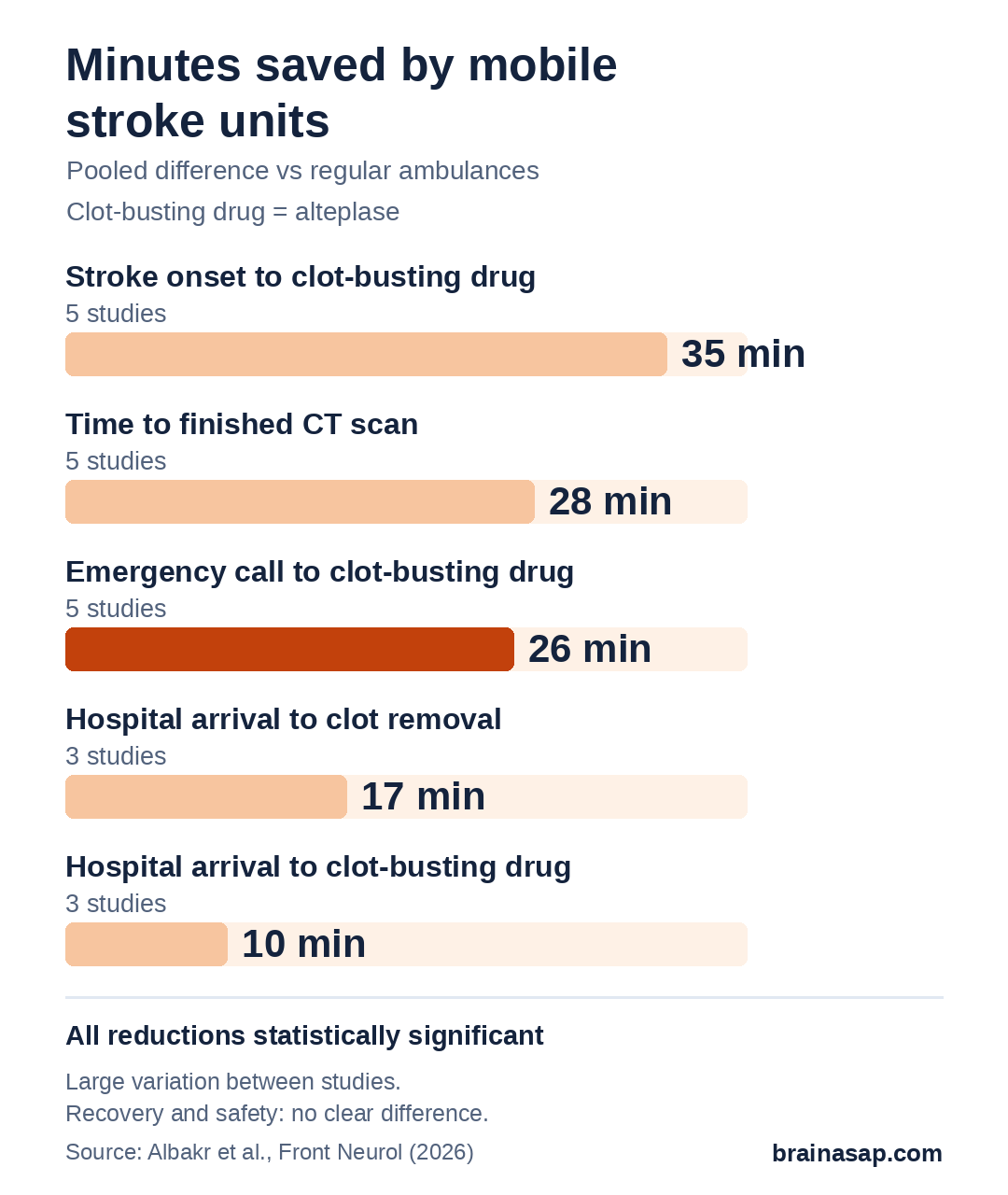
- Call to clot-busting drug: 26 minutes sooner (5 studies).
- Stroke onset to clot-busting drug: 35 minutes sooner.
- Finished CT scan: 28 minutes sooner.
- Hospital arrival to clot removal: 17 minutes sooner, with consistent results.
Units with a neurologist on board and units using a remote neurologist saved similar amounts of time. That matters for cost, since staffing a neurologist in every ambulance is expensive.
Recovery and Safety Looked Similar
- Disability after stroke: Measured on the modified Rankin Scale, mostly at 3 months. No significant difference in 6 studies.
- Brain bleeding: No significant difference (6 studies).
- Deaths: No significant difference (7 studies).
The authors note that “no difference” here does not prove equal outcomes. Too few studies reported recovery to detect a modest benefit, and earlier treatment is well known to improve stroke outcomes.
Why the Numbers Are Rough
- Big variation: Results differed widely between studies, often with heterogeneity of 70% to 90%.
- Mostly non-randomized: 6 of 10 studies.
- Different settings: Cities vs rural areas, and different health systems.
- Few studies per measure: 3 to 7.
Faster Care Is Clear; Better Recovery Needs Proof
For cities weighing mobile stroke units, this review supports the core promise: treatment starts meaningfully sooner. A remote neurologist may be enough to get that benefit.
What the pooled data could not show is whether those saved minutes translate into less disability. Larger randomized trials that follow recovery are needed to settle it.
Citation: DOI: 10.3389/fneur.2026.1852802. Albakr AI, Alqahtani ZM, AlSharidah AM, et al. Treatment first, transport second: rethinking stroke management with mobile stroke units—A systematic review and meta-analysis of controlled trials. Front Neurol. 2026;17:1852802.
Study Design: Systematic review and meta-analysis of randomized and non-randomized controlled studies (PROSPERO CRD420261297860).
Sample Size: 10 studies; 13,110 patients (4,350 MSU, 8,760 regular EMS).
Key Statistic: Alarm-to-thrombolysis pooled median difference 26.3 min (95% CI 20.1 to 32.4).
Caveat: High heterogeneity; 6 non-randomized studies; functional and safety comparisons underpowered.