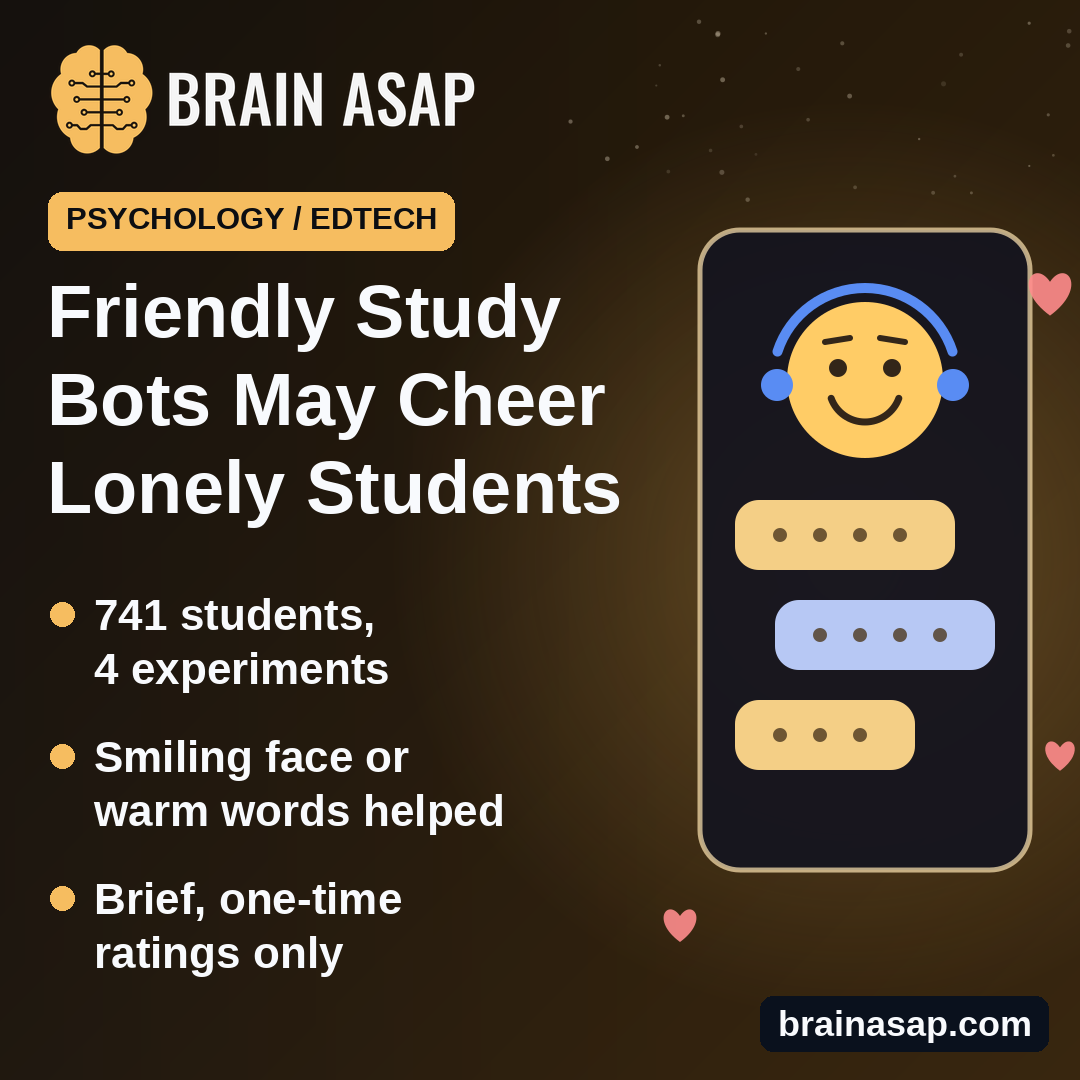
TL;DR: In four online experiments with Chinese university students, a study-app assistant with a friendly face or chatty wording led to more positive feelings than a plain version. The boost was bigger in students who felt lonelier.
Key Findings
- 4 experiments, 741 students: Each saw either a human-like or a plain study assistant.
- Happier with a face: 4.3 vs 2.4 out of 5 on positive feelings in the first experiment.
- Friendly words worked too: 4.2 vs 2.5 out of 5.
- Feeling of company explained part of it: Students sensed more of a social presence.
- Bigger effect in lonelier students: About 2.7 times larger than in less lonely students.
Source: Frontiers in Psychology (2026) | Tian and Qiu
Loneliness is common at university, and many students now spend hours a day with AI study helpers. Does it matter whether those helpers look and talk like a person?
Two researchers at Nanning College of Technology in China ran four quick experiments to find out how students feel right after meeting a human-like versus a plain virtual learning assistant.
A Smiling Icon or Friendly Words vs a Plain Assistant
In each experiment, students were randomly shown one of two versions of an assistant inside a mock study app:
- Human-like assistant: An icon with eyes, a smile, a thumbs-up and a headset, or replies written in warm, conversational language.
- Plain assistant: The same icon shape and layout with no face, or the same information in neutral wording.
Students then rated how human the assistant seemed, how much it felt like someone was there with them (social presence), and their positive feelings, each on a 1-to-5 scale. Two of the experiments also measured how lonely each student felt.
Human-Like Cues Brought Brighter Moods
The first two experiments, with 118 and 129 students, tested a face and friendly wording separately. Both made a large difference in how students said they felt.
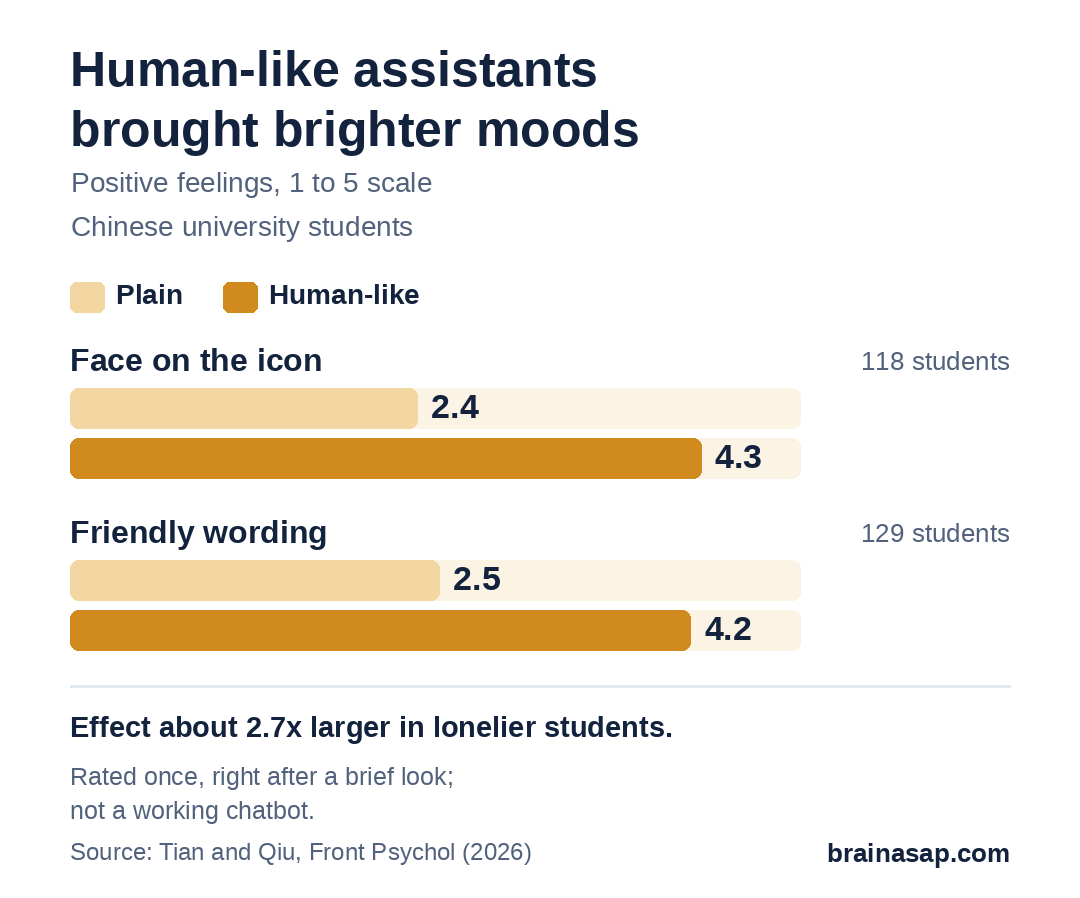
Statistical modeling suggested the boost ran partly through social presence: the human-like assistant felt more like company, and that feeling went along with brighter moods.
Lonelier Students Responded More
The next two experiments, with 270 and 224 students, measured loneliness before showing the assistant. A friendly-faced assistant raised positive feelings at every loneliness level, but the effect was about 2.7 times larger in students with high loneliness than in those with low loneliness. Lonelier students also felt a stronger sense of social presence from the human-like version.
A Few Seconds With an Icon Is Not Real Use
- Static stimuli: Mostly icons and short scripts, not a working chatbot over weeks.
- Immediate self-report: Feelings were rated once, right after viewing.
- Loneliness not changed: The study did not show the assistant reduced anyone’s loneliness.
- No learning outcomes: Grades, engagement and continued use were not measured.
- One country: University students in China.
Comfort for Lonely Students, or a Substitute for People?
The findings suggest design choices as small as a smile or a warm phrase can shape how students feel about a study tool, especially students who feel alone. Whether that comfort lasts, helps learning, or nudges lonely students away from real-world connection is the open question that longer studies with working assistants need to answer.
Citation: DOI: 10.3389/fpsyg.2026.1758999. Tian Y, Qiu Y. Positive emotional responses to anthropomorphic virtual learning assistants among university students with different levels of loneliness. Front Psychol. 2026;17:1758999.
Study Design: Four randomized between-subjects online experiments with mediation and moderation analyses.
Sample Size: 741 university students (118, 129, 270, 224).
Key Statistic: Positive emotions 4.32 vs 2.38 (Study 1a); visual-cue effect B = 0.83 at high vs 0.31 at low loneliness (Study 2a).
Caveat: Brief static stimuli, single-session self-report; loneliness measured, not manipulated.