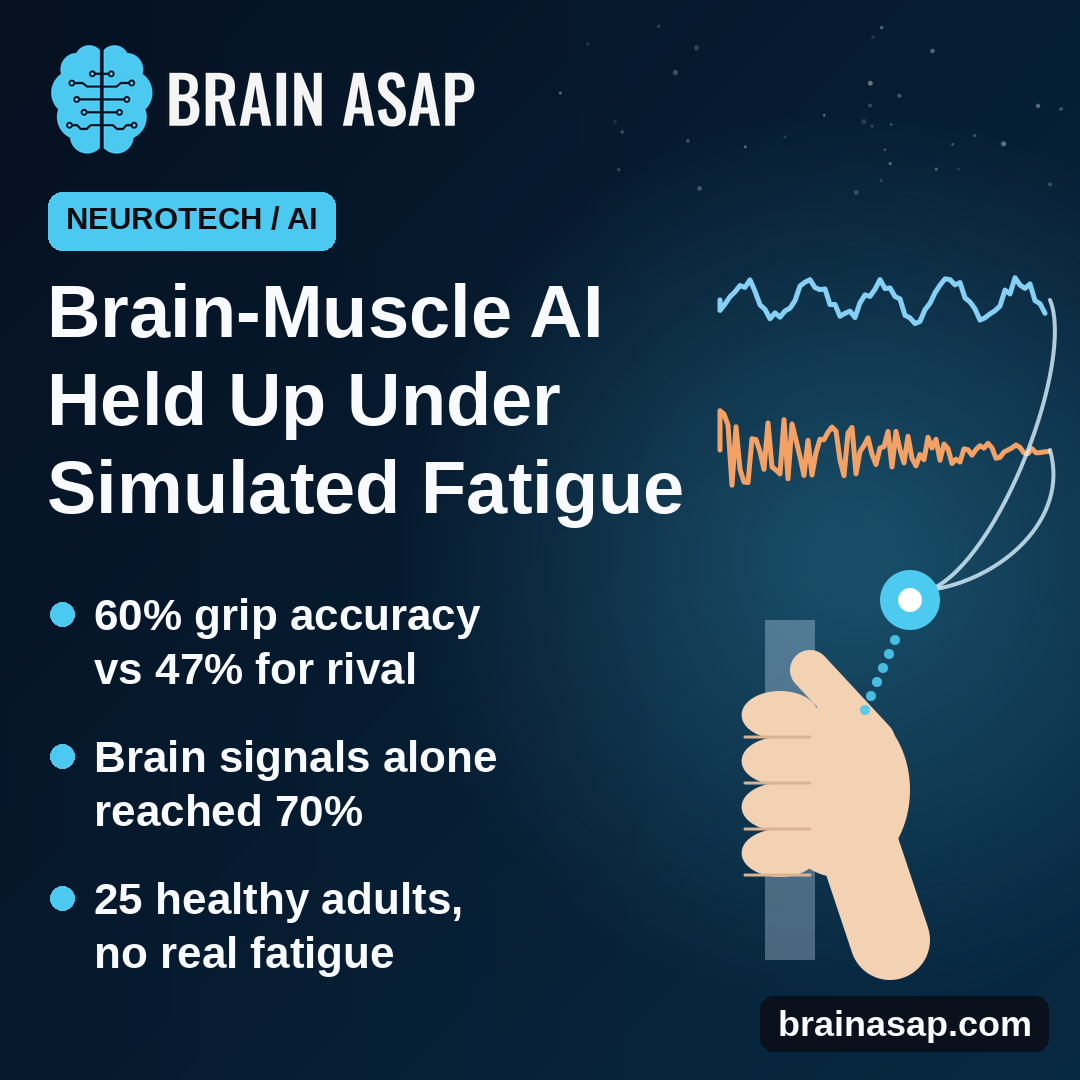
TL;DR: A new AI model that combines brain and muscle signals kept recognizing hand grips better than rival models when the muscle signals were artificially weakened to mimic fatigue. At the heaviest weakening, though, brain signals alone did better than any combined model.
Key Findings
- Recordings from 25 healthy adults: Brain (EEG) and forearm muscle (EMG) signals during 3 types of grip.
- Fatigue was simulated: Muscle signals were shrunk and made noisier by 10% to 90%.
- Held up better than rivals: 60% accuracy at the heaviest weakening, vs 47% for a rival combined model.
- Brain-only did better still: 70% at that level, since only the muscle signal was weakened.
- Worked on new people: 57% accuracy for someone the model had never seen.
Source: Frontiers in Human Neuroscience (2026) | Cao et al.
Robotic gloves and rehab devices can read a person’s intent to move from brain waves, muscle signals or both. Muscle signals are clearer, but they fade and get noisy as muscles tire during long therapy sessions.
Engineers in China built a model designed to notice when muscle signals are unreliable and lean more on the brain instead.
Brain Waves Plus Muscle Signals to Read a Grip
The team used a public dataset recorded from 25 healthy right-handed adults. Each wore an EEG cap over the movement areas of the brain and sensors on six arm muscles while performing three grips:
- Spherical: holding a ball.
- Cylindrical: wrapping fingers around a rod.
- Hook: carrying something like a bag handle.
Their model, called FRFNet, splits the muscle signal into a part that reflects the grip and a part that reflects wear and tear, then decides moment by moment how much to trust each signal. Random guessing among three grips would be right about 33% of the time.
Muscle Fatigue Was Mimicked, Not Measured
Nobody actually tired themselves out. To mimic fatigue, the researchers shrank the recorded muscle signals and added noise, in nine steps from 10% to 90% weakening. Brain signals were left untouched.
The Combined Model Faded More Slowly
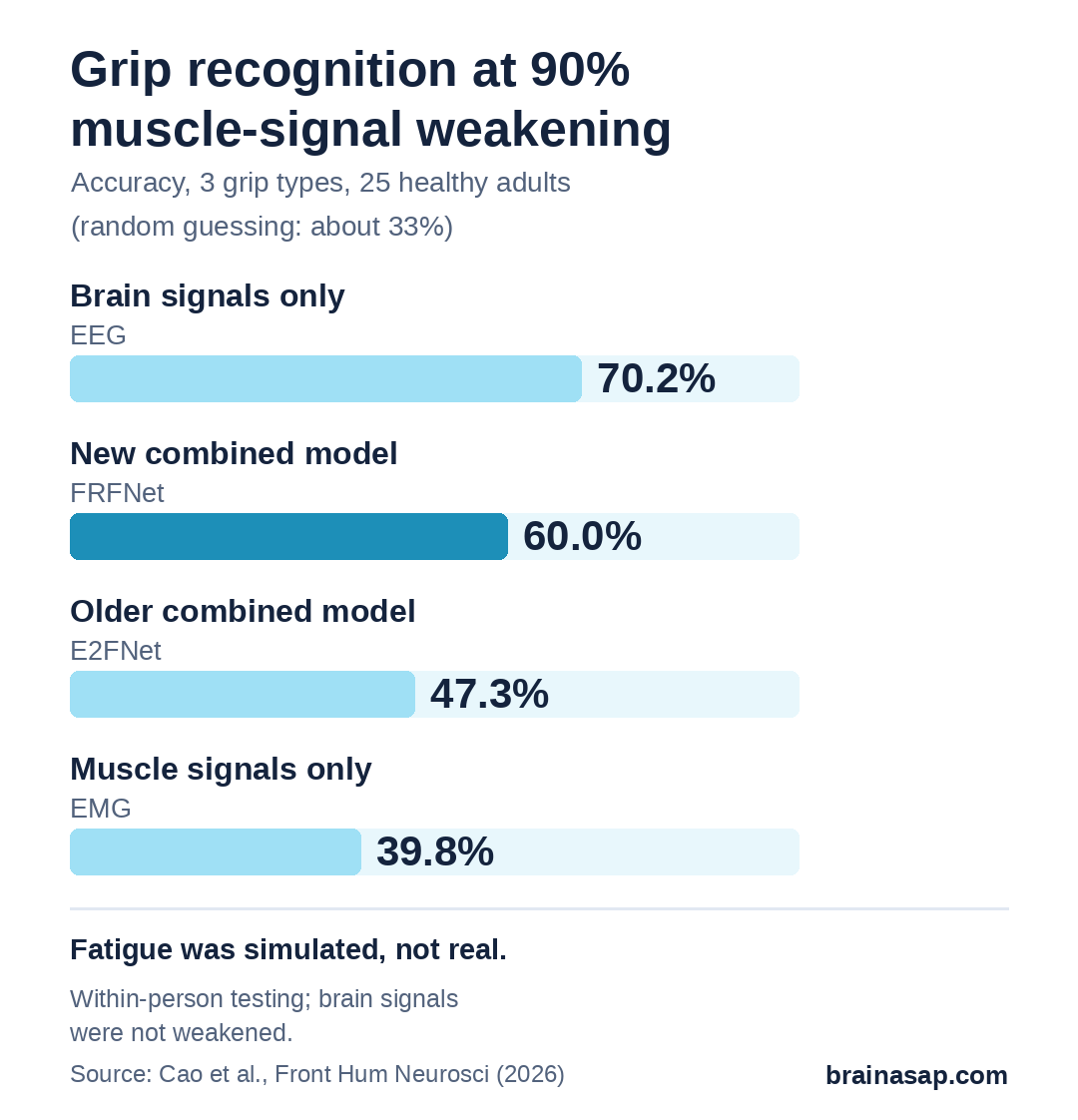
When each person’s own data were used for training and testing, FRFNet was correct 89.9% of the time at light weakening. At 90% weakening, it still reached 60.0%, 12.7 percentage points ahead of a rival fusion model called E2FNet, and well ahead of muscle signals alone, which fell to 39.8%.
The harder test trained the model on 24 people and tested it on the 25th. Here FRFNet reached 57.0% at 90% weakening, while E2FNet dropped to 34.8%, close to random guessing.
Brain-Only Beat Every Combined Model at Heavy Weakening
The paper’s own table shows a catch. Brain signals alone held steady at 70.2%, which is better than FRFNet from 60% weakening onward. In other words, once muscle signals are badly degraded, the combined model would do better simply ignoring them. FRFNet’s advantage is real at light to moderate weakening and against other fusion designs, not against brain-only decoding at the extreme.
Simulated Fatigue, Healthy Volunteers
- No real fatigue: Real tired muscles may change in ways simple shrinking and noise do not capture.
- Healthy adults only: Stroke patients’ signals may look very different.
- Three grips: A narrow task, not general movement reading.
- Speed: 5.3 milliseconds per decision excludes the time to record and clean signals or move a device.
- Company author: One author is affiliated with a medical device company.
Will It Hold Up With Real Tired Muscles?
The design idea of trusting the brain more as muscles tire makes sense for long rehab sessions. The next test is with real fatigue and with stroke survivors, comparing the model directly against brain-only decoding at every fatigue level.
Citation: DOI: 10.3389/fnhum.2026.1885665. Cao Y, Bai S, Zhao Z, He Y, Fu M, Liu X, Niu L. FRFNet: a fatigue-robust EEG–EMG fusion network for hand movement intention recognition. Front Hum Neurosci. 2026;20:1885665.
Study Design: Machine-learning model development and evaluation on a public EEG-EMG dataset with synthetic EMG degradation; within-subject and leave-one-subject-out testing.
Sample Size: 25 healthy adults; 3 grasp classes.
Key Statistic: 60.0% within-subject and 57.0% leave-one-out accuracy at 90% synthetic degradation; EEG-only 70.2%.
Caveat: Simulated fatigue, healthy participants, no device testing.