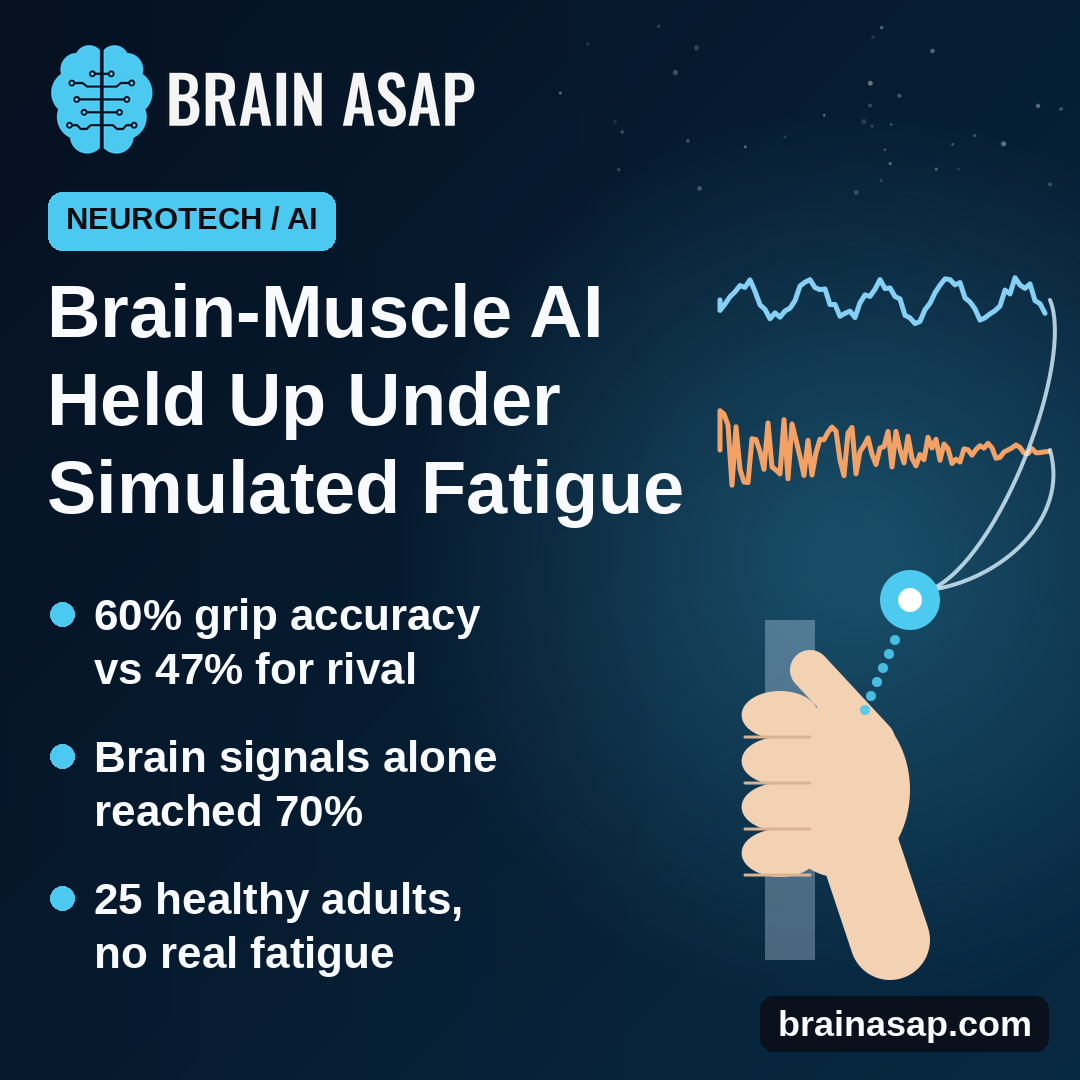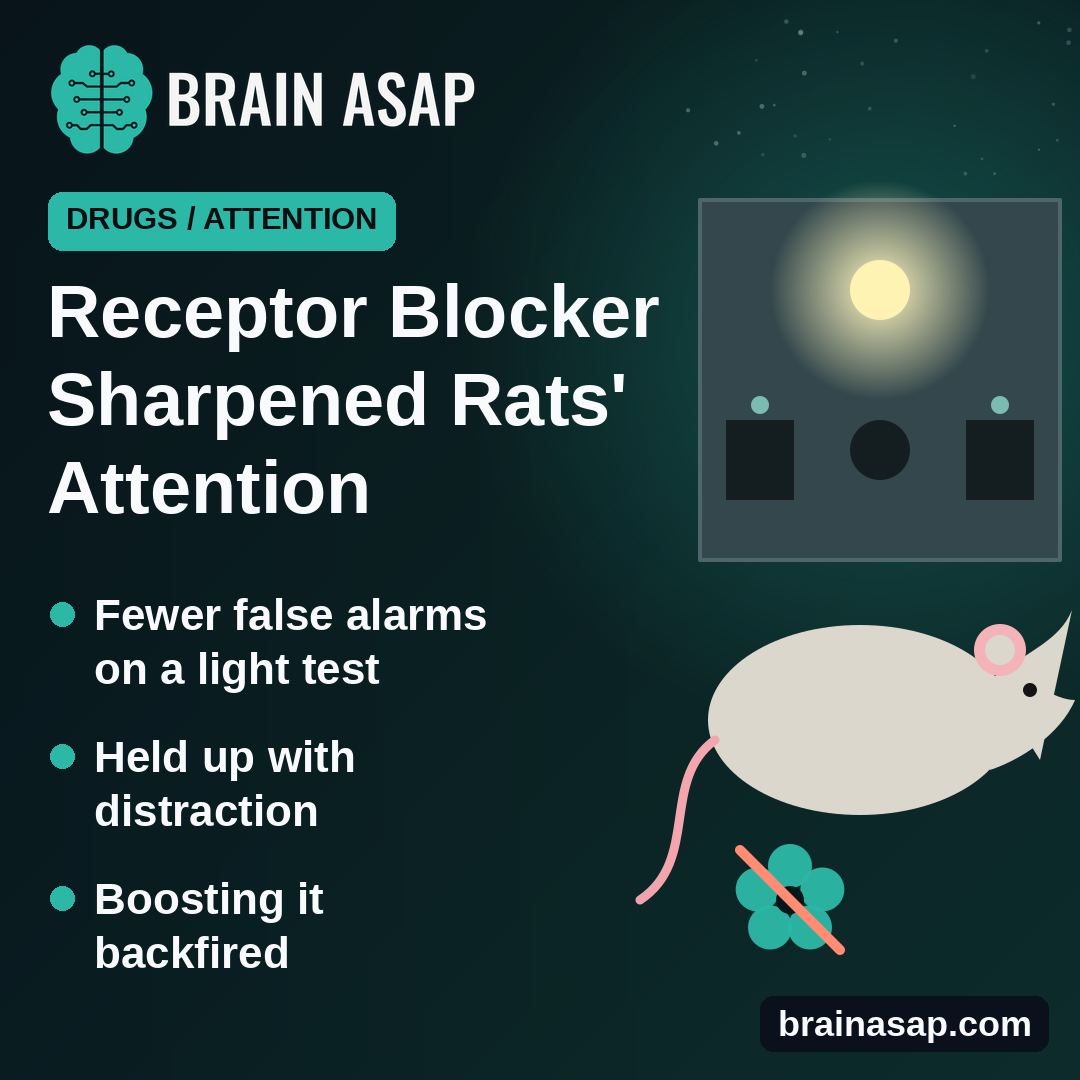
TL;DR: In rats trained to spot a brief flash of light, a drug that blocks one nicotine-type receptor (alpha-7) made them better at telling flash from no flash, even with distractions. Drugs that boosted the same receptor made them worse at high doses.
Key Findings
- Alpha-7 blocker helped: Moderate doses of MLA improved detection, mostly by fewer false alarms.
- Held up under distraction: Unlike every other drug tested.
- Galantamine helped only in quiet trials: The Alzheimer’s drug’s benefit vanished with a flashing distractor, and a high dose hurt.
- Boosting alpha-7 backfired at high doses: Rats reported the light less often.
- Broad nicotinic blocker hurt: High-dose mecamylamine made detection worse.
Source: Psychopharmacology (2026) | Robson, Matthews et al.
Many brain conditions, from Alzheimer’s to ADHD to schizophrenia, start with attention slipping. A brain chemical called acetylcholine helps us notice faint signals, and drug makers have long hoped that boosting one of its receptors, called alpha-7, would sharpen attention. Human trials have been disappointing.
A team at the University of Cambridge tried something closer to the opposite. In rats, they found that turning the alpha-7 receptor down helped more than turning it up.
A Flash-or-No-Flash Test for Rats
The researchers trained 64 rats (two groups of 32, half female) to start each trial by poking their nose into a port. Then a small light either flashed briefly or stayed off. The rats reported what they saw by choosing one of two food ports. A correct choice earned a sugar pellet.
Some flashes lasted just 0.03 seconds, so the task was hard. In half the blocks, the house light pulsed once per second as a distractor.
Each rat got every dose of each drug and a matching dummy injection, in balanced orders, with at least two drug-free days between tests. The main measure was sensitivity: how well a rat told a real flash apart from nothing, separate from any general habit of saying “yes” or “no.”
Blocking Alpha-7 Sharpened Detection
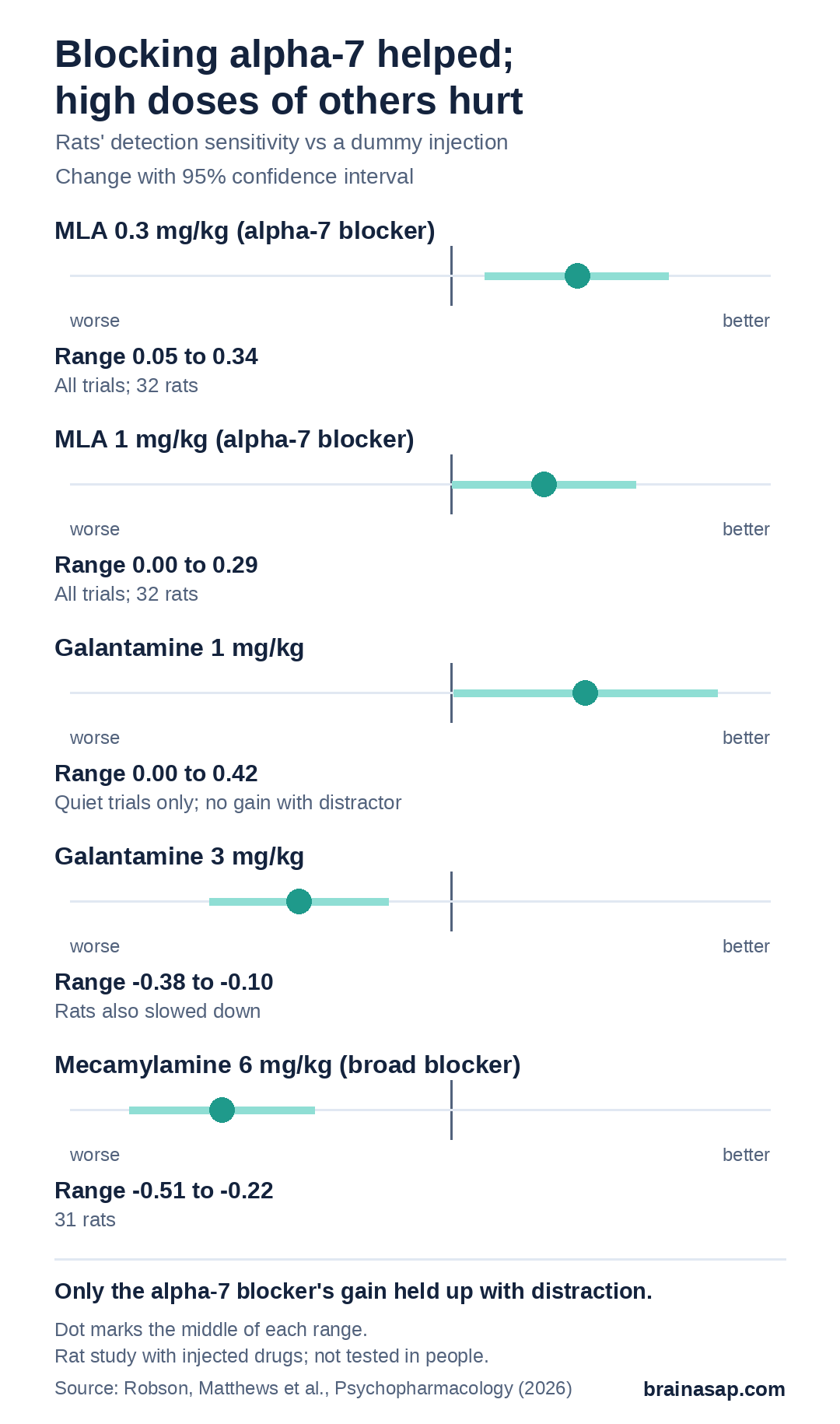
The drug MLA blocks alpha-7 receptors. At moderate doses (0.3 and 1 mg/kg), it raised sensitivity compared with the dummy injection.
- Fewer false alarms: Rats more often correctly said “no flash” when nothing appeared.
- Hit rate unchanged: They did not catch more of the real flashes.
- More cautious at 0.3 mg/kg: Rats leaned toward “no flash,” so strategy shifted along with perception.
- No slowing: Rats started trials and responded just as fast.
The gain held up fairly well when the distractor was on. At 0.3 mg/kg with distraction, the improvement fell just short of statistical significance, but there was no sign that the distractor wiped it out. No other drug in the study did that.
An Alzheimer’s Drug Helped Only When It Was Quiet
Galantamine, prescribed for mild to moderate Alzheimer’s, raises acetylcholine levels in general. At 1 mg/kg it improved sensitivity, but only on trials without the flashing distractor. At 3 mg/kg it made detection worse and slowed the rats down, so tiredness or lower motivation may explain part of that drop.
Turning Alpha-7 Up Backfired
Two drugs that strengthen alpha-7 signaling, CCMI and SSR-180,711, did not help at any dose. At their highest doses, rats caught fewer real flashes and became more reluctant to report a flash at all. SSR-180,711 at 10 mg/kg also lowered sensitivity on quiet trials.
For comparison, mecamylamine, which blocks nicotinic receptors broadly, cut sensitivity at its highest dose. The authors read this as a sign that nicotinic signaling overall is needed for detection, while alpha-7 activity in particular may work best within a narrow range.
Rats on Injections, Not People on Pills
- Rats, not humans: Findings come from trained rats on one visual task.
- Mechanism not measured: Researchers did not track receptor binding or acetylcholine release in the brain.
- Drug order not randomized: Doses within each drug were balanced, but drugs were tested in a practical sequence.
- CCMI tested twice in different mixtures: Second run used a new vehicle and higher doses.
- Industry ties: Study was partly funded by Boehringer Ingelheim, which supplied two compounds and employs one author.
Could Less Alpha-7 Mean Better Focus?
The study suggests that more acetylcholine signaling is not always better for attention, and that the right amount of alpha-7 activity may sit in a narrow window. That could help explain why alpha-7 boosters have struggled in human trials.
The authors suggest testing galantamine combined with a selective alpha-7 blocker. Whether that pairing would sharpen attention in people with Alzheimer’s or schizophrenia is an open question that only human studies can answer.
Citation: DOI: 10.1007/s00213-026-07169-7. Robson HJ, Matthews ARH, Wilod Versprille LJF, du Hoffmann J, Dalley JW. Modulatory effects of α7-nicotinic cholinergic receptors on perceptual sensitivity in a visual signal detection task. Psychopharmacology. 2026.
Study Design: Within-subject drug studies in trained rats; balanced dose orders; signal detection model at the trial level.
Sample Size: Two cohorts of 32 Sprague-Dawley rats (16 female each); 31 analyzed in cohort one.
Key Statistic: MLA 0.3 mg/kg raised sensitivity versus vehicle (95% CI 0.05 to 0.34).
Caveat: Animal study; systemic injections; drug order not randomized; partly industry funded.