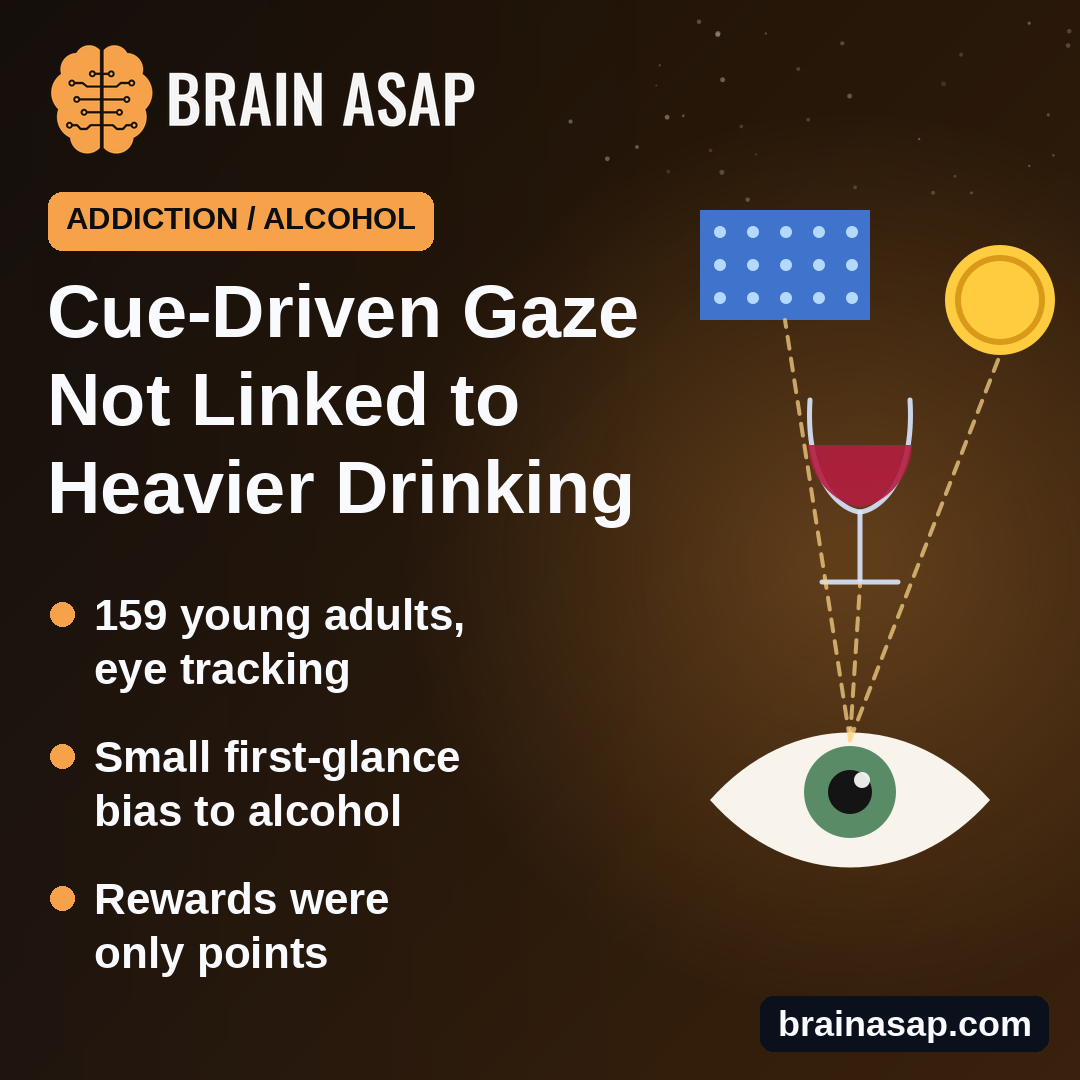
TL;DR: In 159 young adults, people whose eyes were drawn to reward cues rather than to the rewards themselves glanced first at alcohol images slightly more often than one comparison group, but not the other. They did not drink more, contrary to an earlier study.
Key Findings
- 159 volunteers aged 18 to 35: All at least occasional drinkers.
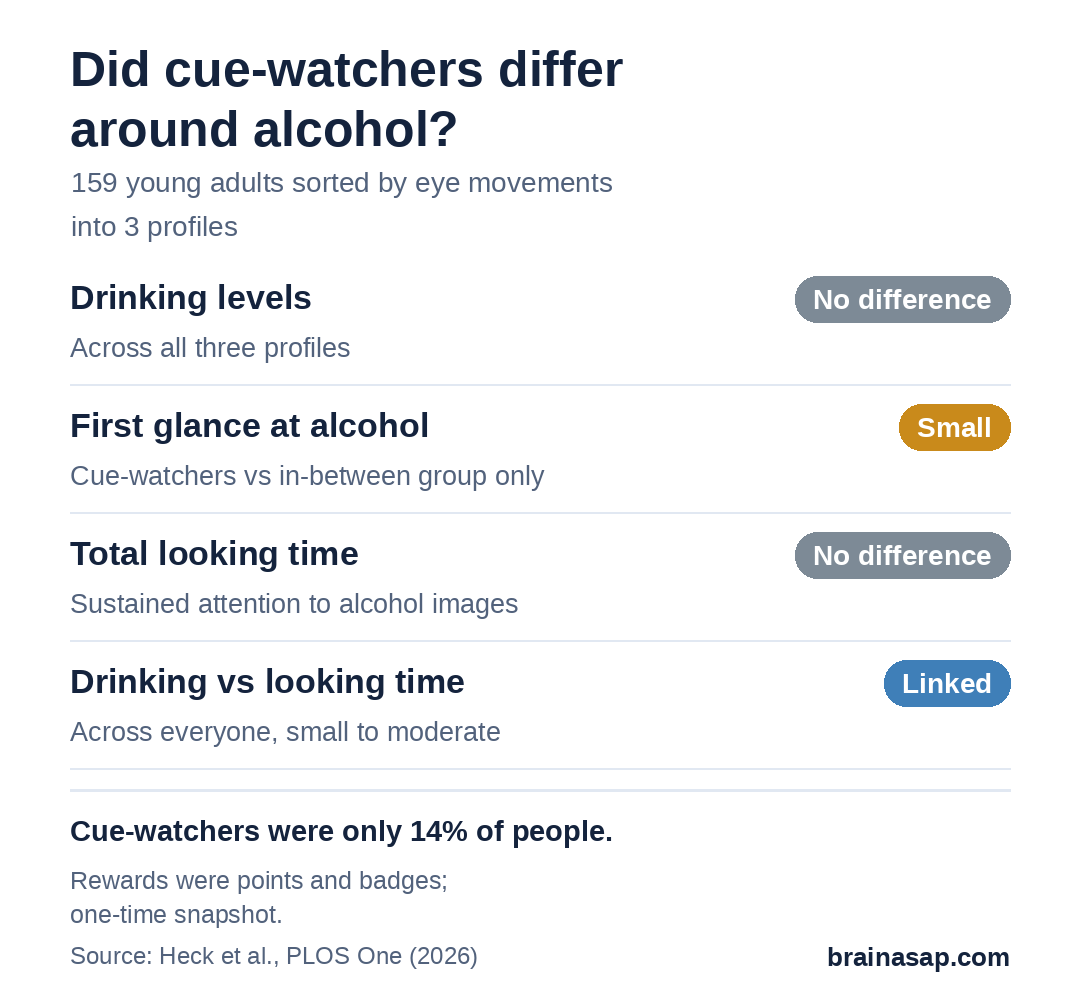
- Only 14% were cue-watchers: 57% watched the reward spot, and 29% were in between.
- Small first-glance difference: Cue-watchers looked first at alcohol slightly more than the in-between group.
- No drinking difference between the groups.
- Total looking time at alcohol did not differ either.
Source: PLOS One (2026) | Heck et al.
The click of a lighter, the pop of a cork, a phone buzz: cues that signal a reward can become rewarding themselves. In rats, some animals fixate on the cue, a lever that lights up before food arrives, while others head straight to the food tray. The cue-fixated rats, called sign-trackers, are more prone to addiction-like behavior.
Researchers at the University of Liège in Belgium tested whether the same split shows up in people’s eye movements, and whether it relates to how people look at and drink alcohol.
Watching the Signal or the Reward
Volunteers watched a screen where a patterned blue rectangle (the cue) appeared before a casino-style coin worth points appeared at a separate spot (the goal). An eye tracker recorded where they looked while waiting. Based on their gaze, a statistical method sorted people into three profiles:
- Cue-watchers (sign-trackers): Looked mostly at the cue. 14% of people.
- Reward-watchers (goal-trackers): Looked mostly where the coin would appear. 57%.
- In-between: A mix of both. 29%.
Participants then viewed pairs of alcohol and neutral pictures freely, and filled in questionnaires about their drinking. The study’s analyses were preregistered.
Cue-Watchers Glanced at Alcohol Slightly More
The researchers measured how often each person’s first glance landed on the alcohol picture. The three profiles differed, but the effect was small, and the difference came mainly from cue-watchers vs the in-between group. Cue-watchers and reward-watchers did not differ significantly.
Total time spent looking at alcohol pictures, a measure of sustained attention, did not differ between profiles.
No Link to How Much People Drank
An earlier study had found that human cue-watchers drank more. This one did not replicate that: drinking scores did not differ significantly across profiles. Across everyone, though, people who drank more did spend somewhat more time looking at alcohol pictures, a small-to-moderate link that held after correction.
A side experiment with 138 more people used a lever on screen that participants could “press” with their gaze, closer to the rat setup. Its results were inconclusive and appear only in the supplement.
Points and Badges Are Weak Rewards
- Fake rewards: Points and badges may not motivate people the way food motivates hungry rats.
- Few cue-watchers: 14% of 159 is a small group to compare.
- Uncertain profiles: Some people’s profile assignment was shaky, and the authors kept three profiles partly to match earlier work.
- One-time snapshot: Cannot predict who will develop drinking problems.
Does Human Sign-Tracking Need Stronger Rewards?
The authors suggest the weak results may reflect the task more than the idea. The test is whether a version with real, tangible rewards and more engaging cues can reliably identify cue-watchers, and whether those people go on to drink more over time.
Citation: DOI: 10.1371/journal.pone.0358192. Heck M, Lesenfants D, Didone V, Anselme P, Quertemont E. Human sign-tracking and its relationship with attentional biases for alcohol. PLoS One. 2026;21(9):e0358192.
Study Design: Preregistered cross-sectional eye-tracking study with latent profile analysis; side experiment in supplement.
Sample Size: 159 healthy volunteers aged 18 to 35 (side experiment n = 138).
Key Statistic: Initial alcohol orienting group effect χ²(2) = 7.24, p = 0.02, η²(H) = 0.03; AUDIT-C across profiles p = 0.11.
Caveat: Fictitious rewards, small sign-tracker group, uncertain profile membership.