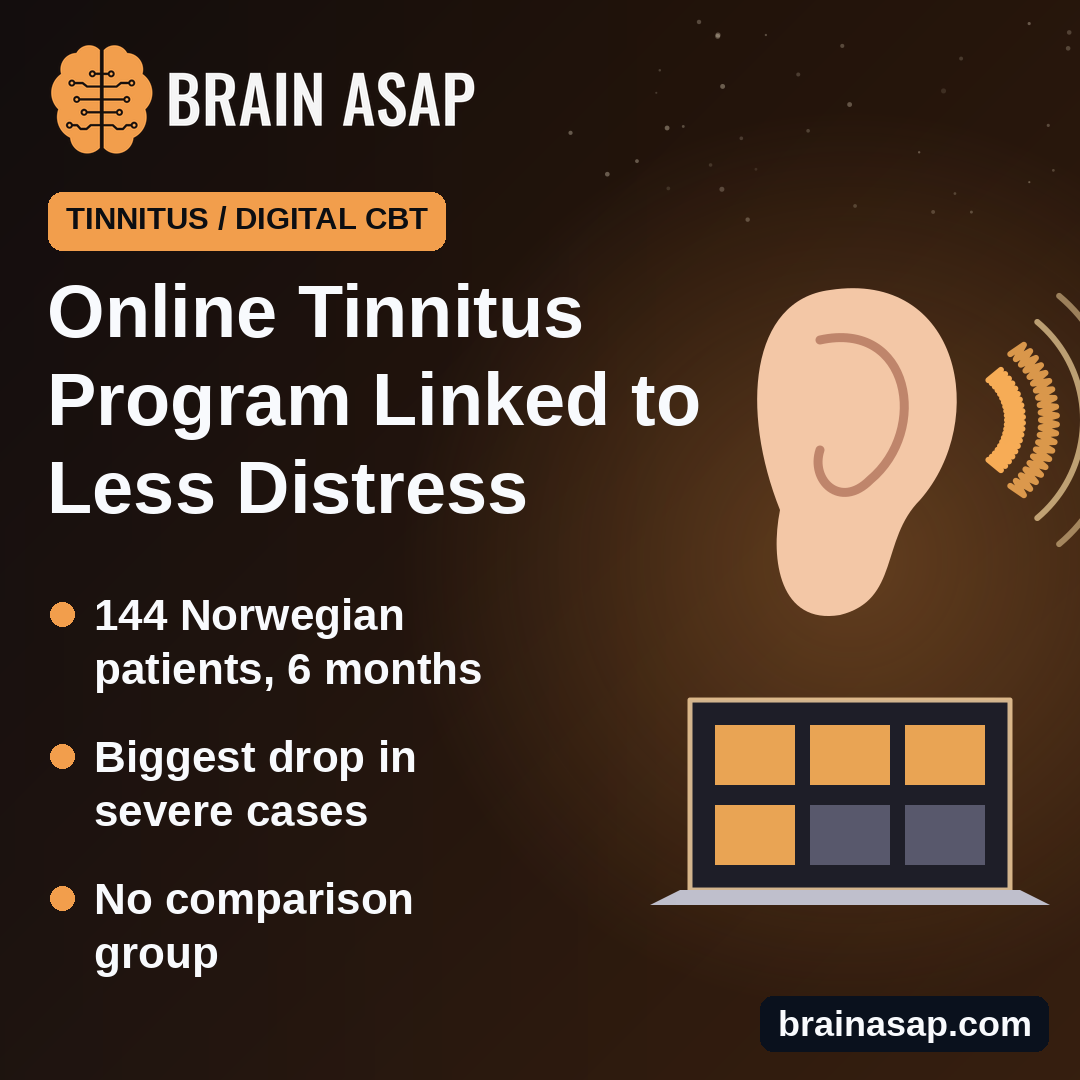
TL;DR: In 144 Norwegian tinnitus patients, an online program of retraining therapy and CBT was linked to less tinnitus distress after 6 months, most in severe cases. With no comparison group, the program can’t take full credit.
Key Findings
- 144 patients: A 6-hour seminar, then 19 online modules over up to a year.
- Distress score fell: From 47 to 40 out of 100 on average after 6 months.
- Severe cases dropped most: From 73 to 55.
- Mild cases barely moved: From 27 to 26.
- Small gains elsewhere: Anxiety, depression and sound sensitivity eased a little; reactions to trigger sounds (misophonia) did not.
Source: Frontiers in Psychiatry (2026) | Dalseng et al.
Tinnitus, a ringing, hissing or buzzing sound with no outside source, affects 10% to 15% of people. For some it is a background nuisance; for others it disrupts sleep, focus and mood. Effective therapy exists, but there are not enough trained therapists, especially in rural areas.
A hospital in Molde, Norway, offered patients a self-guided online program instead, and researchers at the Norwegian University of Science and Technology tracked how they did.
A Seminar, Then 19 Online Modules
Patients referred by their doctors were first examined by an ear, nose and throat specialist. Treatment had two parts:
- Introductory seminar: 6 hours, in person or online, explaining how tinnitus works.
- Online program: 7 modules of tinnitus retraining therapy, which teaches people to tune out the sound and use background sound, followed by 12 modules of cognitive behavioral therapy (CBT), which works on unhelpful thoughts and reactions. Patients had access for a year.
Patients filled in questionnaires before starting and after 90 and 180 days. The main measure was the Tinnitus Handicap Inventory, a 0-to-100 score of how much tinnitus disrupts daily life. The team split patients by starting score into mild (47 people), moderate (59) and severe (38).
Distress Fell Most in Severe Tinnitus
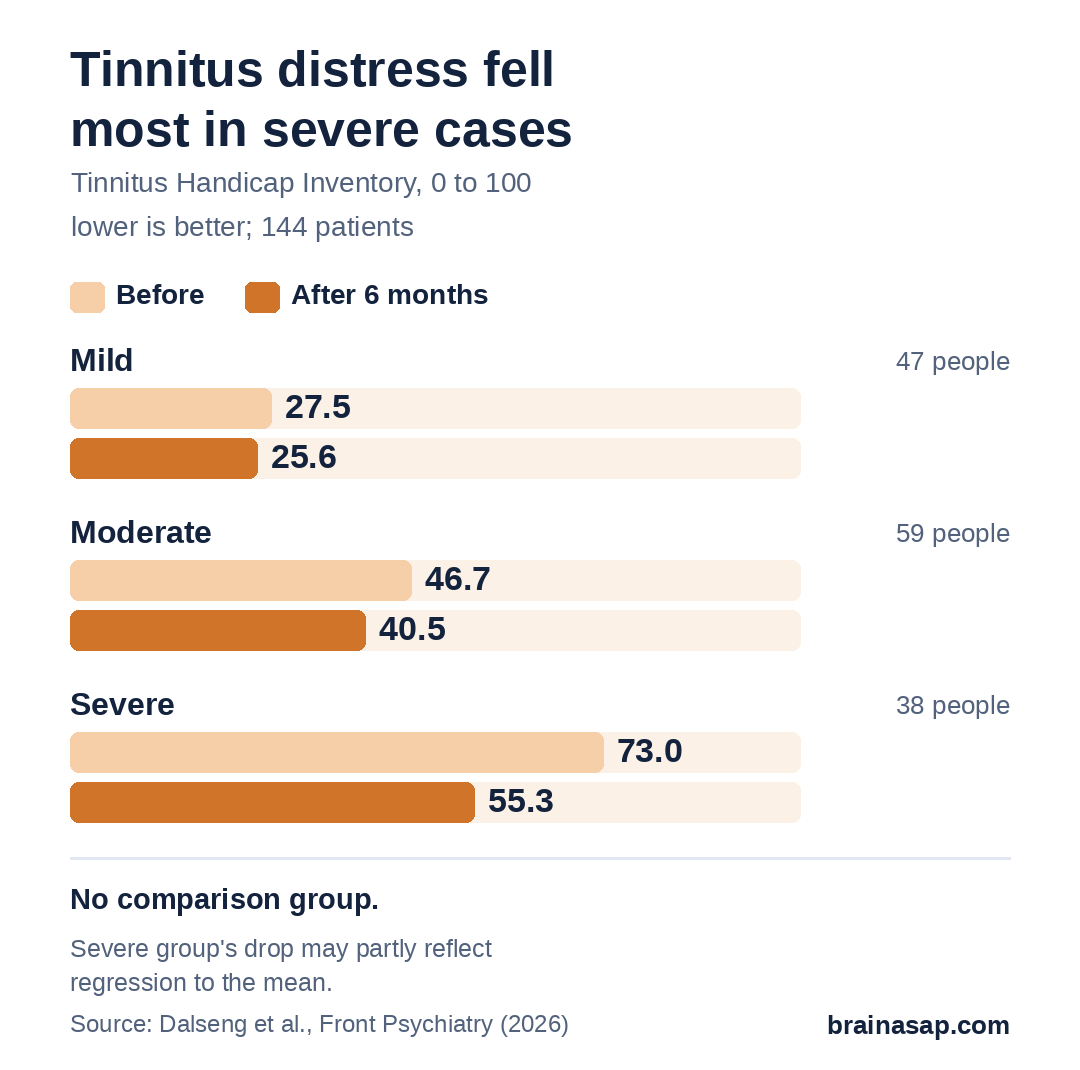
Across everyone, the average distress score fell from 47.4 to 39.5, a small-to-medium change. The severe group dropped by about 18 points, a large change. The moderate group improved by about 6 points, and the mild group by about 2.
Anxiety, depression and sensitivity to everyday sounds improved slightly. Strong emotional reactions to specific sounds, called misophonia, did not change.
Why the Severe Group’s Drop Needs Caution
When people are selected because their scores are very high, their scores tend to come down on later tests even without treatment, a pattern called regression to the mean. The authors note this may explain part of the severe group’s improvement. Without an untreated comparison group, there is no way to separate it out.
Many Patients Missing From the Final Picture
- No control group: Natural improvement over time can’t be ruled out.
- Heavy dropout: Of 294 patients who agreed, 121 lacked early questionnaires and 29 had very mild tinnitus.
- Gaps at 6 months: 46 of 144 (32%) were missing and estimated statistically.
- Use not tracked: Nobody recorded how many modules patients completed.
- Extra help for some: A few patients had optional support sessions.
A Low-Cost Option Worth a Proper Trial
For a hospital with limited therapists, an online program that patients can work through at home is appealing, and the results suggest it may help people whose tinnitus troubles them most. A randomized trial with a waiting-list or usual-care group is needed to show how much of the improvement comes from the program itself.
Citation: DOI: 10.3389/fpsyt.2026.1868527. Dalseng KS, Liavåg N, Sunde DL, Solem S. Digital treatment for tinnitus combining tinnitus retraining therapy and cognitive behavioral therapy: a Norwegian naturalistic study. Front Psychiatry. 2026;17:1868527.
Study Design: Single-arm prospective observational (naturalistic) study without a control group.
Sample Size: 144 patients (47 mild, 59 moderate, 38 severe+).
Key Statistic: THI 47.35 to 39.52 at 180 days (d = 0.41); severe+ 72.95 to 55.32 (d = 0.95).
Caveat: Uncontrolled; 32% missing 180-day data imputed; adherence not tracked; regression to the mean.