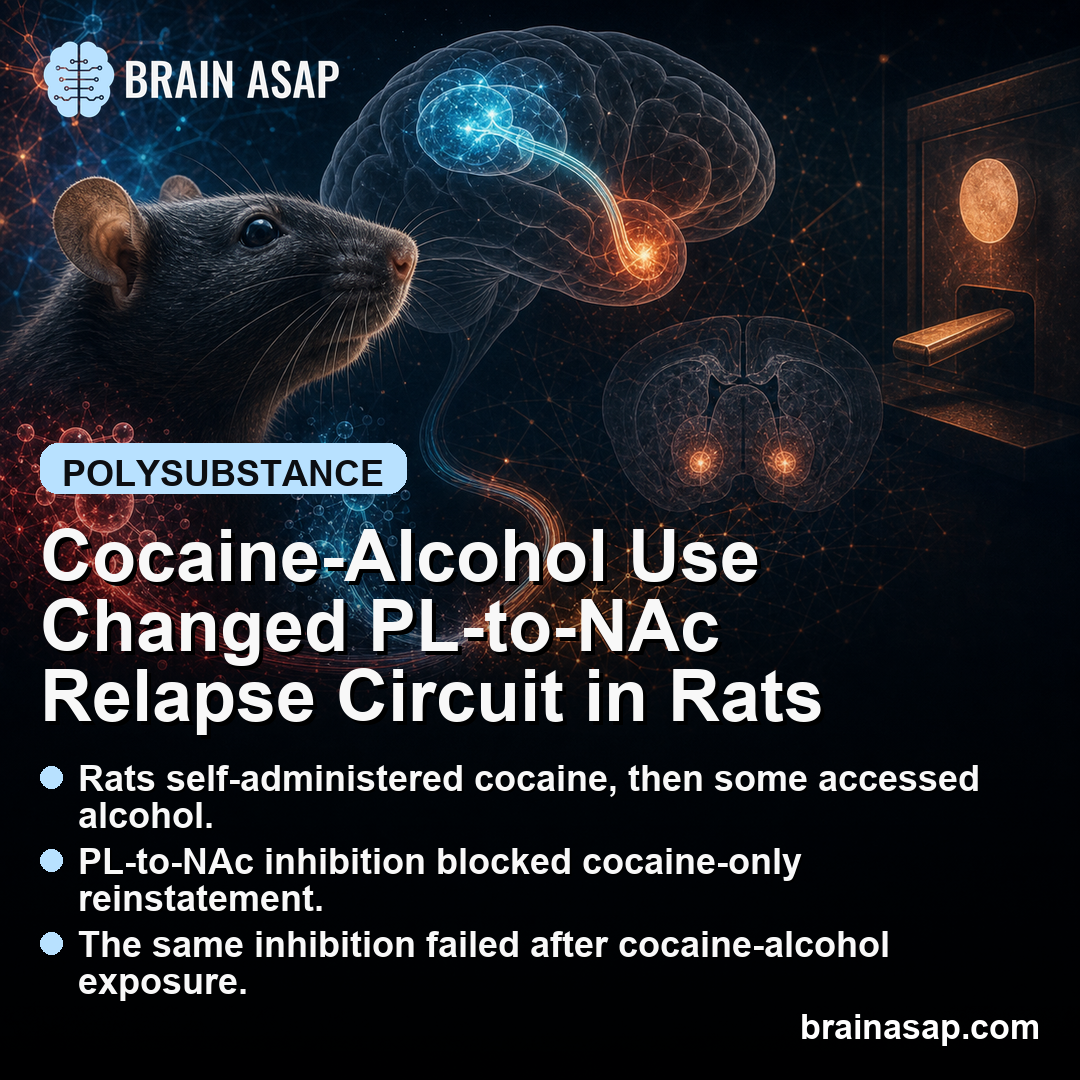
TL;DR: A 2026 rat study in Neuropsychopharmacology found that chemogenetically inhibiting a prelimbic cortex to nucleus accumbens core pathway blocked cue-triggered cocaine seeking after cocaine alone, but did not block relapse-like behavior after sequential cocaine and alcohol use.
Key Findings
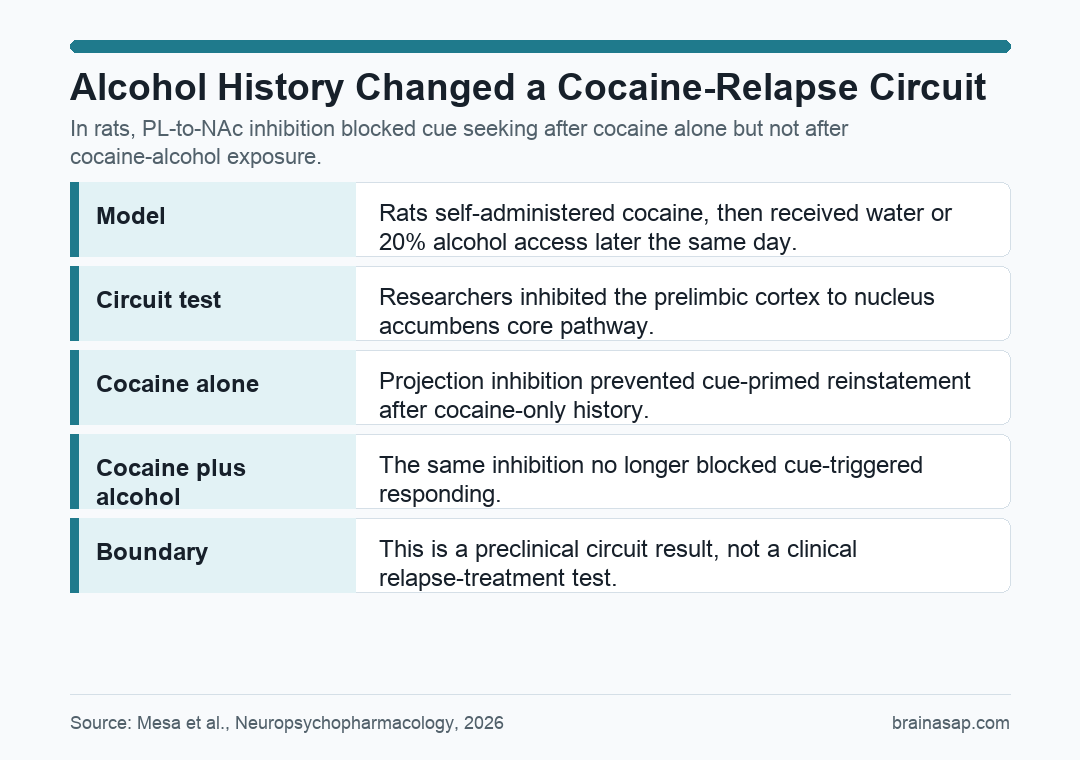
- The model tested sequential polysubstance use: rats self-administered cocaine, then some received access to 20% alcohol later the same day.
- PL-to-NAc inhibition worked after cocaine alone: inhibiting the projection prevented cue-primed reinstatement in the cocaine-only condition.
- The same inhibition failed after cocaine-alcohol exposure: rats with alcohol access still increased active lever pressing during cue testing.
- Stimulation was not enough to drive the behavior: activating the projection did not increase cue-primed cocaine seeking or cocaine-induced locomotion.
- The work is preclinical: the findings are about relapse circuitry in rats, not a direct treatment test in people.
Source: Neuropsychopharmacology (2026) | Mesa et al.
A new rat study suggests that a brain circuit involved in cue-triggered cocaine seeking behaves differently after cocaine-alcohol polysubstance use than it does after cocaine alone.
The circuit was a projection from the prelimbic cortex to the nucleus accumbens core, often shortened to PL-to-NAc.
In cocaine-only rats, inhibiting this projection blocked reinstatement of cocaine seeking after drug cues.
In rats that had access to alcohol after cocaine sessions, the same inhibition no longer blocked cue-triggered responding.
Central result: alcohol exposure did not make relapse inevitable.
The study showed that a circuit manipulation that worked in a cocaine-only model failed in a sequential cocaine-alcohol model, the kind of difference addiction studies can miss when they test one substance in isolation.
Rats Modeled Cocaine Use Followed by Alcohol Access
The study used a sequential model rather than giving both drugs at the same time.
Rats first learned to self-administer cocaine during daily sessions.
After those cocaine sessions, some animals received access to water only, while others received a two-bottle choice that included 20% alcohol.
This design is important because cocaine and alcohol co-use is common in human substance use, but many preclinical relapse studies isolate cocaine.
Researchers wanted to know whether adding alcohol history would change the role of PL-to-NAc signaling during later cue-triggered cocaine seeking.
The behavioral sequence was straightforward:
- Cocaine self-administration: rats pressed for intravenous cocaine at 1 mg/kg per infusion.
- Post-session liquid access: rats received either water alone or water plus 20% alcohol.
- Extinction: lever pressing declined when cocaine and cues were no longer reinforced.
- Cue-primed reinstatement: cocaine-associated cues were presented again after chemogenetic manipulation.
The full study included 84 Sprague Dawley rats, most of them male.
Group sizes were smaller by the final reinstatement tests, which is typical for multi-stage surgical and behavioral experiments but still important when reading the results.
Inhibition Blocked Cue Relapse Only After Cocaine Alone
The first experiment used inhibitory DREADDs to reduce activity in the PL-to-NAc projection before the reinstatement test.
DREADDs are engineered receptors that let researchers turn selected neurons up or down with a drug-like ligand.
In this case, the goal was to test whether silencing that projection would reduce cue-primed cocaine seeking.
In the cocaine-only condition, it did.
Rats with the inhibitory manipulation did not show the same increase in active lever pressing during cue testing.
That fits earlier work showing that prelimbic cortical output to the nucleus accumbens core can support relapse-like cocaine seeking.
In the cocaine-alcohol condition, the result changed.
Rats with alcohol access still increased active lever pressing during the cue test even when the PL-to-NAc projection was inhibited.
The study reported a significant Liquid x AAV x Time interaction, and the post-hoc pattern showed cue-induced responding in the cocaine-alcohol inhibited group but not in the cocaine-only inhibited group.
The most helpful way to say it is narrow and concrete: PL-to-NAc inhibition was sufficient to block cue-triggered cocaine seeking after cocaine alone, but not after cocaine plus alcohol access.
Alcohol History Also Changed Extinction Behavior
The alcohol-access animals differed before the final cue test.
During extinction, rats in the cocaine-alcohol condition pressed the active lever more than cocaine-only rats.
That suggests the added alcohol history changed the behavioral state of the animals, not just the circuit response during the final test.
The cocaine-alcohol history changed interpretation at three levels:
- Behavior before cues: active-lever pressing stayed higher during extinction.
- Manipulation result: PL-to-NAc inhibition reached the target but no longer blocked cue responding.
- Model implication: polysubstance history may recruit relapse circuitry beyond the PL-to-NAc pathway.
The study also confirmed that the inhibitory manipulation reduced activity in the targeted prelimbic neurons.
PL c-Fos was lower after CNO in both the water and alcohol conditions, which helps interpret the negative behavioral result.
The manipulation reached the target, but the behavior was no longer blocked in the alcohol-history group.
The failed inhibition result is more informative than a simple technical failure.
The data are more consistent with cocaine-alcohol exposure recruiting additional or alternative relapse circuitry, so silencing one known cocaine-relapse pathway was no longer enough.
Stimulating PL-to-NAc Neurons Did Not Increase Cocaine Seeking
The second experiment asked the opposite question. If inhibiting PL-to-NAc can reduce cocaine seeking after cocaine alone, would stimulating the same projection increase cue-triggered reinstatement or cocaine-induced locomotion?
Stimulation did not drive the behavior.
Excitatory DREADD stimulation increased c-Fos in targeted prelimbic neurons, showing that the manipulation had a biological effect.
But it did not increase cue-primed cocaine seeking, and it did not increase cocaine-induced locomotion.
This is an important asymmetry. A pathway can be necessary for a behavior under one condition without being sufficient to drive that behavior when stimulated.
Addiction circuits are not simple on/off switches. Behavior depends on drug history, cue context, extinction state, downstream networks, and the timing of neural activity.
Polysubstance Relapse May Need Different Circuit Models
The study’s broader value is that it puts polysubstance history into the relapse-circuit question.
Many people who use cocaine also use alcohol, and cocaine plus alcohol can produce cocaethylene, a metabolite with its own pharmacological profile.
Even without reducing the result to one metabolite, the study shows that alcohol history can change what a circuit manipulation does.
Researchers connect the finding to prior evidence that cocaine-alcohol co-use increases basolateral amygdala activation during cue-primed reinstatement.
That points toward a more distributed relapse network in polysubstance models.
If the behavior is being supported by additional amygdala-related or accumbens-related routes, PL-to-NAc inhibition alone may not be enough.
One practical consequence is that circuit results from single-drug studies should be checked against co-use models.
In this study, alcohol access did not simply add another substance to the schedule; it changed which manipulation predicted cue-driven behavior.
That is a important warning for preclinical screening, because real-world substance use histories often include more than one drug.
The main translation caution is direct.
This was a rat study using self-administration, extinction, chemogenetics, and reinstatement tests.
Those tools are helpful for mechanism, but they are not the same as human relapse, treatment response, or clinical outcomes.
Still, the finding is practical for research design.
A treatment idea or circuit target that looks strong in cocaine-only animals may not behave the same way after cocaine-alcohol exposure.
That means polysubstance history should be treated as a core feature of addiction biology, not as background noise.
Citation: DOI: 10.1038/s41386-025-02198-w. Mesa et al. The role of the prelimbic cortex to nucleus accumbens core projection in the reinstatement of cocaine-seeking after cocaine-alcohol polysubstance use. Neuropsychopharmacology. 2026;51:769-777.
Study Design: Rat cocaine self-administration, post-session water or alcohol access, extinction, cue-primed reinstatement, and chemogenetic inhibition or stimulation of prelimbic cortex neurons projecting to the nucleus accumbens core.
Sample Size: 84 Sprague Dawley rats entered the study across two experiments; final reinstatement group sizes were smaller after viral targeting and behavioral exclusions.
Key Statistic: In the inhibitory experiment, active lever pressing increased from extinction to test in cocaine-only control rats and cocaine-alcohol rats, but not in cocaine-only rats with PL-to-NAc inhibition.
Caveat: Rat self-administration and chemogenetic data; polysubstance relapse circuitry may differ in human clinical settings.