TL;DR: A 2026 study in PNAS found that across convention-learning experiments, people explored uncertain options at first, then committed once enough evidence crossed a Tolerance Principle threshold rather than simply copying others or optimizing probabilities.
Key Findings
- Two-stage learning fit behavior: Participants behaved probabilistically while uncertain, then shifted into stable choices once accumulated evidence crossed a mental threshold.
- Imitation performed poorly: Human choices deviated from models that simply copied the most recent observed behavior.
- Optimization also missed: Bayesian and other optimization models did not reproduce the human learning pattern as well as the threshold model.
- Tolerance Principle generalized: A parameter-free equation originally used for language learning predicted social convention adoption.
- Dissent tipping points became modelable: The model also helped estimate how a critical mass of dissenters can overturn an established convention.
Source: Proceedings of the National Academy of Sciences (2026) | Guilbeault et al.
Social conventions can look mysterious from the outside.
A group somehow settles on a name, a norm, a workplace habit, or a shared readout without anyone issuing a law.
A PNAS paper argues that people may solve this problem with a surprisingly simple rule: sample options first, then commit when the pattern becomes regular enough.
People Sampled Before They Settled
The study challenges two familiar explanations for social learning. Study details:
One says people imitate the behavior they just saw. Another says they behave like careful statistical optimizers, constantly choosing the option that looks most probable.
The experimental data fit neither explanation cleanly.
Participants in coordination networks explored different behaviors while uncertain, then shifted into stable choices after enough evidence accumulated.
That appears less like copying and more like a thresholded rule-learning process.
The distinction changes how social norms are interpreted. If people copied, the most recent visible behavior would dominate. If people optimized continuously, choices would change smoothly as probabilities changed.
The reported pattern was more categorical: a noisy exploration phase followed by a commitment phase.
That shift helps explain why a convention can feel unstable for a while and then suddenly feel obvious.
A Grammar Rule Crossed Into Social Norms
The model used the Tolerance Principle, a mathematical rule developed to explain how children learn grammar.
A child can learn that many English past-tense verbs take “-ed” while still tolerating exceptions such as “went.” The rule asks when a pattern is common enough for the mind to treat it as a rule despite exceptions.
The paper’s twist is that the same kind of threshold worked in adults learning nonlinguistic conventions. A pattern did not need to be perfect to become rule-like.
It needed to be regular enough that exceptions no longer prevented commitment. The helpful pieces of the model were straightforward:
That gives the paper a cognitive bridge from language learning to social behavior.
The same mental habit that lets a child learn a rule with exceptions may help adults decide when a social pattern has become stable enough to follow.
Coordination Tasks Made Convention Formation Observable
The researchers compared computational models against data from coordination experiments, including earlier datasets and new experiments.
Participants interacted in social networks and had to align on shared choices, such as agreeing on a name for an unfamiliar face.
Those tasks are deliberately stripped down.
They remove many real-world complications so the learning process can be observed: what options people see, how choices change over time, and when behavior stabilizes.
Small rewards for matching others gave participants a reason to coordinate without dictating which convention they should choose.
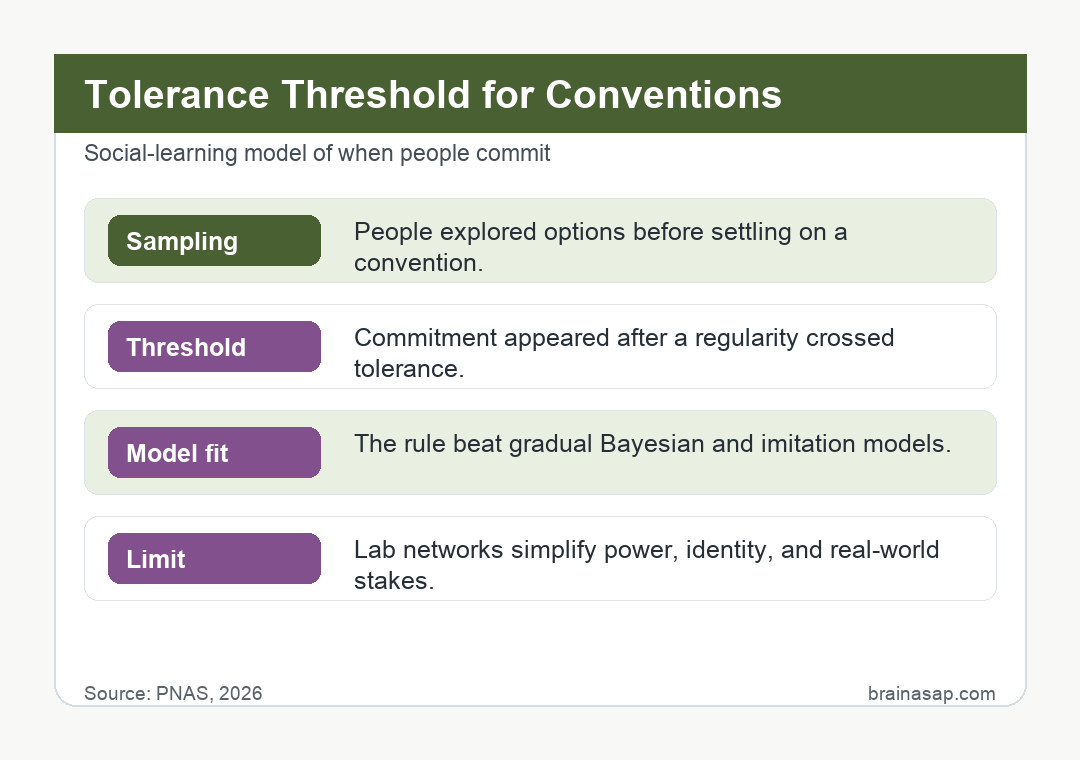
The threshold model performed better than imitation, optimization, and Bayesian alternatives at reproducing the human learning pattern.
People do not need to consciously calculate the equation for the model to be informative.
Their behavior followed the shape the equation predicted.
That is often how cognitive models work: they describe the structure of a decision, not the words a person says to themselves while deciding.
A participant may experience the shift as a hunch that one option has become the normal one.
Bayesian Models Were Too Gradual for Human Commitment
Bayesian models can update beliefs gradually as evidence arrives. They are powerful for many learning problems, but the convention data had a sharper shift.
People behaved probabilistically, then clicked into a stable convention. Social change often feels discontinuous for the same reason.
A norm can look unsettled while people are still sampling, then suddenly look obvious once enough people have crossed the commitment threshold.
The paper gives that intuition a formal mechanism.
The result also explains why exceptions do not always break a convention.
If a person has already seen enough consistency, one or two conflicting examples may be treated as noise rather than evidence that the rule has collapsed.
Dissent Became a Mathematical test
The model also offers a way to think about how conventions flip.
If commitment depends on a tolerance threshold, then a dissenting minority must become large, visible, or consistent enough to make the old pattern stop looking rule-like.
That has relevance for public health messaging, organizational culture, technology adoption, and political behavior.
A new norm may fail because it is unpopular, but it can also fail because people have not yet seen enough reliable evidence that others are adopting it.
The paper leaves those messy systems for later work.
It still gives social-change research a more concrete cognitive starting point than “people imitate” or “people optimize.” It suggests that the mind waits for enough regularity, then treats the social pattern as a rule.
That idea also clarifies why persuasion alone may fail.
If people have not seen enough consistent examples of the new convention, the message may sound reasonable without crossing the threshold needed for commitment.
The reverse is also possible.
A convention can remain sticky even after people encounter exceptions because the old pattern still exceeds the tolerance threshold.
That helps explain why norms can outlast the first signs of change.
Controlled Networks Leave Out Power and Identity
The experiments were controlled coordination tasks, not full societies.
Real conventions are shaped by identity, hierarchy, punishment, prestige, incentives, institutions, and unequal risk.
A worker deciding whether to challenge a workplace norm is not in the same position as a participant naming an unfamiliar face for a small reward.
The limitation defines where the result should be used.
The threshold model explains how a mind can tolerate noise and still form a rule, but real-world norm change also depends on who carries the risk of deviating first.
The central scientific contribution is specific: social conventions may stabilize because many individuals are doing a similar evidence-threshold calculation at once.
Once enough minds decide the pattern is regular enough, a convention can start to look natural even though it was learned through noisy social sampling.
The next research problem is whether the same threshold shifts under pressure.
Prestige, punishment, group identity, and personal risk may raise or lower the amount of evidence a person needs before treating a behavior as the new rule.
Those forces are exactly what controlled coordination tasks are built to simplify away.
The threshold model still needs to explain several real-world complications:
- Sampling phase: People explore options while the convention is still uncertain.
- Commitment point: Choices stabilize once the pattern becomes regular enough.
- Exception tolerance: A rule can survive scattered exceptions without collapsing.
- Imitation was not enough: Simple copying did not match the experimental pattern.
- Constant optimization was not enough: Participants did not behave like perfectly updating statisticians.
- Threshold learning fit better: The model captured the shift from exploration to stable convention.
Citation: DOI: 10.1073/pnas.2508061123. Guilbeault et al. A simple threshold captures the social learning of conventions. Proceedings of the National Academy of Sciences. 2026
Study Design: Computational modeling and human coordination experiments, including a preregistered dyadic experiment on noisy nonlinguistic pattern learning.
Sample/Model: Multiple social-network coordination experiments and a preregistered dyadic experiment.
Key Statistic: Threshold-based agents using the Tolerance Principle better reproduced human social learning than imitation, optimization, or Bayesian inference models.
Caveat: Single-study evidence; interpret with the source design and sample.