TL;DR: A 2025 study in Nutrients found that a systematic review of adolescent diet and mental health found the clearest readout for whole dietary patterns, while single nutrients and supplement-style interventions looked less consistent.
Key Findings
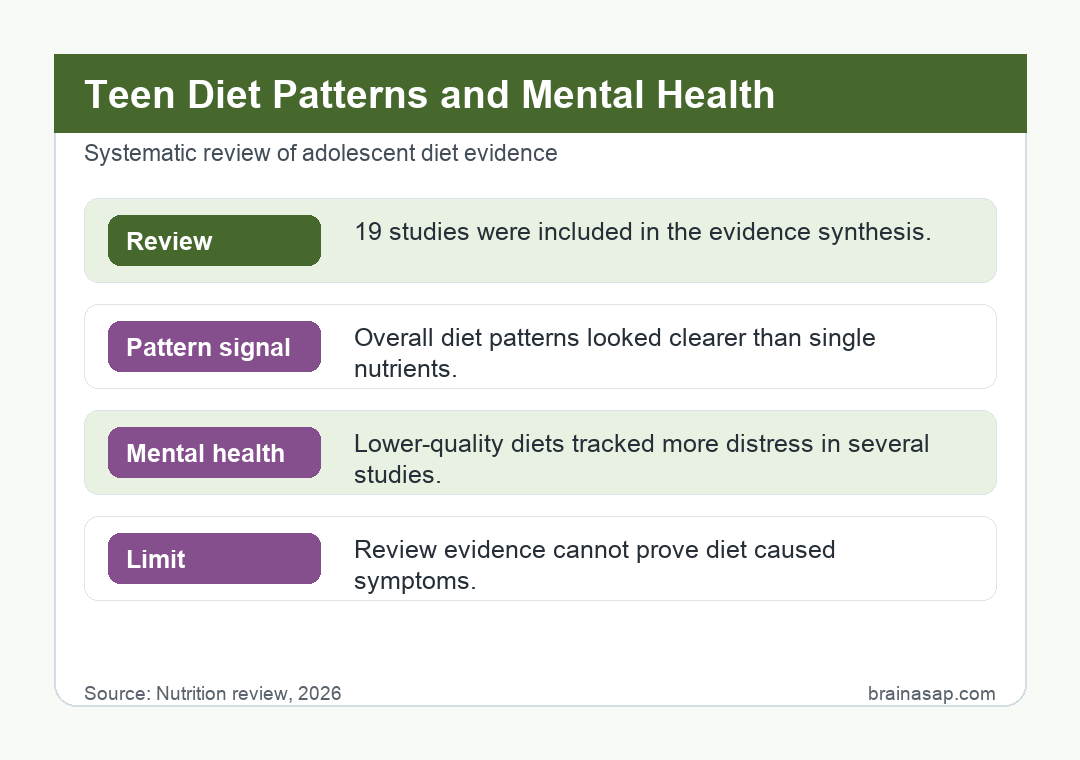
- 19 studies reviewed: The review covered six randomized controlled trials and 13 prospective cohort studies.
- Diet patterns looked clearer: Healthier overall diets were more consistently linked to fewer depressive symptoms and better mental health outcomes.
- Low-quality diets tracked distress: Poorer eating patterns more often went with higher psychological distress.
- Vitamin D stayed mixed: Some single-nutrient findings, including vitamin D readouts, were inconsistent rather than decisive.
- Better trials are still needed: The source emphasized adolescent-specific evidence rather than universal diet prescriptions.
Source: Nutrients (2025) | Tucker et al.
Teen mental health is often discussed through screens, school pressure, sleep, family stress, and therapy access.
Adolescent diet adds a quieter variable: the everyday food pattern that develops while the brain, gut, endocrine system, and social routines are still changing.
The Review Tested Diet Patterns, Not Specific Nutrients
The strongest part of the review is its refusal to turn adolescent mental health into a single-nutrient story.
Study details:
- 19 studies reviewed: The review covered six randomized controlled trials and 13 prospective cohort studies
- Diet patterns looked clearer: Healthier overall diets were more consistently linked to fewer depressive symptoms and better mental health outcomes
- Low-quality diets tracked distress: Poorer eating patterns more often went with higher psychological distress
- Vitamin D stayed mixed: Some single-nutrient findings, including vitamin D readouts, were inconsistent rather than decisive
Teenagers do not eat vitamin D, omega-3, fiber, sugar, and protein in isolation; they eat meals, snacks, school lunches, family defaults, convenience foods, and weekend patterns.
That is why the pattern-level readout is more biologically believable than a supplement headline.
A healthier dietary pattern can change several inputs at once: glycemic swings, micronutrient sufficiency, gut microbial substrates, inflammation, sleep stability, and energy availability.
It also matches how symptoms accumulate. Mood can be pushed around by afternoon crashes, irregular meals, gastrointestinal discomfort, poor sleep, and the stress of trying to manage school on unstable energy.
A single supplement may help if a teenager is deficient, but it cannot recreate the physiology of a better overall diet.
The review’s main readout therefore fits how food actually reaches the brain: through repeated exposures, not one isolated ingredient.
- Pattern exposure: meals and snacks repeatedly shape glucose, sleep, energy, and gut-brain signaling.
- Single-nutrient limit: supplements can matter in deficiency states but rarely capture total diet quality.
- Adolescent context: food access, family routines, school schedules, and distress can move together.
6 Trials and 13 Cohorts Produced Uneven Evidence
The review included six randomized controlled trials and 13 prospective cohort studies. Trials can test interventions more directly, while cohorts can follow real-world eating patterns over time.
Neither design is easy in adolescent nutrition.
Diet is hard to blind, adherence is hard to sustain, puberty changes metabolism and sleep, and families differ in food access long before a study begins.
That unevenness does not make the review useless.
It tells us which claims can be made now.
The evidence supports diet quality as a plausible mental-health variable, not as a stand-alone treatment that outranks therapy, medication, sleep care, safety, or social support.
Depressive Symptoms Carried the Clearest readout
Depressive symptoms and psychological distress carried the clearest readout. Healthier diets were more often linked with fewer depressive symptoms, while lower-quality diets more often tracked higher distress.
This makes physiological sense without overselling diet as a cure.
Diet quality can influence energy crashes, sleep regularity, inflammation, gut signaling, body composition, and the ability to participate in school, exercise, and social life.
Those routes can affect mood indirectly.
A teenager who sleeps poorly, skips breakfast, cycles through high-sugar snacks, and feels exhausted by afternoon may experience a different emotional baseline from a teenager with steadier meals and better nutrient density.
Social context stays part of the mechanism.
Food insecurity, family stress, neighborhood options, and school meal quality can shape both diet and mental health, so a diet readout can also reveal structural pressure around a teenager.
Vitamin D readouts Were Mixed Across Studies
Individual nutrient supplements produced mixed evidence. Vitamin D showed some possible readouts, but not enough consistency to define the review’s main conclusion.
That mixed result is important because vitamin D is easy to turn into a headline.
Deficiency screening may still matter clinically, especially in adolescents with low sun exposure, restricted diets, darker skin in low-UV regions, or medical risk factors.
But the review points away from treating one lab value as the diet-mental-health story.
A nutrient correction can be helpful and still leave the larger pattern untouched: ultra-processed food load, protein quality, fiber, breakfast regularity, and the rhythm of eating across the day.
The distinction is practical.
A vitamin D trial asks whether one biochemical correction changes symptoms.
A diet-pattern study asks whether a teenager’s repeated food environment changes the background conditions in which mood, sleep, energy, and concentration unfold.
Those are different hypotheses. Both can be worth testing, but they should not be collapsed into the same claim.
Teen Diet Trials Need Sleep and Social Context
The 19-study evidence base supports a cautious interpretation: whole dietary patterns looked more consistent than isolated nutrient targets.
The review does not identify one diet score, supplement, or meal plan as a clinical treatment for adolescent depression.
The next generation of trials should measure diet quality, depressive symptoms, anxiety symptoms, sleep timing, physical activity, food insecurity, family stress, baseline deficiency status, and socioeconomic constraints together.
Without those variables, diet can become a proxy for everything else in a teenager’s life.
Teen nutrition belongs beside sleep, care access, movement, school stress, and family context in mental-health prevention research. It should not be sold as a shortcut around them.
The review’s best contribution is its direction of travel: stop searching for a single rescue nutrient first, and test the real dietary patterns adolescents live inside.
That also changes how clinicians and schools should think about intervention design.
A teen who skips meals because of depression needs a different response from a teen whose diet quality reflects cafeteria options, household food insecurity, athletic demands, medication effects, or disordered eating risk.
Better studies should separate those groups instead of treating adolescent diet as one exposure.
The physiology may look different when the main driver is deficiency, high ultra-processed food intake, irregular meal timing, or chronic stress around food access.
Dietary patterns are most plausible as a support for mental-health resilience when they improve the biological and social conditions that make mood regulation easier to sustain.
A well-built trial would also avoid measuring mood alone.
It should track sleep duration, daytime energy, concentration, gastrointestinal symptoms, physical activity, and school attendance, because those intermediate outcomes can explain how diet quality affects mental-health symptoms.
That approach would make the field more helpful for families.
Instead of asking whether one nutrient prevents depression, researchers could ask which daily food patterns help stabilize the routines and body states that protect a teenager’s capacity to cope.
The public-health version is just as important.
If school meals, food prices, neighborhood access, and family work schedules shape diet quality, then adolescent nutrition research cannot stop at individual advice.
It also has to ask which environments make steady, nutrient-dense eating realistic.
Diet quality may be modifiable, but the barriers are practical: teenagers eat inside family schedules, school meal systems, food prices, transportation limits, and household budgets.
Future reviews should also separate prevention from treatment.
A diet pattern that supports lower average distress in the community may not have the same effect in teens with severe depression, eating disorders, trauma exposure, or medication-related appetite changes.
Citation: DOI: 10.3390/nu17233677. Tucker et al. A Recipe for Resilience: A Systematic Review of Diet and Adolescent Mental Health. Nutrients. 2025;17(23):3677
Study Design: Systematic review of randomized controlled trials and prospective cohort studies on diet and adolescent mental health.
Sample/Model: 19 studies total: six randomized controlled trials and 13 prospective cohort studies.
Key Statistic: Healthier dietary patterns were more consistently linked to fewer depressive symptoms than individual nutrient supplements.
Caveat: Single-study evidence; interpret with the source design and sample.