TL;DR: A study published in 2026 in China took blood samples from 75 adults with a first bout of depression who had never taken medication for it, plus 40 healthy adults, and asked everyone about pain and mood.
People with depression reported much more pain. Among them, those with higher levels of an immune signal called IL-1 alpha, which helps drive inflammation, tended to report more burning or shooting pain of the kind nerves produce. This shows a link at one point in time, not proof that inflammation causes the pain.
Key Findings
- More pain with depression: People with depression scored clearly higher than healthy adults on every type of pain on a standard pain questionnaire.
- Higher IL-1 alpha, more nerve-like pain: In people with depression, higher blood IL-1 alpha went with more burning, shooting or tingling pain, a modest but statistically clear link.
- Surprising CRP result: A common blood marker of inflammation, CRP, was lower in people with depression than in healthy adults.
- A possible chain: Statistical models fit a path from IL-1 alpha to nerve-like pain, then to worry, then to more severe depression, but these were exploratory.
- Most markers unchanged: 16 of the 18 immune signals measured did not differ between people with depression and healthy adults.
Source: BMC Psychiatry (2026) | Zhu, Cheng, Cheng et al.
Many people with depression also live with aches and pains that have no clear physical cause. Anxiety often comes along too.
One idea is that low-grade inflammation, the body's immune alarm system running a little hot, links all 3. A 2026 study in BMC Psychiatry, by researchers at the Anhui Mental Health Center in Hefei, China, looked for blood signs of that link in people at the very start of their illness.
Who Was Tested?
Between 2020 and 2024, the team recruited 2 groups:
- Adults with depression: 75 people aged 18 to 65 in their first episode of major depression, never treated with medication for it (47 women, 28 men)
- Healthy adults: 40 people from the hospital's checkup center (20 women, 20 men)
The 2 groups were similar in age, gender, education, income and work. People with serious physical illness, inflammatory disease or substance use were left out.
What Did They Measure?
- Blood: a morning sample after fasting overnight, tested for 18 immune signals linked to inflammation
- Pain: a 22-item questionnaire covering constant pain, pain that comes and goes, nerve-like pain (burning, shooting, tingling) and how upsetting the pain feels
- Mood: depression and anxiety rated by clinicians and by the patients themselves
- Everyday memory: a questionnaire about slips like forgetting appointments
How Did People With Depression Differ?
Compared with healthy adults, people with depression reported:
- More pain of every type on the questionnaire
- More everyday memory slips
- Higher IL-1 alpha in their blood
- Lower CRP, a marker doctors often check for inflammation
The lower CRP runs against earlier work that often finds CRP higher in depression. None of the other 16 immune signals differed clearly between the groups.
Did IL-1 Alpha Track With Pain?
Within the depression group, Zhu and colleagues checked whether IL-1 alpha went with nerve-like pain after accounting for age, gender, body weight and personality.
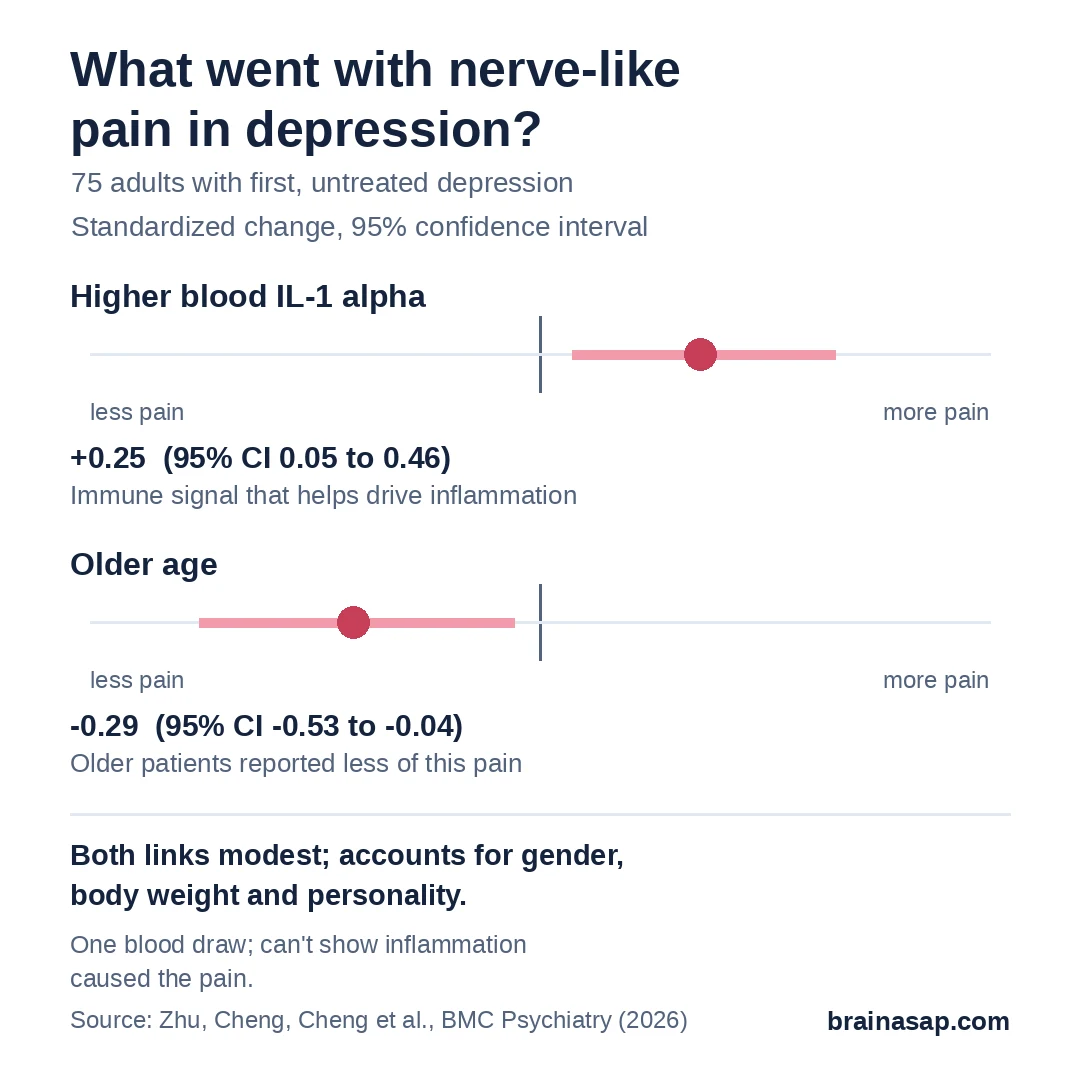
It did. People with higher IL-1 alpha reported more nerve-like pain, a modest link. Older people reported less of this pain.
A Chain From Inflammation to Low Mood?
Next, the team tested a step-by-step path with statistical models:
- Higher IL-1 alpha went with more nerve-like pain.
- More nerve-like pain went with more worry and anxious feelings.
- More anxious feelings went with more severe depression.
IL-1 alpha had no direct link with depression once pain and anxiety were in the model. That pain-to-worry step looked stronger in people with higher CRP.
Researchers called this part exploratory, and noted that the same data could fit other orders of events. A computer model built on this small group also pointed to IL-1 alpha as the top predictor of pain, but it was not tested on new patients.
Why Caution Is Needed
- One blood draw: Can't show whether inflammation came before the pain or the other way round.
- Small groups: 75 patients and 40 healthy adults, too few to split by who had pain and who didn't.
- Self-rated pain: Nerve-like pain was not checked by nerve tests.
- Missing factors: Smoking, sleep and how long people had been depressed can all shift inflammation and were not recorded.
- Only 18 markers: Many other immune signals were not measured.
Could Anti-Inflammatory Treatment Help Depression With Pain?
Looking ahead, the team suggested IL-1 alpha could one day help flag people with depression whose pain and distress are linked to inflammation. Whether blocking that signal would ease pain, worry or low mood has not been tested in people with depression; it would take studies that follow patients over time and treatment trials.
Citation: DOI: 10.1186/s12888-026-08351-z Zhu C, Cheng L, Cheng J, Xia Q, Yan J, Li C, Zheng M, Yang J, Gao J, Zhang L, Ju P, Gao H. IL-1α and CRP as key inflammatory mediators linking neuropathic pain, anxiety, and depression in major depressive disorder. BMC Psychiatry. 2026;26:634.
Study Design: Cross-sectional case-control study; HAMD-24, HAMA-14, BDI-II, BAI, SF-MPQ-2, PRMQ; 18 plasma cytokines/chemokines by Meso Scale Discovery; OLS with HC3 SEs (confirmatory); PROCESS models 6 and 59, Gaussian graphical model and gradient boosted regression (exploratory).
Sample Size: 75 first-episode drug-naive MDD patients (47 female) and 40 healthy controls (20 female), Anhui Mental Health Center, 2020–2024; 218 screened.
Key Statistic: IL-1α → SF-MPQ-2 neuropathic pain β = 0.25 (95% CI 0.05–0.46, p = 0.014); age β = −0.29 (−0.53 to −0.04, p = 0.021). Serial indirect path IL-1α → neuropathic pain → subjective anxiety → HAMD = 0.042 (95% CI 0.004–0.098); direct c′ = 0.07 (p = 0.533). MDD vs controls: higher IL-1α (p = 0.04), lower CRP (p < 0.0001).
Caveat: Cross-sectional; small sample; self-rated pain; mediation and machine-learning analyses exploratory and not externally validated; smoking, sleep and illness duration not recorded.