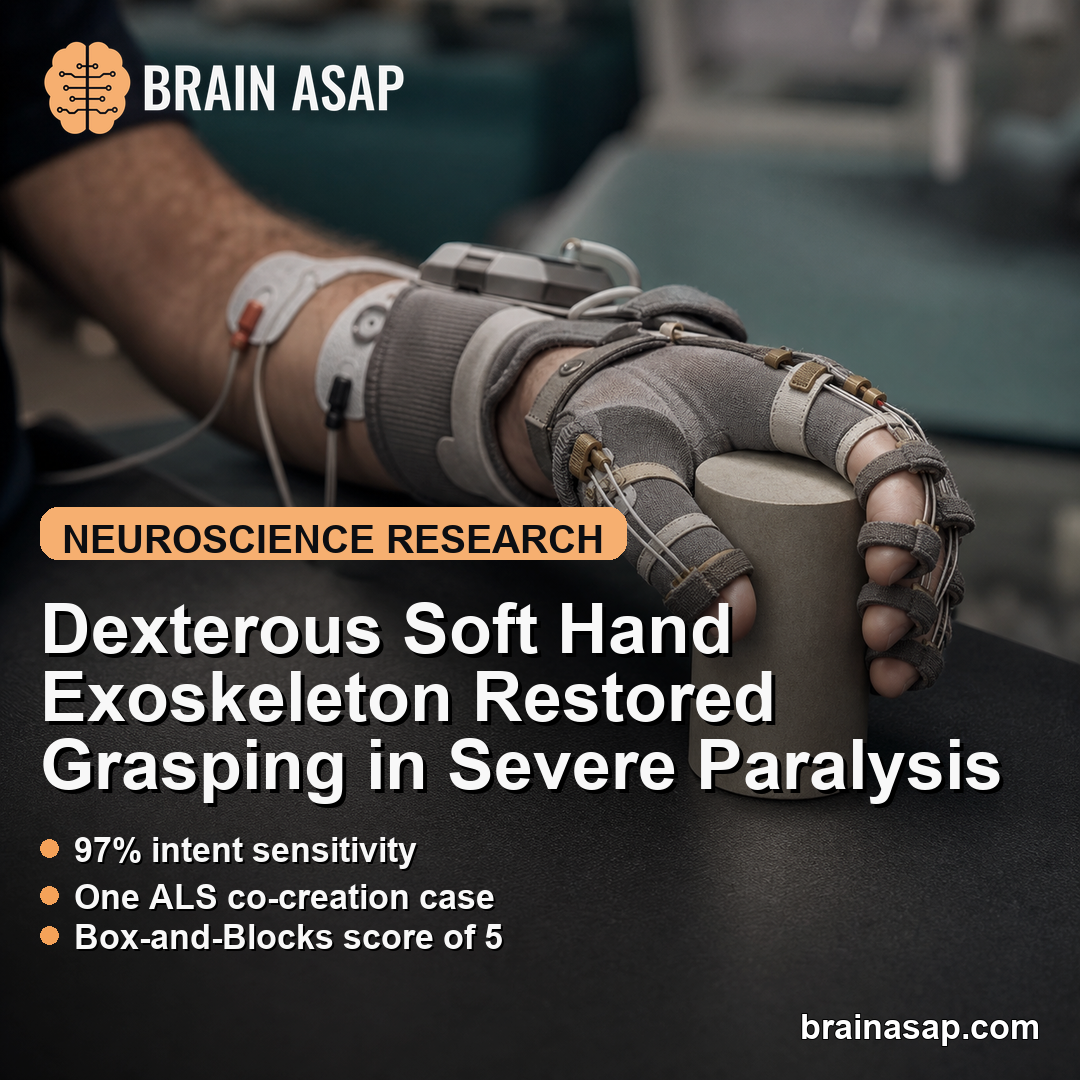
TL;DR: A 2026 study in Nature Machine Intelligence reported that a textile soft hand exoskeleton with thumb control and surface electromyography (sEMG) intent detection restored practical grasping in one person with severe ALS-related hand paralysis and helped the most severely impaired stroke participants more than moderately impaired users.
Key Findings
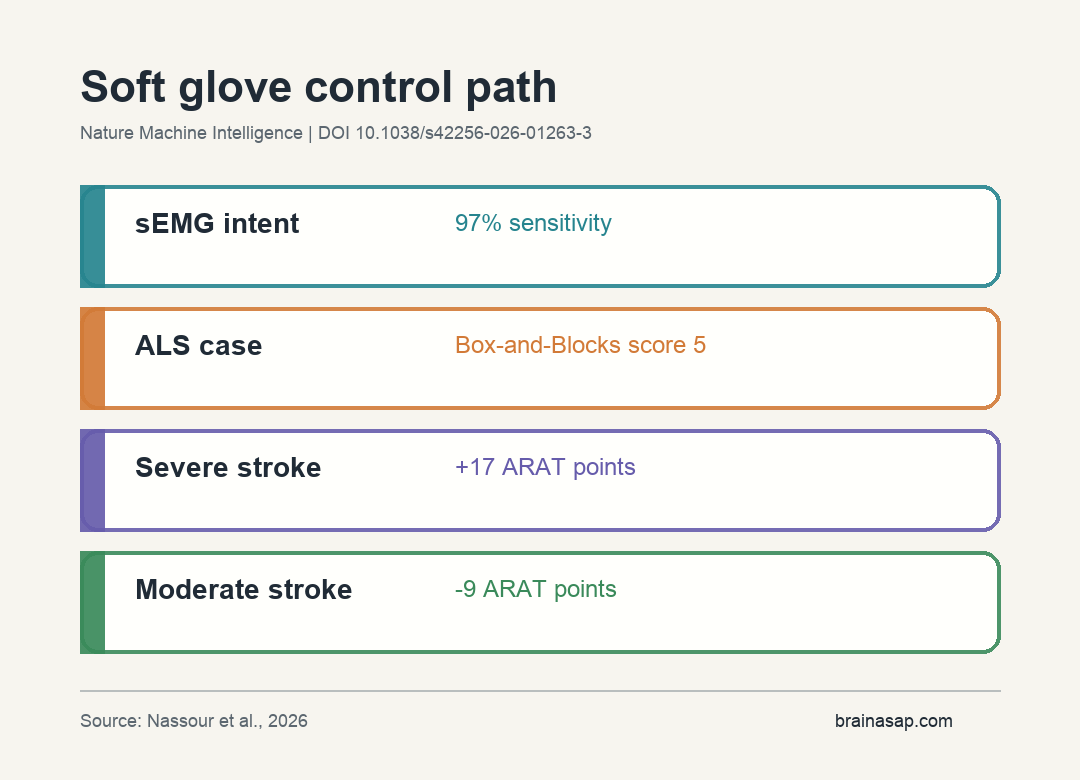
- 97% intent sensitivity: A non-invasive sEMG grasp predictor detected faint muscle activity with 97% sensitivity when paired with motion data and machine-learning error correction.
- One ALS co-creation case: The glove was iteratively built around a person with severe right-hand impairment from amyotrophic lateral sclerosis (ALS).
- Box-and-Blocks score of 5: The ALS participant could grasp objects, score 5 on the Box-and-Blocks Test, and feed himself while using the exoskeleton.
- Six stroke participants: The device was also tested in 6 people with stroke-related hand impairment to compare performance across impairment levels.
- 17-point severe-gain contrast: Severely impaired stroke participants scored 17 Action Research Arm Test points higher with the glove, while moderately impaired participants averaged 9 points lower.
Source: Nature Machine Intelligence (2026) | Nassour et al.
Soft hand exoskeletons are meant to return grasping, not just demonstrate movement in a lab. The hard population is people with severe or near-complete hand paralysis, because they cannot supply much finger shaping or thumb positioning on their own.
Nassour’s team built the device around that problem. Instead of a glove that mainly bends and straightens fingers, their textile-based exoskeleton added wrist dorsiflexion plus an active opposable and abductable thumb, giving the system enough movement options to handle objects with different shapes.
A Textile Exoskeleton Was Built Around Severe ALS Hand Paralysis
The first phase centered on one person with severe right-hand impairment due to amyotrophic lateral sclerosis. This co-creation choice targeted a gap: many assistive gloves are optimized for people who still have moderate residual hand function.
Researchers refined the glove through repeated prototype testing with the patient, neurologists, and physiotherapists. The resulting design emphasized 3 practical capabilities:
- Thumb opposition: The active thumb helped select contact points for precision and power grasps.
- Hand preshaping: The glove could prepare the hand before contact instead of waiting for the user to shape the grasp.
- Wearable softness: Textile construction kept the device lighter and safer than a rigid hand frame.
For the ALS participant, the device enabled object grasping and a Box-and-Blocks Test score of 5. That is not a normal hand-function score, but it is meaningful when the starting point is severe paralysis and the task includes moving blocks with the affected hand.
sEMG Intent Detection Read Weak Muscle Signals
The control problem was as important as the mechanics. The patient preferred a hands-free interface, so the team used surface electromyography, or sEMG, to detect faint muscle activity from the flexor pollicis longus.
The grasp predictor reached 97% sensitivity when combined with motion data and machine-learning correction. The system was not only moving the hand; it was trying to infer when the user intended to grasp despite weak and noisy sEMG input.
The control stack had several parts:
- Muscle activity: sEMG captured the remaining voluntary activation available to the patient.
- Motion context: Movement data helped separate intended grasp attempts from noise.
- Error correction: Machine learning helped compensate when sEMG input was weak or unstable.
Stroke Testing Showed the Device Helped Severe Impairment Most
The team then tested the glove in 6 stroke participants. The pattern was not simply “robotic assistance helps everyone.” It depended strongly on residual ability.
Participants with severe hand impairment performed better with the glove, gaining 17 Action Research Arm Test points. Moderately impaired participants, by contrast, averaged 9 points lower with exoskeleton assistance.
That split makes engineering sense. A person with moderate voluntary hand function may already be faster or more flexible without the glove, while someone with severe paralysis may need the device to create a grasp at all.
The Active Thumb Was the Functional Difference
Everyday grasping is not just finger closing. Eating with a fork, holding a bottle, or picking up an object often needs thumb opposition, contact-point selection, and enough wrist position to bring the hand to the object.
The paper’s device added those features because severe paralysis leaves little room for the user to compensate. The glove was designed for the person who cannot preshape the hand before the device takes over.
The device points to a specific design lesson:
- Severe impairment needs more autonomy: The glove must do more of the shaping when the user cannot.
- Moderate impairment needs adaptability: A fixed assistive pattern can interfere with movements the user can still perform.
- Control should match residual activity: Robust intent detection matters most when only faint muscle activity remains.
Clinical Use Still Needs Larger Testing
The study is not a definitive clinical trial. The ALS development phase centered on one co-created case, and the stroke validation group included only 6 people.
The results show feasibility and an impairment-level contrast, not broad proof that this exact glove should be prescribed widely.
The device also had limits for users with moderate impairment. Predefined grasp patterns and a control strategy tuned for minimal residual activity may constrain people who can still initiate and adjust their own grasp.
The practical takeaway is still concrete. For people with severe hand paralysis, a dexterous soft glove with active thumb control and sEMG-based intent detection may restore specific daily actions that simpler hand-opening devices cannot provide.
Citation: DOI: 10.1038/s42256-026-01263-3. Nassour et al. A dexterous soft hand exoskeleton restores intentional grasping in individuals with severe hand impairment. Nature Machine Intelligence. 2026.
Study Design: Translational device-development study with co-creation in one ALS case, healthy-control sEMG comparison, and stroke-participant validation.
Sample Size: One severe ALS hand-paralysis case, 15 healthy controls for sEMG comparison, and 6 stroke participants.
Key Statistic: The sEMG grasp predictor reached 97% sensitivity; severely impaired stroke participants scored 17 Action Research Arm Test points higher with the glove.
Caveat: The most clinically meaningful ALS evidence came from one co-created case, and stroke validation was small.