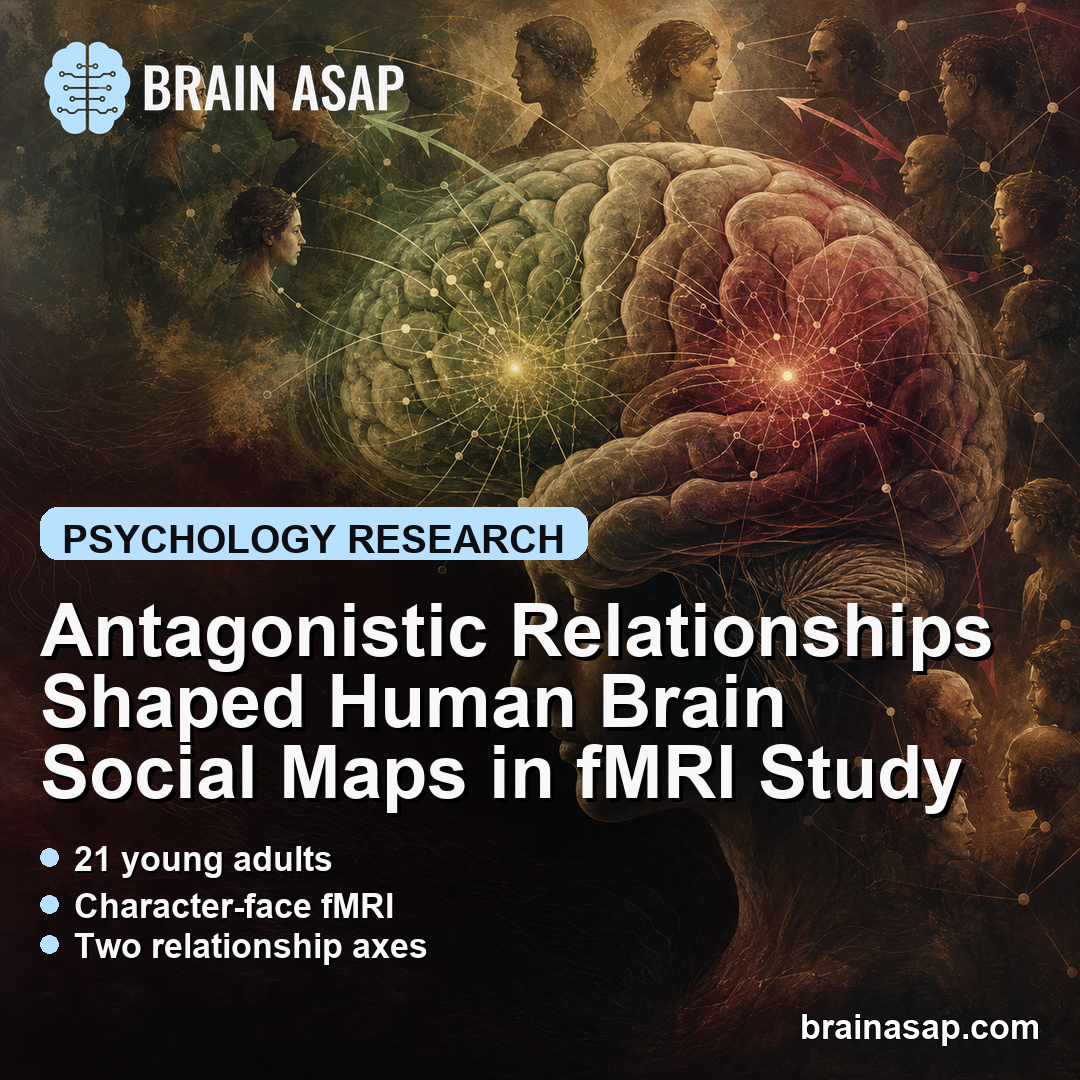
TL;DR: A 2026 study in Communications Psychology used functional MRI (fMRI) before and after a television drama and found that antagonistic relationships were represented most clearly in the left anterior supramarginal gyrus and right medial prefrontal cortex.
Key Findings
- 21 young adults: The study scanned 21 college students before and after they watched a 6-episode drama with friendships and rivalries.
- Character-face fMRI: During scanning, participants viewed faces of the drama’s central characters, then later rated each character pair.
- Two relationship axes: Behavioral ratings captured relationship strength and valence, separating close friends, rivals, and strangers.
- Antagonism dominated RSA: Representational similarity analysis found the strongest valence effects for negative relationships.
- SMG and mPFC clusters: Negative relationship structure appeared in the left anterior supramarginal gyrus and right medial prefrontal cortex.
Source: Communications Psychology (2026) | Chikazawa et al.
Social maps are not only lists of who likes whom. Real groups include friends, rivals, strangers, alliances, and conflicts, and the brain has to keep track of those relationships as a network.
Chikazawa’s team used functional MRI, or fMRI, with a television drama as a controlled way to teach participants a new social world. The design let researchers compare brain responses before and after people learned who was friendly, hostile, or unrelated to whom.
Participants Learned a Drama’s Friendship and Rivalry Network
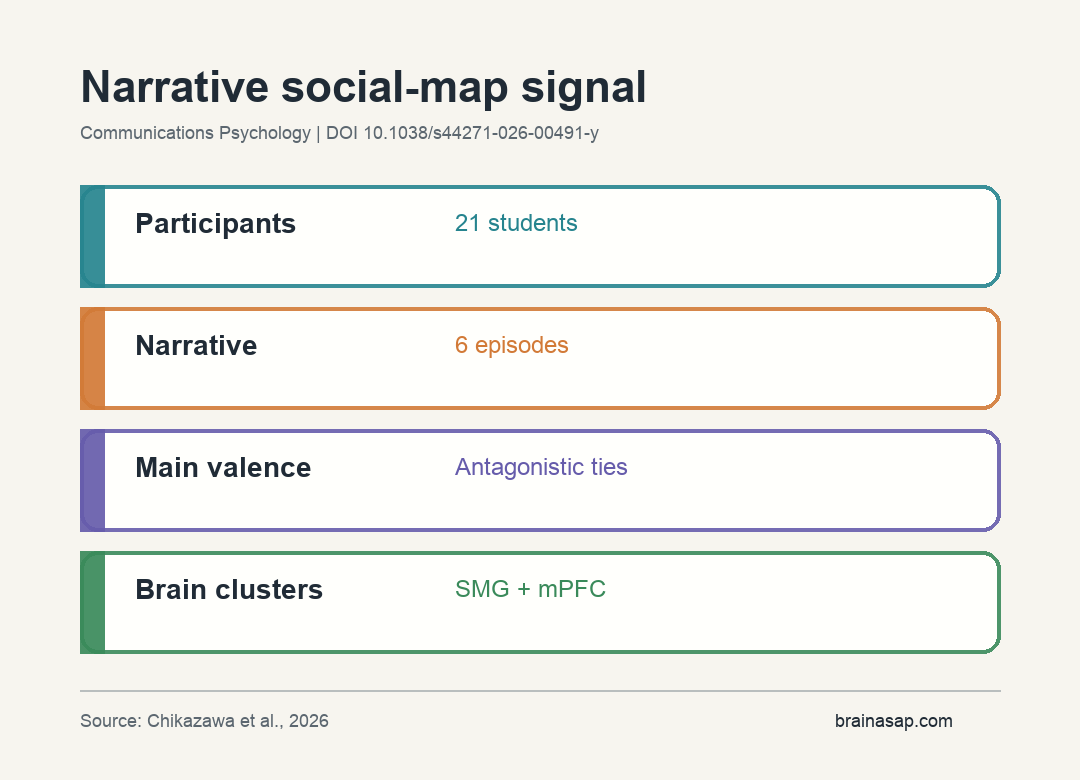
The study included 21 college students, with a mean age of 21.3 years. They completed an fMRI session before watching the drama and another session afterward.
Between scans, participants watched 6 episodes of SUITS, a drama chosen because its plot contains intertwined affiliations and conflicts among central characters. During scanning, faces appeared for 3 seconds at a time, and participants pressed a button when the same face repeated.
The before-and-after setup works because the faces themselves did not change. Each participant’s knowledge of the characters changed, which makes the design cleaner than a simple face-recognition task.
After scanning, participants rated every pair of characters on 2 dimensions:
- Relationship strength: How strongly the 2 characters were connected.
- Relationship valence: Whether the relationship was positive, negative, or neutral.
- Pair category: The ratings distinguished friend, rival, and stranger-like pairs.
Representational Similarity Analysis Tested the Social Map
The main method was representational similarity analysis, or RSA. Instead of asking whether one brain area simply became more active, RSA asks whether patterns of brain activity resemble the structure of the relationships participants learned.
That distinction keeps the interpretation narrow. A region can respond more strongly after a narrative without encoding the relationship map itself.
The analysis separated broad activation from pattern similarity tied to the friendship-rivalry structure.
The analysis used model matrices for relationship valence and facial-feature similarity, then looked across the brain for activity patterns that became more aligned with the relationship ratings after drama viewing.
Antagonistic Ties Carried the Strongest Valence Signal
The key result was not a general friendship signal. Relationship-valence effects were driven mainly by antagonistic relationships, meaning rivalries and hostile ties shaped the neural map more clearly than friendly ties.
Positive relationships were still present in the rating space. The neural pattern most clearly tracked the negative side of valence after the narrative had given those faces social meaning.
Negative ties may be especially efficient for social navigation because they tell a person where conflict, exclusion, or threat could arise. In the drama task, that information was learned from character interactions rather than from direct experience.
The strongest clusters appeared in the left anterior supramarginal gyrus and right medial prefrontal cortex. Both areas fit the broader social-cognition literature, but the paper’s contribution is that they represented learned relationship valence from a narrative network.
The statistical threshold for the RSA maps was voxel-level p < 0.001 and cluster-level p < 0.05. With N = 21, the study had sensitivity for moderate-to-large within-person effects, not subtle population-level differences.
Precuneus Activation Increased Without Encoding the Relationship Pattern
The univariate analysis showed increased activation in the precuneus after drama viewing. That likely reflects retrieval of narrative-related person knowledge when participants saw character faces.
The analysis distinguishes that activation from RSA evidence. The precuneus did not show statistically significant representational similarity patterns for interpersonal relationships.
In simpler terms, it may have helped retrieve narrative knowledge without carrying the measured friendship-rivalry geometry.
This separation keeps the interpretation cleaner:
- Activation result: The precuneus responded more after participants knew the story.
- Pattern result: SMG and mPFC represented the valence structure, especially negative ties.
- Behavioral anchor: The neural maps were tied to each participant’s relationship ratings.
Naturalistic Stories Can Build Measurable Social Knowledge
The study supports a practical idea: people can build social maps from narratives, not only from direct relationships. A drama can teach a small social world strongly enough for the brain to represent who is connected and how.
The same logic extends beyond television because much human social learning is indirect. People learn alliances, conflicts, and reputations through workplace accounts, family narratives, social media, and news rather than only through firsthand interaction.
The result should not be overread as proof that the brain prioritizes spite in every real social group. The sample was small, young, and exposed to one scripted narrative.
The study also measured learned fictional relationships, not participants’ own friendships or conflicts.
Still, the directional finding is specific. In this task, negative relationship valence gave the clearest neural structure.
Conflict may help organize who opposes whom, who affects decisions, and how a social network should be navigated.
Citation: DOI: 10.1038/s44271-026-00491-y. Chikazawa et al. Antagonism shapes social maps in the human brain. Communications Psychology. 2026;4:100.
Study Design: Pre-post fMRI study using naturalistic narrative viewing, character-face scans, behavioral relationship ratings, and whole-brain representational similarity analysis.
Sample Size: 21 college students, ages 19 to 23 years.
Key Statistic: Relationship-valence effects were most prominent for antagonistic ties in left anterior supramarginal gyrus and right medial prefrontal cortex clusters.
Caveat: The study used one fictional drama and a small young-adult sample, so real-world social networks need separate testing.