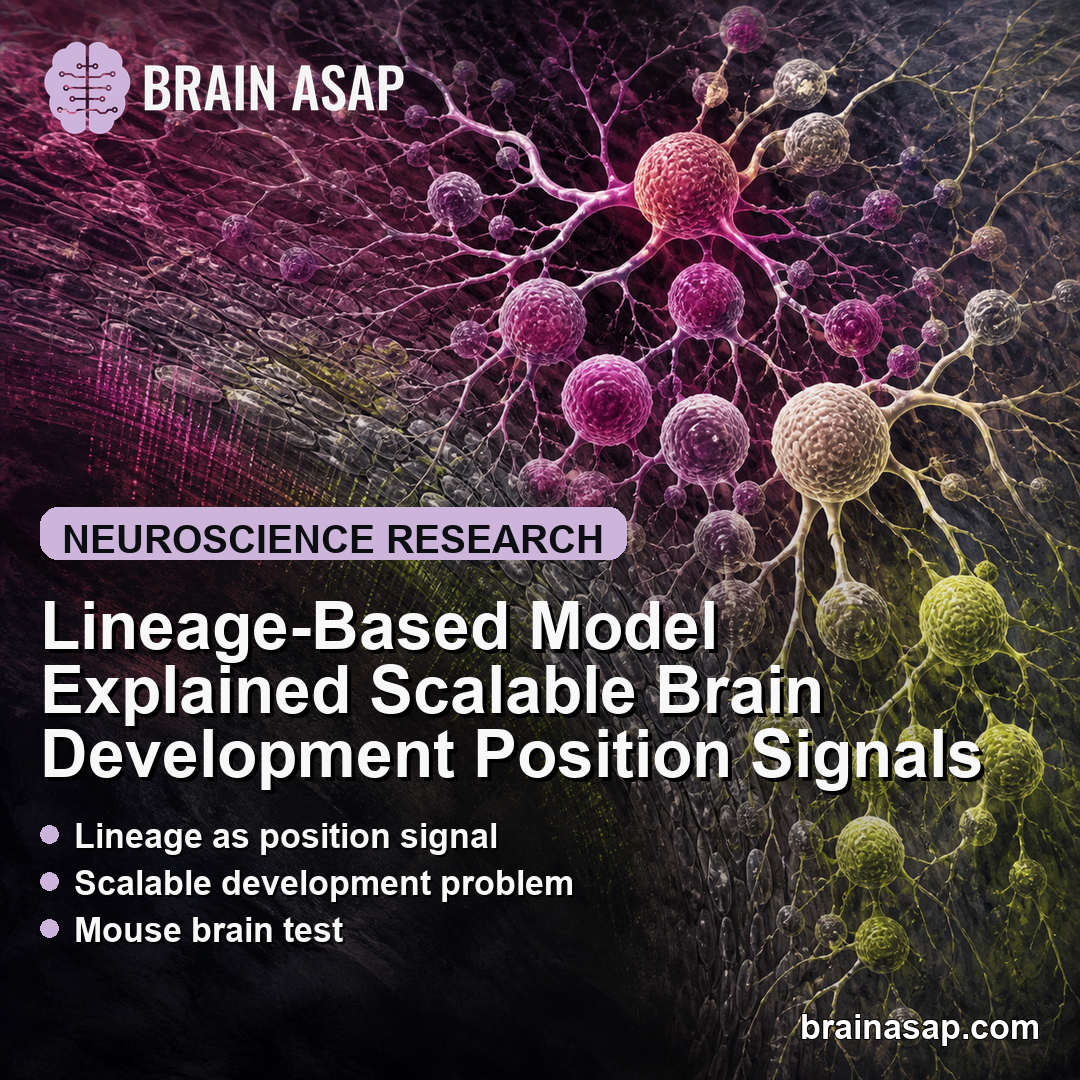
TL;DR: A 2026 Neuron study proposed that developing brain cells can gain positional information partly from lineage, because cells descended from the same progenitor tend to stay near one another as tissue grows.
Key Findings
- Lineage as position signal: The model argues that shared ancestry can help cells infer where they are without relying only on long-range chemical gradients.
- Scalable development problem: Chemical signals work locally, but vertebrate brains require positional organization across huge numbers of cells.
- Mouse brain test: Researchers tested the model against individual and group gene-expression patterns in developing mouse brains.
- Zebrafish confirmation: The same logic was checked in zebrafish, supporting use across brains of different sizes.
- Complement, not replacement: The theory supports lineage working alongside chemical signaling rather than replacing it.
Source: Neuron (2026) | Kerstjens et al.
Positional information is one of the basic problems of brain development. A cell’s future depends on where it sits, yet an early developing brain starts from a small set of dividing cells and becomes a much larger tissue.
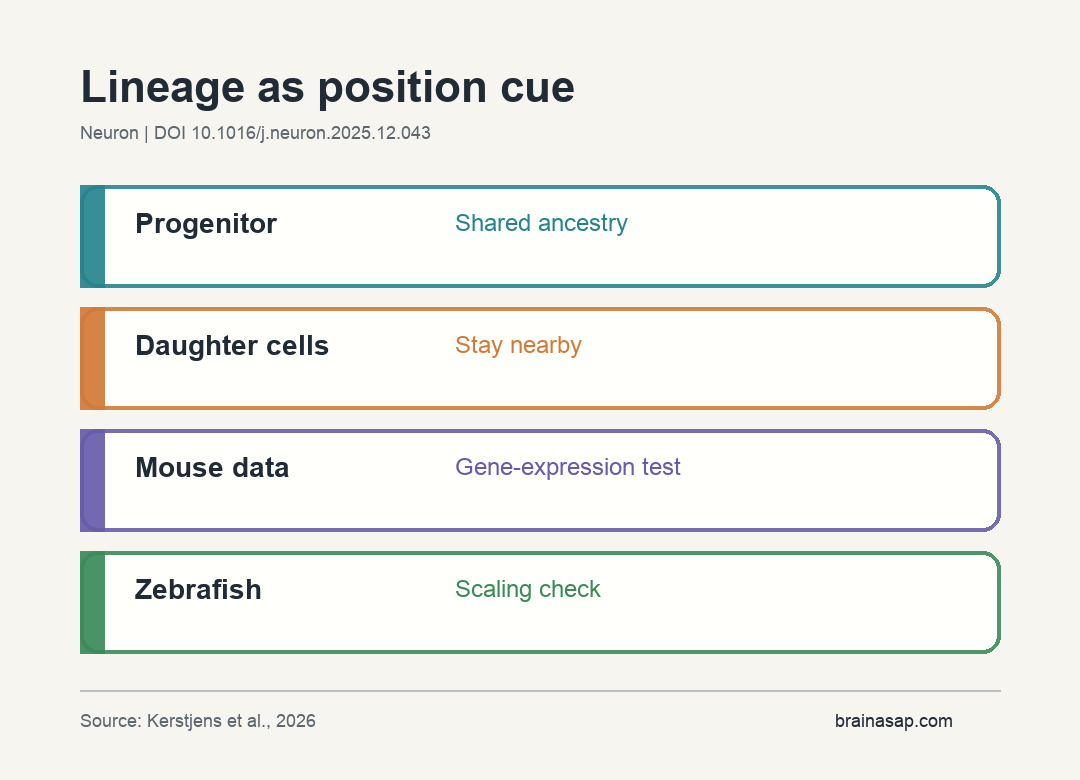
Kerstjens’s team proposes a simple additional rule: cells that share a lineage tend to remain near one another. That shared ancestry could create location information as the brain expands, without requiring every cell to read a long-range chemical address.
Developing Cells Need More Than Fading Chemical Gradients
Classical developmental biology often explains positional information through chemical signals. A molecule diffuses through tissue, cells sense its concentration, and location becomes a biological instruction.
That mechanism is real, but it has a scaling problem. Chemical gradients fade with distance, while a vertebrate brain grows into a large structure containing many cell types and regions.
The lineage model does not ask chemical gradients to solve the whole address problem alone. It treats a cell’s local family history as another coordinate system, one that grows naturally as the tissue expands.
The lineage model adds a second source of information:
- Local ancestry: Daughter cells remain near parent-lineage relatives.
- Spatial clustering: Shared lineage produces neighborhood structure as tissue expands.
- Position cue: A cell can infer location from nearby relatives, not only from external chemical gradients.
Lineage Works Like Ancestry Across Geography
The source material uses a population analogy. Descendants often settle near their parents, so shared ancestry creates geographic patterns across generations without a central map.
The proposed brain-development mechanism is similar. If related cells tend to remain close, lineage can preserve spatial information as a tissue grows.
That does not require each cell to know the whole brain plan.
In that sense, lineage can turn cell division into a map-making process. Every round of division creates new relatives, and their tendency to remain nearby leaves a trace of where that developmental branch belongs.
For that reason, the model is described as scalable positional information. The cue grows with development because lineage expands as cells divide, instead of being imposed only by a distant organizer gradient.
Mouse Gene Expression Tested the Model at Scale
The researchers began with theoretical computations, then compared the model against developing mouse brain data. The source material describes analyses of individual and group gene expression, which let the team ask whether lineage-based organization matches measured developmental patterns.
Gene expression is the right kind of test for this question because cell identity and position are linked during development. If lineage contributes positional information, related patterns should appear in how developing cells express genes across space.
That validation step separates the model from a purely elegant idea. Here, the claim is that lineage-based structure helped explain how cells acquire position across a growing vertebrate brain.
The model also keeps the cell’s perspective narrow. A cell does not need access to the entire organ. It only needs local information from itself and its neighbors.
Zebrafish Added a Cross-Species Scaling Check
The team also confirmed the model in zebrafish. A theory about positional information should not work only in one brain size or one mammalian dataset.
Mouse and zebrafish brains differ substantially, so cross-species support suggests the mechanism may capture a general developmental principle. The stronger claim is not that every brain region follows one rule, but that lineage can provide a reusable scaffold for spatial organization.
The study therefore frames lineage and chemistry as partners:
- Chemical signaling: Useful for local instructions and pattern refinement.
- Lineage proximity: Useful for preserving neighborhood information during growth.
- Combined model: More plausible for large tissues than either mechanism alone.
The Theory May Extend Beyond Brain Development
The paper focuses on vertebrate brain development, but the same logic could apply to other growing tissues. Tumors are one obvious possibility because tumor cells also expand through lineage while occupying changing spatial neighborhoods.
The idea also reframes developmental failure. A misplaced cell may not only receive the wrong chemical cue; it may also sit in the wrong lineage neighborhood, with neighbors that provide a misleading local context.
The source material also notes possible implications for artificial intelligence systems that replicate or pass information across generations. That point is speculative, but it follows from the same abstraction: inherited information plus local neighborhood structure can organize a complex system.
The limitation is that the available source was a captured source page, not the full article PDF. The draft therefore stays close to the stated model, the mouse and zebrafish validation claims, and the DOI-linked Neuron record rather than adding unsupported molecular details.
Citation: DOI: 10.1016/j.neuron.2025.12.043. Kerstjens et al. A lineage-based model of scalable positional information in vertebrate brain development. Neuron. 2026.
Study Design: Developmental-neuroscience modeling study with theoretical computation and cross-species checks using mouse brain gene expression and zebrafish validation.
Sample/Model: Vertebrate brain development model tested with developing mouse brain data and zebrafish evidence.
Key Statistic: The source record reports model support across mouse and zebrafish data rather than a single clinical effect size.
Caveat: The active source was a captured source page with DOI metadata, so mechanistic detail should be checked against the final Neuron article before publication.