TL;DR: A Swedish study of 42 people with depression found no link between the brain’s main calming chemical, GABA, and slowed movement, early waking or poor appetite. The researchers measured GABA with two kinds of scans, but most patients had fairly mild versions of these symptoms.
Key Findings
- No link with slowed movement: Neither observer ratings nor activity trackers tracked GABA.
- No link with sleep or appetite: Early waking and appetite loss did not track GABA either.
- Two ways of measuring: GABA levels by spectroscopy in 36 people; GABA receptors by PET in 28.
- No link over time: Changes over 4 weeks did not move together.
- Narrow range: Symptoms were mostly mild, which makes links harder to detect.
Source: BMC Psychiatry (2026) | Steinholtz et al.
Depression looks different from person to person. Some people mainly feel sad or anxious, while others slow down physically, wake too early and lose their appetite, a pattern doctors call melancholic.
One long-standing idea is that this slowed-down type is linked to low levels of GABA, the brain’s main calming, or inhibitory, chemical messenger. Researchers at Uppsala University in Sweden put that idea to a direct test.
Measuring the Brain’s Calming Chemical Two Ways
The study drew on 42 adults aged 18 to 54 with bipolar or unipolar depression, half men and half women, who were taking part in a brain-stimulation trial. All stayed on their usual medicines.
The team measured GABA in two ways:
- Spectroscopy (MRS): A special MRI scan that estimates how much GABA sits in the dorsal anterior cingulate cortex, a front brain region involved in emotion and movement planning
- PET: A tracer that shows how many GABA receptors are available in that region, in deep movement circuits called the basal ganglia, and in the hypothalamus, which helps run sleep and appetite
Scans were repeated about 4 weeks later, after a course of real or sham brain stimulation.
How the Symptoms Were Scored
- Slowed movement: A clinician rated facial expression, voice, gestures and amount of speech
- Daily activity: A wrist activity tracker
- Sleep: Questions about time spent asleep in bed and waking in the night or early morning
- Appetite: A self-rated question about appetite loss
Sleep and appetite were combined into a single score for these “vegetative” symptoms.
No Link Showed Up
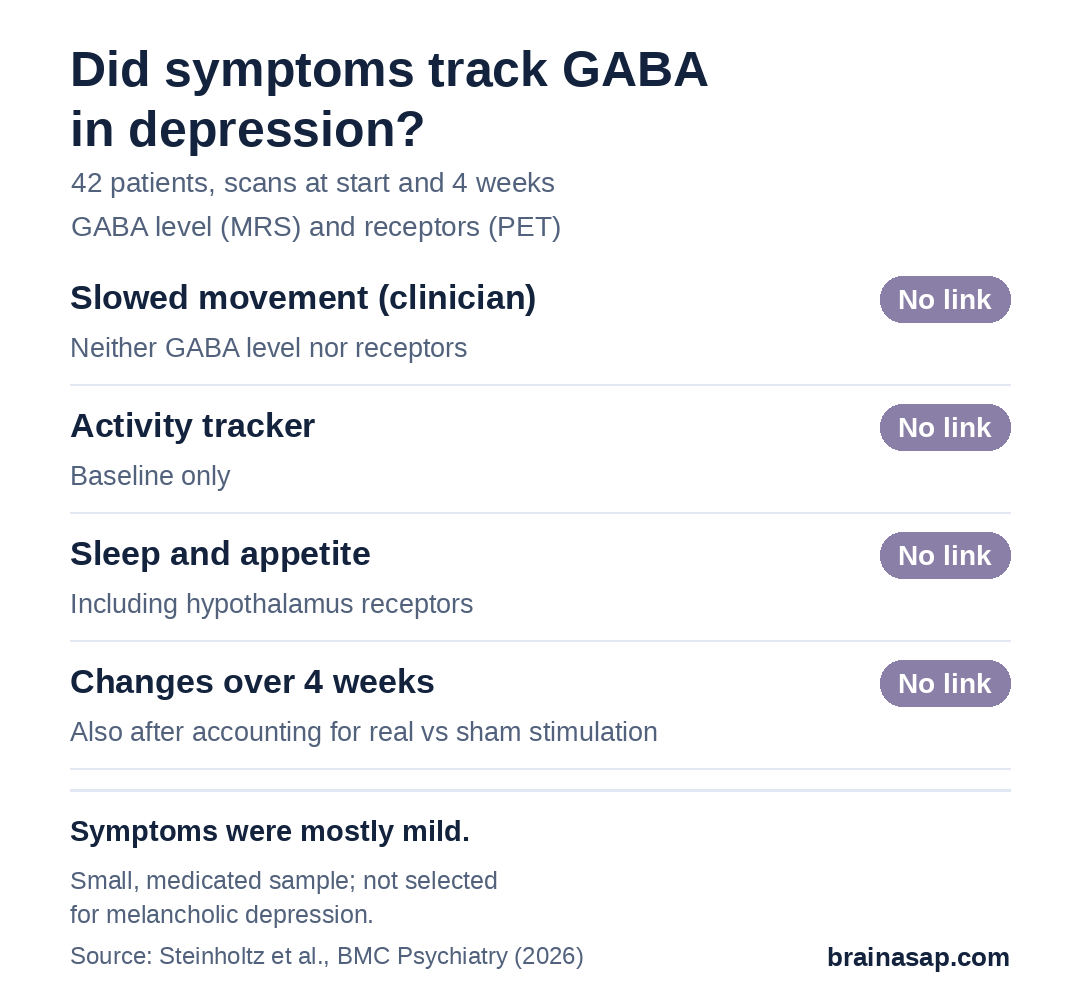
None of the symptom scores tracked GABA levels or GABA receptors, either at the start or in how they changed over 4 weeks. Accounting for whether people got real or sham stimulation did not change that.
Why a Null Result Isn’t the Final Word
- Mild symptoms: Few patients had strong slowing or sleep and appetite problems, limiting the range to detect links
- Not melancholic depression: Patients were not selected for the melancholic type
- Borrowed rating scale: The slowing measure was built for negative symptoms in schizophrenia
- One small region for spectroscopy: Other areas involved in movement were not measured
- Scan limits: These methods miss fast GABA signaling and changes in receptor subtypes
- Medications: Patients stayed on their usual psychiatric medicines, which may affect GABA
- Small sample: 42 people, with fewer usable scans
The study also says nothing about whether the brain stimulation worked; that was a separate question.
Testing People With Stronger Symptoms Is Next
The idea that GABA shapes melancholic depression is not ruled out. The authors suggest studying people with clear melancholic depression and pronounced slowing, and measuring GABA in more brain regions, to see whether a link appears when symptoms are stronger.
Citation: DOI: 10.1186/s12888-026-08573-1. Steinholtz L, Persson J, Thörnblom E, Wall A, Lubberink M, Fällmar D, Bodén R. Inhibitory neurotransmission in frontostriatal circuitry: implications for psychomotor and vegetative symptoms in depressive episodes. BMC Psychiatry. 2026;26:679.
Study Design: Secondary analysis of a randomized iTBS trial; MEGA-PRESS MRS and [11C]flumazenil PET with symptom ratings at baseline and 4 weeks.
Sample Size: 42 patients with bipolar or unipolar depression; MRS 36 baseline, 33 paired measurements; PET 28 baseline, 24 paired measurements.
Key Statistic: No significant associations between psychomotor or vegetative scores and GABA levels or GABA-A receptor availability.
Caveat: Mostly mild symptoms; small, medicated sample; not selected for melancholia.