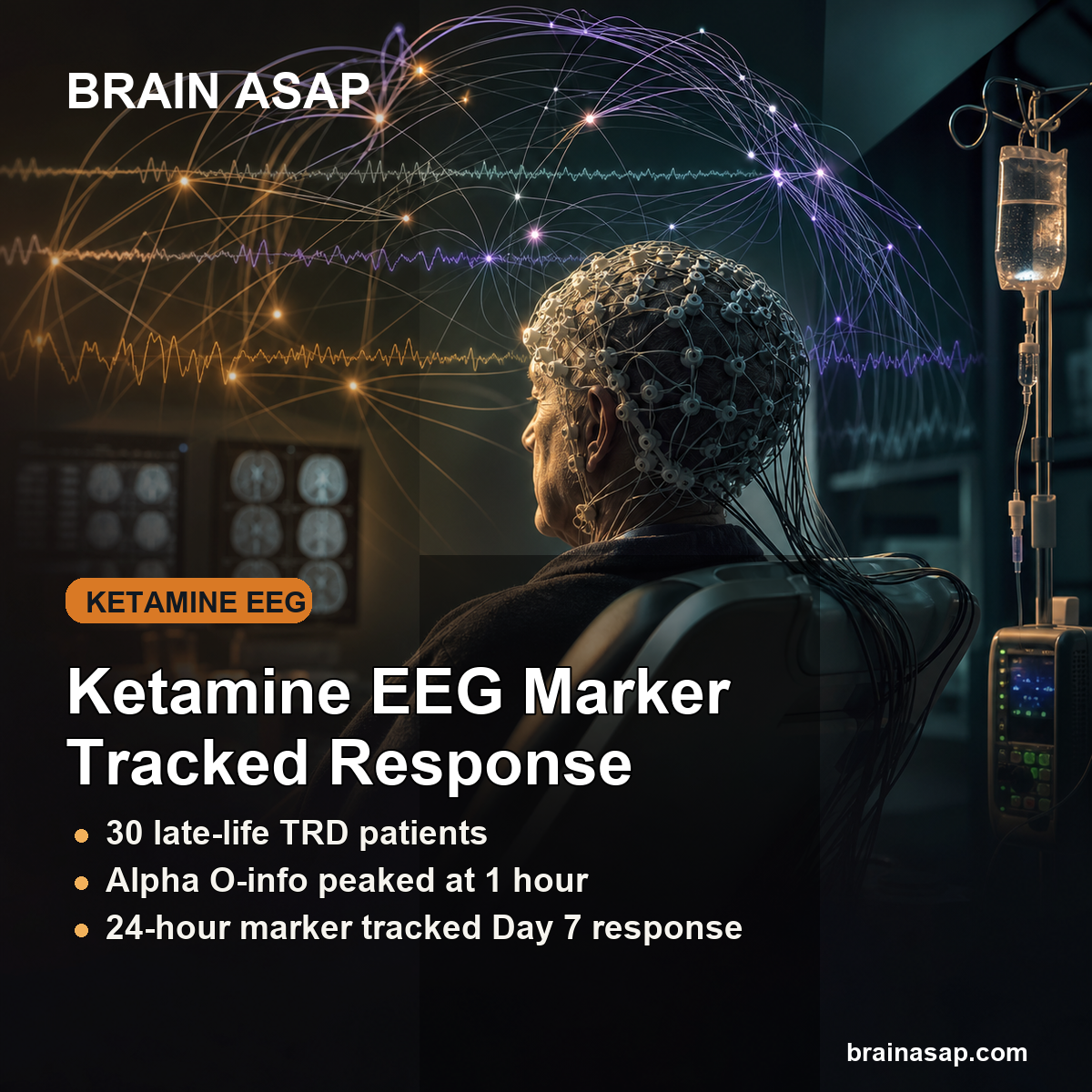
TL;DR: A 2026 study in Translational Psychiatry found that ketamine changed EEG-derived high-order brain interactions in late-life treatment-resistant depression, and a 24-hour increase in alpha-band redundancy tracked greater depression improvement by Day 7.
Key Findings
- 30 analyzed participants: The secondary analysis compared 18 ketamine-treated and 12 midazolam-treated late-life veterans with treatment-resistant depression at baseline.
- Single infusion: Ketamine was given over 40 minutes at 0.1, 0.25, or 0.5 mg/kg, while midazolam was used as an active placebo at 0.03 mg/kg.
- Alpha-band peak: The largest resting-state high-order interaction effect appeared in alpha-band O-information at 1 hour after ketamine, with Cohen’s d = 2.57.
- 24-hour response link: Greater 24-hour alpha-band redundancy was associated with greater Montgomery-Asberg Depression Rating Scale improvement at Day 7.
- Exploratory biomarker: Dissociation links were more consistent than antidepressant links, so the authors framed the clinical response result as promising but exploratory.
Source: Translational Psychiatry (2026) | Shah et al.
Ketamine treatment can reduce depressive symptoms quickly in some patients with treatment-resistant depression, but response is variable. This study asked whether the brain’s short-term EEG organization after ketamine could help explain who improves.
The researchers did not focus on ordinary pairwise connectivity alone. They used high-order interactions, a set of information-theory measures meant to describe how groups of three or more EEG signals share information.
High-Order EEG Metrics Captured Brain Network Organization
The central metric was O-information, or O-info. In plain terms, it estimates whether a group of EEG channels is dominated by redundant shared information or by more synergistic information that emerges only when signals are considered together.
A second metric, S-information, measured the overall strength of high-order interdependence. The distinction matters because a brain network can become more strongly coordinated without the same pattern of redundancy-versus-synergy.
- Redundancy: Similar information is distributed across several channels.
- Synergy: The combined channel group carries information not obvious from single channels alone.
- O-info: The balance between those two interaction types.
- S-info: The overall magnitude of high-order interaction.
The study analyzed a reduced 15-electrode EEG montage, intentionally close to a lower-density setup that could be more practical outside specialized research labs.
Ketamine Produced a Time-Ordered Shift in Alpha, Theta, and Gamma
The trial enrolled U.S. military veterans aged at least 55 years with treatment-resistant depression. At baseline, the analyzed sample included 18 ketamine-treated and 12 midazolam-treated participants.
EEG was measured before infusion and after treatment. The analysis focused on baseline, 1 hour, 24 hours, and 7 days after infusion for resting-state data, with mismatch-negativity task data also analyzed.
The strongest resting-state result came early. Alpha-band O-info showed the largest single ketamine effect at 1 hour, with Cohen’s d = 2.57. Across all channel groupings, O-info moved positive across frequency bands at 1 hour, then shifted negative at 24 hours and moved closer to zero by Day 7.
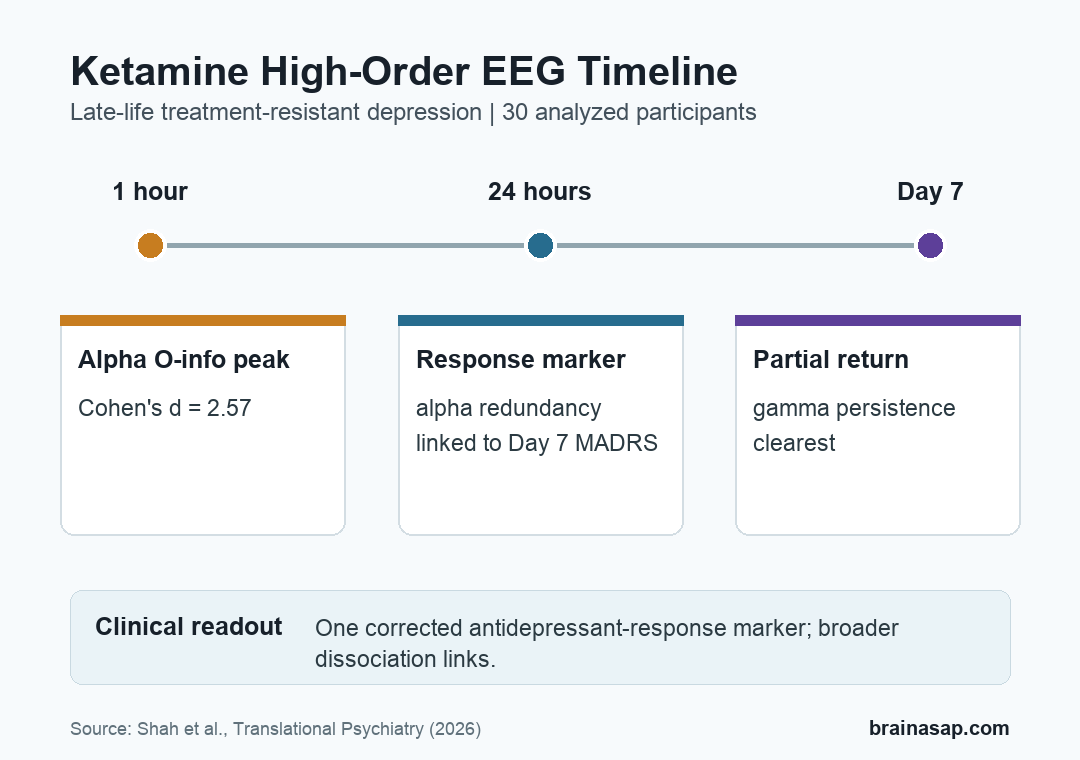
- 1 hour: Alpha-band O-info peaked, suggesting a large early increase in redundancy-dominant organization.
- 24 hours: The broad distribution shifted downward, but alpha redundancy at this time point carried the clearest response association.
- Day 7: Effects moved toward zero, with the clearest persistence in gamma-band O-info.
Alpha Redundancy at 24 Hours Tracked Day 7 Depression Improvement
The main clinical outcome was percent change in Montgomery-Asberg Depression Rating Scale (MADRS) score from baseline to Day 7. The analysis tested whether changes in HOI metrics predicted that clinical change within the ketamine group.
The antidepressant-response finding was narrow. In the baseline-adjusted model, only 24-hour alpha O-info survived false-discovery-rate correction, with beta = 69.31, standard error 25.77, p = .007, and q = .050.
That means greater increases in alpha-band redundancy at 24 hours were associated with greater Day 7 improvement. Other candidate features pointed in interesting directions, but they did not survive correction.
- Clinical signal: The response association centered on one corrected alpha-band feature, not every EEG metric tested.
- Timing: The relevant clinical marker appeared at 24 hours, not only during the acute infusion period.
- Interpretation: The finding supports alpha redundancy as a candidate marker, not as a ready clinical test.
Dissociation Associations Were Stronger Than Antidepressant Associations
The study also examined acute dissociation using the Clinician Administered Dissociative States Scale (CADSS). Here the HOI associations were broader.
Four 24-hour features survived correction for CADSS change: alpha O-info, alpha S-info, beta O-info, and beta S-info. All were positive, meaning larger HOI increases were linked to greater dissociative symptoms.
That distinction is important. Ketamine-related EEG organization may capture several treatment-state processes, including dissociation, not only antidepressant response.
The Main Limit Is the Small Single-Infusion Sample
The paper is useful because it tests a specific mechanistic idea in a controlled clinical sample. It also keeps the practical ambition modest: lower-density EEG could be more scalable than specialized imaging if the signal holds up.
The evidence is still early. The clinical analysis used a single-infusion protocol, a late-life veteran sample that was predominantly male, and a modest ketamine group. The authors also noted that high-order interaction metrics are undirected; they describe how information is distributed, not whether information flows top-down or bottom-up.
- Sample limit: The baseline analyzed sample was 30 participants, with attrition by later time points.
- Dose pooling: Ketamine doses were pooled after dose-sensitivity checks, but the small sample limited subtle dose comparisons.
- Biomarker status: The MADRS association should be tested in larger longitudinal samples before clinical use.
Ketamine altered high-order EEG organization over hours and days, and greater 24-hour alpha redundancy was associated with greater Day 7 MADRS improvement. In this small secondary analysis, the association is an exploratory marker, not a clinical test.
Citation: DOI: 10.1038/s41398-026-04212-1. Shah et al. High-order brain interactions during ketamine-induced state changes: A functional marker of response in late-life treatment-resistant depression? Translational Psychiatry. 2026.
Study Design: Secondary EEG analysis of a randomized, double-blind, midazolam-controlled ketamine trial in late-life treatment-resistant depression.
Sample Size: 30 analyzed participants at baseline, including 18 ketamine-treated and 12 midazolam-treated U.S. military veterans.
Key Statistic: Alpha-band O-info peaked at 1 hour after ketamine with Cohen’s d = 2.57; 24-hour alpha O-info was associated with Day 7 MADRS improvement.
Caveat: The clinical-response association was exploratory and needs replication in larger repeated-dose and longitudinal samples.