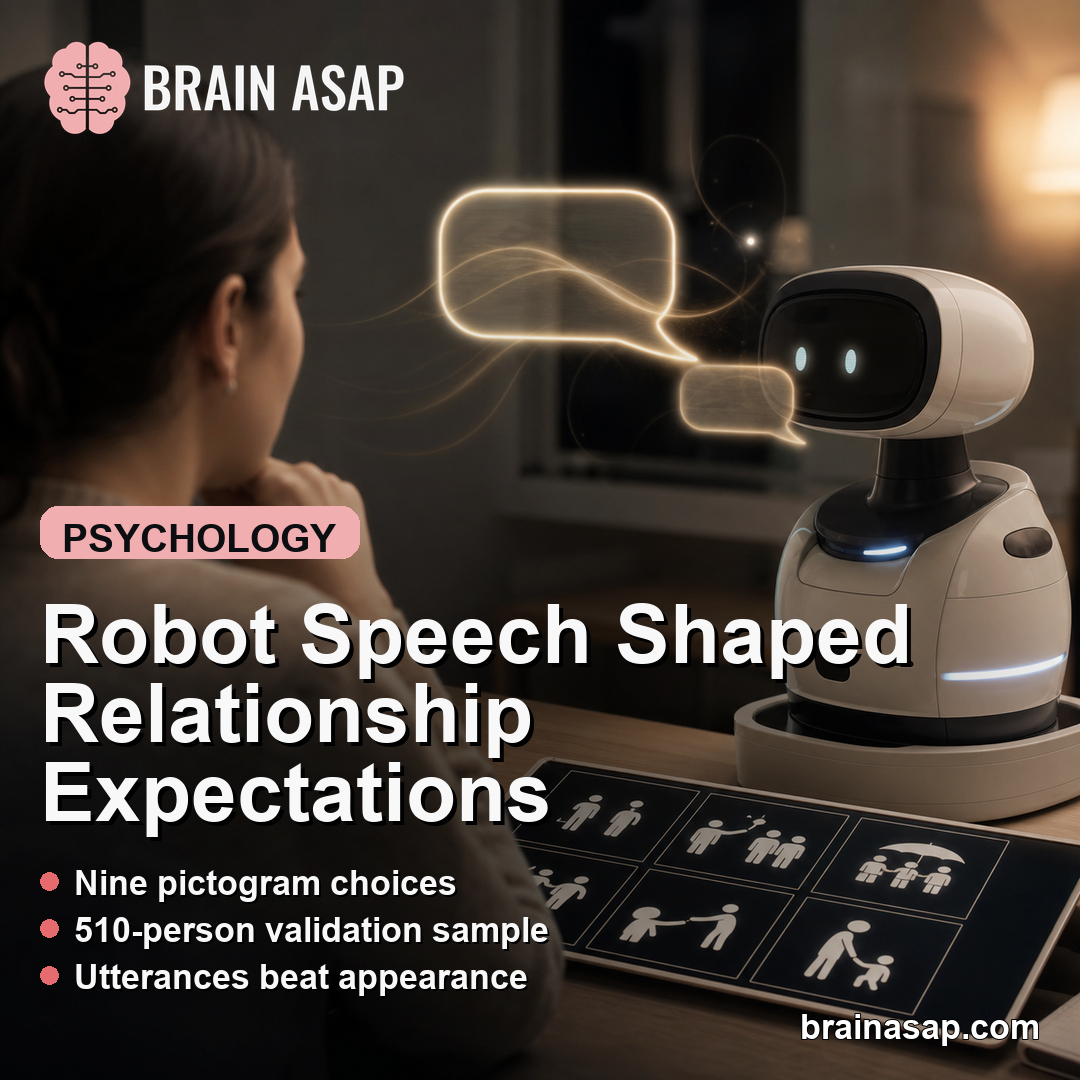
TL;DR: A 2026 Scientific Reports study found that a robot’s utterances shaped expected human-robot relationship structure far more than the robot’s physical appearance in Japanese online scenario experiments.
Key Findings
- Nine pictograms: Researchers built a nine-pictogram questionnaire to capture perceived relationship structures such as balanced contribution, one-sided service, and shared goals.
- 510-person validation sample: Survey A recruited 510 Japanese online participants to test whether pictogram choices matched human relationship types.
- Human relationships differed: Pictogram choices varied significantly across human relationship categories (chi-square(32) = 411.298, p < .01).
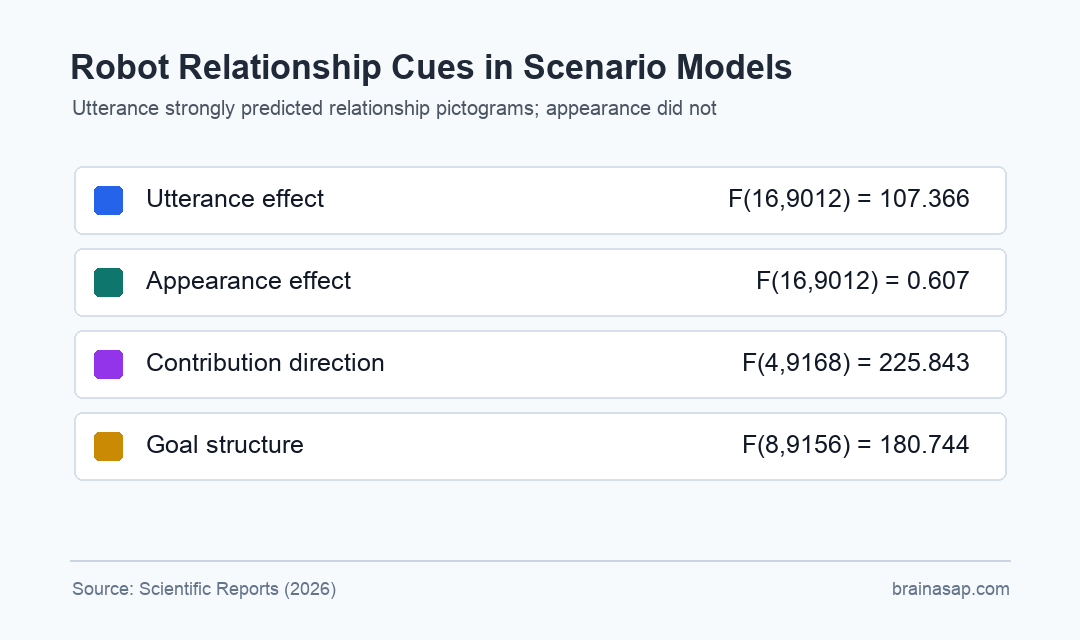
- Utterance dominated appearance: In robot scenarios, utterance type remained a robust predictor of pictogram choice (F(16,9012) = 107.366, p < .001), while appearance was not significant.
- Relational dimensions shifted: Utterance type also changed contribution-direction and goal-structure dimensions, while appearance did not significantly change either dimension.
Source: Scientific Reports (2026) | Kubota et al.
Human-robot interaction (HRI) studies often rate robots as likable, warm, competent, safe, or human-like. Here, researchers asked what kind of relationship people believed they had—or wanted to have—with a robot.
The researchers built a pictogram-based tool to represent relational structure, including who contributes to whom and whether the two sides share goals.
Nine Pictograms Mapped Ideal and Expected Relationships
The questionnaire used nine pictograms inspired by social psychology and game theory. Instead of rating a robot on a word scale, participants selected the image that best represented the relationship in a scenario.
Survey A used human relationships first. A sample of 510 Japanese online participants judged relationship types such as spouse, friend, parent, subordinate, or customer-service contexts.
- Contribution direction: Some pictograms represented balanced contribution, while others represented one side mainly helping the other.
- Goal structure: Some images represented shared goals, while others represented separate or asymmetric goals.
- Scenario fit: The tool was designed for intuitive choices rather than long questionnaire batteries.
Human relationship categories produced significantly different pictogram choices, with chi-square(32) = 411.298 and p below .01. Those choices supported the idea that people could use the pictograms in a structured way.
The validation step was important because a pictogram tool can be easy to understand while measuring little. By showing that different human relationships produced different response patterns, the researchers established a baseline before applying the same structure to robots.
Robot Utterances Changed Expected Relationship Models
The robot experiments varied role, appearance, and utterance. Appearance changed the robot’s physical form, while utterance changed what the robot said about the interaction.
In the strongest model comparison, utterance type remained a robust predictor of pictogram choice: F(16,9012) = 107.366, p below .001. Robot appearance was not significant in the same model, with F(16,9012) = 0.607.
- Appearance cue: The robot’s visual form was manipulated across scenarios.
- Speech cue: The robot’s utterance framed contribution, role, or relationship expectation.
- Chosen relationship: Participants selected the pictogram that best matched the expected structure.
The data suggest that how a robot describes the interaction may matter more for relationship expectations than whether it appears more mechanical or human-like.
For example, a robot that frames itself as sharing a task, taking orders, giving advice, or acting independently may invite different assumptions about responsibility. That relational framing can change whether people expect partnership, service, authority, or tool-like use.
Contribution Direction and Shared Goals Also Followed Speech Cues
The researchers also reduced pictogram choices into dimensions. One dimension described contribution direction, while another described goal structure.
Utterance type had robust effects on both dimensions: F(4,9168) = 225.843 for contribution direction and F(8,9156) = 180.744 for goal structure, both with p values below .001.
- Direction changed: Speech cues shifted whether participants expected balanced or one-sided contribution.
- Goals changed: Speech cues also shifted whether participants expected shared or separate goals.
- Appearance did not: Appearance was non-significant for both derived dimensions.
Appearance can still matter in robotics. In these scenarios, relational wording carried more explanatory weight than the visual design manipulation.
The models also included repeated responses from the same participant, which is important because each person saw multiple scenarios. Mixed-effects modeling reduces the chance that the pattern only reflects some participants generally preferring one pictogram style.
Scenario-Based HRI Results Need Cultural and Real-World Testing
The study was scenario-based. Participants reacted to descriptions rather than living with or using robots over time, so the findings are about projected relationship expectations.
The sample also came from Japanese online recruitment. Culture, language, social norms, and prior robot exposure may affect how people interpret service, authority, companionship, and partnership cues.
- Strong point: The pictogram method captures relationship structure rather than only robot impression.
- Main limit: Scenario responses may differ from real interactions with physical robots.
- Design implication: Robot scripts and role framing may deserve as much attention as appearance.
For HRI design, robot scripts deserve direct testing alongside appearance. If a robot is meant to act as a helper, partner, tutor, or counselor, the words it uses may define the relationship more strongly than its surface form or role label.
The result also matters for social AI systems. As chatbots and embodied robots become more common, users may infer relationship roles from small wording cues, even when the system has no human-like intentions or shared understanding.
Relational wording is therefore a measurable safety and design variable, not only a copywriting choice.
Citation: DOI: 10.1038/s41598-026-47643-y. Kubota et al. Perceived human-robot relational structures: a pictogram-based questionnaire to assess ideal and assumed relationships. Scientific Reports. 2026.
Study Design: Pictogram questionnaire development and online scenario experiments in human-human and human-robot relationship contexts.
Sample Size: Survey A included 510 Japanese online participants; later robot scenarios used repeated pictogram choices modeled with mixed-effects methods.
Key Statistic: Robot utterance type predicted pictogram choice (F(16,9012) = 107.366, p < .001), while appearance was not significant in the same model.
Caveat: Scenario-based expectations may not match behavior during long-term real-world robot interaction.