TL;DR: A 2026 study in Neuropsychopharmacology found that 30 mg 2C-B produced acute subjective effects in healthy adults that were similar in overall intensity to 125 mg MDMA, shorter and less distressing than 25 mg psilocybin, and less cardiovascularly stimulating than MDMA.
Key Findings
- Crossover comparison: The double-blind study tested 10, 20, and 30 mg 2C-B, 125 mg MDMA, 25 mg psilocybin, and placebo in the same 24 healthy adults.
- 72% peak effect: The 30 mg 2C-B condition reached a mean maximal “any drug effect” rating of 72%, similar to 70% with MDMA and lower than 87% with psilocybin.
- 4.9-hour duration: Mean 30 mg 2C-B effect duration was 4.9 hours, nearly identical to MDMA at 4.8 hours and shorter than psilocybin at 6.1 hours.
- Only MDMA raised oxytocin: MDMA, not 2C-B or psilocybin, significantly increased plasma oxytocin and neurophysin I.
- No severe adverse events: All active drugs increased acute complaint scores except 10 mg 2C-B, but the trial reported no severe adverse events.
Source: Neuropsychopharmacology (2026) | Arikci et al.
2C-B, short for 4-bromo-2,5-dimethoxyphenethylamine, sits in an awkward research space. It is used recreationally and has psychedelic-type effects, but researchers have had much less controlled human data on it than on MDMA or psilocybin.
The Basel group tested whether 2C-B produced entactogen-like social effects, psychedelic-type perceptual effects, or a mixed acute response when compared directly with standard research doses of those better-studied drugs.
2C-B Was Tested Against MDMA and Psilocybin in the Same Adults
The study used a double-blind, randomized, placebo-controlled crossover design, which means each participant served as their own comparison across sessions. The sample included 24 healthy participants, split evenly by sex, with a mean age of 36 years.
Each participant completed six 10-hour test sessions. Researchers compared placebo with three 2C-B doses, one MDMA dose, and one psilocybin dose:
- Low 2C-B dose: 10 mg, expected to produce mild acute effects.
- Medium 2C-B dose: 20 mg, within a range often described as typical for mixed psychedelic and entactogenic effects.
- High 2C-B dose: 30 mg, intended to test stronger acute responses.
- Comparator doses: 125 mg MDMA and 25 mg psilocybin, both common controlled-study doses.
Researchers measured subjective drug effects repeatedly for 9 hours. They also measured blood pressure, heart rate, body temperature, adverse effects, social cognition, emotion recognition, oxytocin, neurophysin I, and 2C-B pharmacokinetics.
30 mg 2C-B Matched MDMA Intensity but Not Psilocybin Intensity
The clearest dose pattern was subjective intensity. The 10 mg 2C-B dose produced only mild drug effects, while 20 mg and 30 mg 2C-B produced stronger changes in perception and interpersonal ratings.
On the “any drug effect” rating, the high 2C-B dose reached a mean maximal effect of 72%. That was close to MDMA at 70%, but lower than psilocybin at 87%.
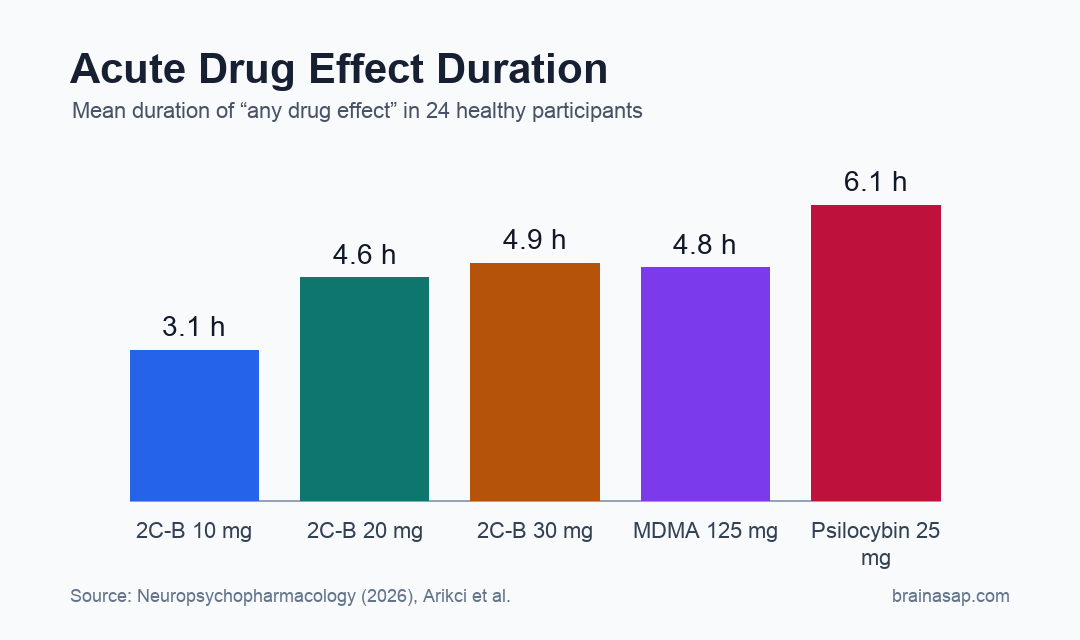
Duration also separated the drugs. The average effect duration was 3.1 hours for 10 mg 2C-B, 4.6 hours for 20 mg 2C-B, and 4.9 hours for 30 mg 2C-B. MDMA lasted 4.8 hours, while psilocybin lasted 6.1 hours.
For future study design, a 30 mg 2C-B session may need monitoring similar in length to MDMA, while psilocybin may require a longer acute observation window.
2C-B Combined Psychedelic-Type and Social Effects
The high 2C-B dose produced psychedelic-type changes, including altered vision, altered hearing, audio-visual synesthesia, altered time perception, and ego dissolution. Those effects were generally weaker than psilocybin but stronger than MDMA for several perceptual ratings.
At the same time, 20 mg and 30 mg 2C-B increased social ratings such as trust, openness, closeness to others, and wanting to be with others. Those interpersonal ratings partly overlapped with MDMA.
- Shared positive effects: High-dose 2C-B, MDMA, and psilocybin all produced similar ratings of good drug effect and high.
- More perceptual change: High-dose 2C-B produced more psychedelic-like sensory ratings than MDMA.
- Less distress than psilocybin: Only psilocybin significantly increased bad drug effects and anxiety compared with placebo.
The social-cognition measures sharpened the comparison. MDMA and 30 mg 2C-B both increased explicit emotional empathy for positive images, while psilocybin reduced cognitive empathy for positive stimuli and reduced correct emotion recognition overall.
MDMA Produced the Strongest Cardiovascular and Oxytocin Effects
Autonomic effects did not match the subjective intensity pattern exactly. MDMA produced the strongest cardiovascular stimulation, followed by psilocybin and then 2C-B.
The 30 mg 2C-B dose increased heart rate compared with placebo, but the increase was lower than MDMA. Blood pressure increases were also lower with 30 mg 2C-B than with MDMA or psilocybin.
- Cardiovascular rank: MDMA showed the highest stimulation, psilocybin was intermediate, and 2C-B was lowest among the active high-dose comparisons.
- Endocrine split: Only MDMA increased oxytocin and neurophysin I, so 2C-B’s social effects did not look like a simple oxytocin copy of MDMA.
- Safety boundary: No severe adverse events occurred, but all active conditions except 10 mg 2C-B increased acute complaint scores.
The endocrine result keeps the mechanistic interpretation narrow. 2C-B increased some social ratings at higher doses, but this small healthy-volunteer study did not show the same oxytocin response seen with MDMA.
2C-B Dose-Finding Still Needs Clinical and Safety Work
The study gives useful dose-comparison data, not evidence that 2C-B treats depression, posttraumatic stress disorder, or any other condition. Participants were healthy volunteers, and the outcomes were acute pharmacology measures rather than clinical symptom change.
Several findings are still practical for future research. The 30 mg dose produced strong mixed effects, the duration was manageable within the study day, and 2C-B had a short plasma elimination half-life of about 1.3 hours.
Future trials would still need larger samples, clinical populations, careful adverse-event monitoring, and clearer rules for therapeutic context. In this pharmacology study, 2C-B produced dose-dependent acute effects that overlapped with MDMA and psilocybin without matching either one completely.
Citation: DOI: 10.1038/s41386-026-02428-9. Arikci et al. Acute dose-dependent effects of 4-bromo-2,5-dimethoxyphenethylamine (2C-B) compared with 3,4-methylenedioxymethamphetamine (MDMA) and psilocybin in a double-blind, placebo-controlled study in healthy participants. Neuropsychopharmacology. 2026;51:1511-1518.
Study Design: Double-blind, randomized, placebo-controlled crossover pharmacology study.
Sample Size: 24 healthy adults, 12 women and 12 men.
Key Statistic: Mean “any drug effect” duration was 4.9 hours for 30 mg 2C-B, 4.8 hours for 125 mg MDMA, and 6.1 hours for 25 mg psilocybin.
Caveat: The study tested acute drug effects in healthy adults, not treatment efficacy in a clinical population.