TL;DR: A 2026 exploratory study in Nature Communications found that a first 25 mg psilocybin dose in 28 psychedelic-naive adults increased electroencephalography (EEG), a scalp recording of brain electrical activity, entropy during the acute session and that entropy predicted one-month well-being change.
Key Findings
- 28 psychedelic-naive adults: Participants received 1 mg psilocybin as a low-dose control session and later 25 mg psilocybin as the active high-dose session.
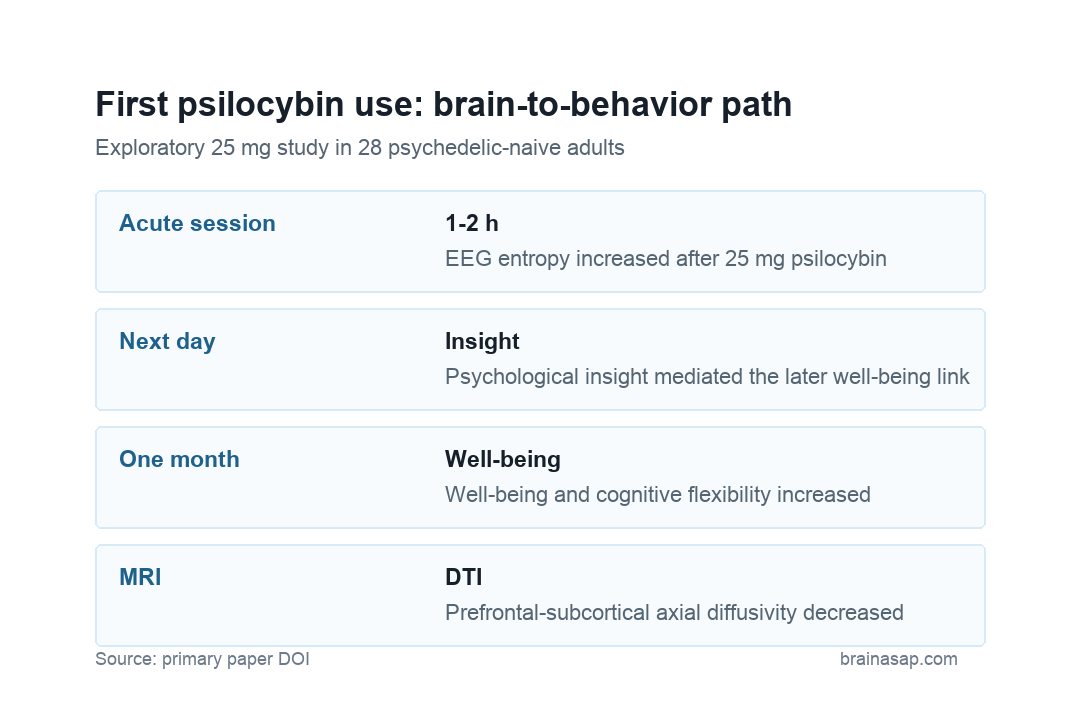
- Acute EEG entropy: Lempel-Ziv complexity, an entropy measure of how irregular or information-rich a time series is, increased at 1 and 2 hours after 25 mg psilocybin.
- One-month well-being: Cognitive flexibility, psychological insight, and well-being increased at one month after the 25 mg dose.
- DTI tract changes: Diffusion tensor imaging (DTI), an MRI method for white-matter microstructure, showed decreased axial diffusivity in overlapping prefrontal-subcortical tracts after 25 mg.
- Exploratory caveat: The fixed-order, within-subject design supports mechanistic hypotheses but does not provide a definitive clinical treatment test.
Source: Nature Communications (2026) | Lyons et al.
Psilocybin research often focuses on therapy outcomes, but this study asked a more mechanistic question: what happens in the brain during a first high-dose psychedelic experience, and do acute brain changes relate to later psychological change?
Psilocybin is converted into psilocin, a serotonin 2A receptor agonist. That receptor action is thought to drive many acute psychedelic effects, but lasting human brain changes after a single first exposure are still not well characterized.
First 25 mg Psilocybin Exposure Increased EEG Entropy
Researchers recorded eyes-closed, task-free EEG before dosing and at 1, 2, and 4.5 hours after dosing. After 25 mg psilocybin, Lempel-Ziv complexity increased at 1 and 2 hours, indicating more irregular and less compressible scalp electrical activity.
The high-dose session also reduced alpha power and changed other frequency bands. The 1 mg control session did not show the same acute EEG changes, which supports a dose-specific interpretation inside this fixed-order design.
- EEG entropy: More irregular electrical-activity structure during the acute psychedelic state.
- Alpha power: Reduced alpha activity after the 25 mg dose.
- Timing: The clearest acute changes appeared during the first 2 hours after dosing.
Entropy Predicted One-Month Psychological Well-Being Change
The EEG finding related to later behavior. Increased cortical entropy at 1 and 2 hours predicted improved psychological well-being at one month. Next-day psychological insight statistically mediated the entropy-to-well-being relationship.
That mediation result means the data fit a sequence in which acute brain entropy related to next-day insight, and insight related to later well-being. It remains a statistical pathway in a small exploratory sample, not proof that entropy caused well-being improvement.
Prefrontal-Subcortical DTI Measures Changed After 25 mg Psilocybin
Researchers also used MRI before dosing and one month later. Diffusion tensor imaging found decreased axial diffusivity in two overlapping pathways: a prefrontal cortex-to-striatum tract and a prefrontal cortex-to-thalamus tract.
Axial diffusivity is not a simple readout of new wiring. It reflects water diffusion along the main direction of a white-matter tract and can be influenced by several tissue properties. The paper treated these anatomical changes as replication targets that need clearer biological interpretation.
- Functional MRI: Enduring functional changes were limited rather than widespread.
- DTI: White-matter microstructure measures changed in overlapping prefrontal-subcortical tracts.
- Behavior: Well-being, insight, and cognitive flexibility improved at one month after 25 mg.
The Study Tested Mechanism, Not a Mental Health Treatment
Participants were healthy adults, not patients being treated for depression, addiction, or post-traumatic stress. The design was placebo-controlled within participants, but the sequence was fixed: 1 mg first, then 25 mg one month later.
Fixed order makes sense when a high-dose psychedelic experience could have lasting effects that contaminate later placebo testing. It also leaves room for expectancy, time, and order effects, so the strongest claims should stay mechanistic and exploratory.
The sample was also modest, with 28 participants, mean age about 41 years, and no previous psychedelic exposure. That design helps isolate first-use biology, but it cannot answer whether the same brain-behavior relationships appear in larger clinical groups.
The researchers combined several measurement windows. EEG captured acute drug-state activity, while functional MRI and diffusion MRI compared baseline with one-month follow-up. Behavioral measures assessed cognitive flexibility, insight, and well-being rather than symptom remission.
Because participants were psychedelic-naive, the 25 mg session also represented a first exposure rather than a repeat session in experienced users. That feature makes the design useful for studying early biological response, even though it may not match clinical protocols that include repeated preparation and integration visits.
Acute Brain Entropy May Be a Useful Psilocybin Research Marker
The most clinically relevant idea is not that entropy should be maximized. A better research question is whether acute brain dynamics help predict who benefits, who does not, and what psychological processes connect the drug session to later change.
If future randomized studies replicate the entropy-insight-well-being pathway, EEG could become a practical biomarker in psilocybin research. For now, the finding is a detailed first-exposure map in a small sample of healthy volunteers.
The measurements also separate acute and enduring effects. The high-dose session produced clear short-term EEG changes, but enduring functional MRI changes were limited. The stronger one-month anatomy finding came from diffusion measures in overlapping prefrontal-subcortical tracts.
Clinical readers should keep the outcome scale in mind. Improved well-being in healthy volunteers is not the same endpoint as remission from major depression, alcohol use disorder, or obsessive-compulsive disorder.
A cautious next step would test whether entropy, insight, and well-being show the same sequence when psychological support, diagnosis, dose, and expectancy are handled in a larger randomized design.
Citation: DOI: 10.1038/s41467-026-71962-3; Lyons et al; Human brain changes after first psilocybin use; Nature Communications; 2026;17:3977.
Study Design: Exploratory placebo-controlled, fixed-order, within-subject EEG and MRI study.
Sample Size: 28 healthy psychedelic-naive adults.
Key Result: EEG entropy increased at 1 and 2 hours after 25 mg psilocybin and predicted one-month well-being change.
Caveat: Small healthy-volunteer sample and fixed-order dosing limit clinical and causal interpretation.