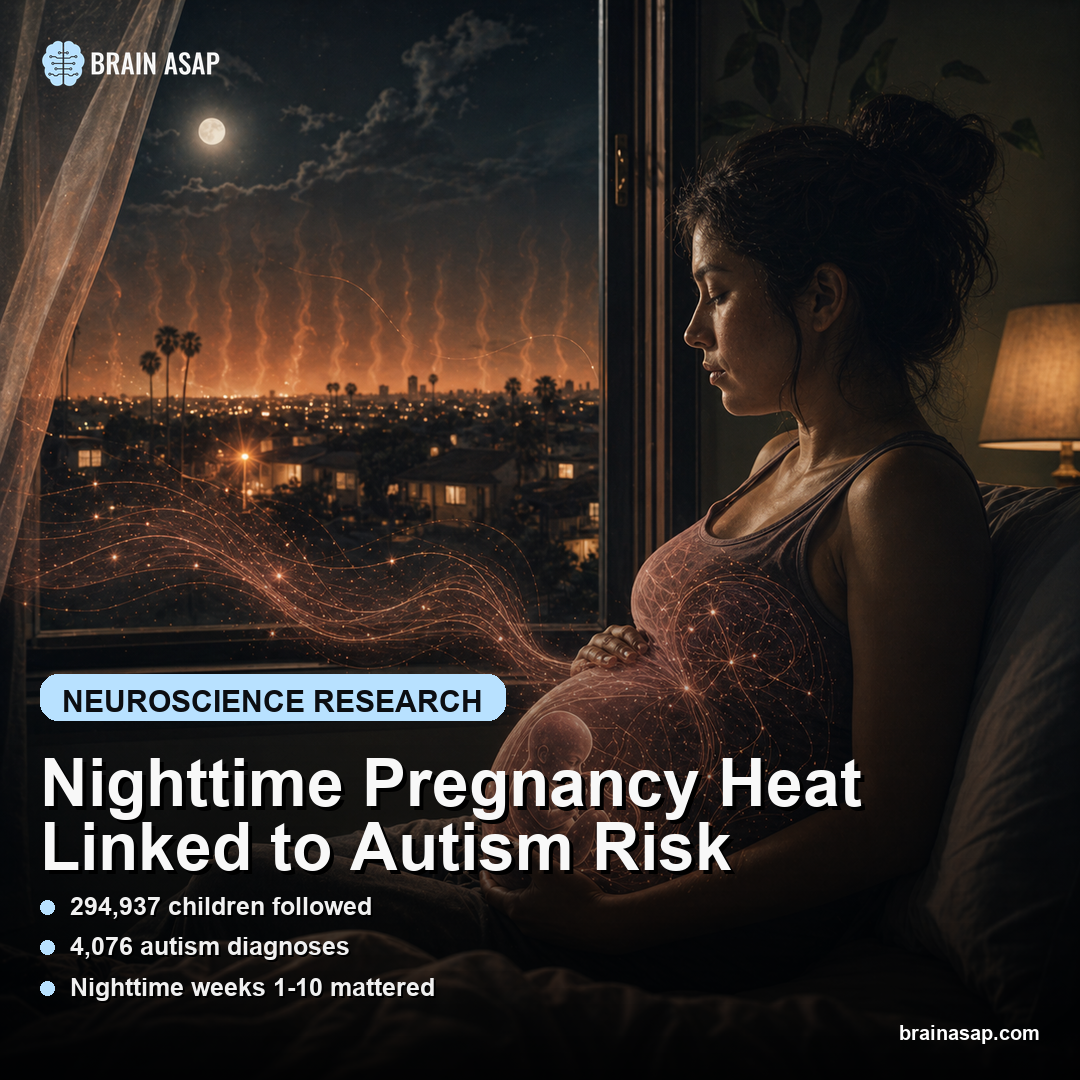
TL;DR: A 2026 study in Science of the Total Environment followed nearly 295,000 Southern California births and linked extreme nighttime heat in early and late pregnancy to higher autism diagnosis by age 5, while daytime heat was not associated.
Key Findings
- A large Southern California cohort anchored the estimate: The retrospective Kaiser Permanente Southern California birth cohort followed 294,937 children born from 2001 to 2014.
- 4,076 autism diagnoses: Autism diagnoses by age 5 were identified in electronic medical records; 80% of diagnosed children were male.
- Nighttime weeks 1-10 mattered: Extreme minimum temperature in gestational weeks 1-10 was associated with higher autism risk, HR 1.154 for the 99th versus 50th percentile.
- Late pregnancy also mattered: Extreme nighttime heat in weeks 30-37 was associated with higher risk, HR 1.132 for the 99th versus 50th percentile.
- Daytime heat was null: The study did not observe an association for weekly maximum temperature.
Source: Science of the Total Environment (2026) | Luglio et al.
Heat exposure is usually imagined as a daytime problem: sun, asphalt, dehydration. The key exposure here was nighttime heat during pregnancy, when the body normally has a chance to recover, cool down, and sleep.
Minimum Temperature Carried the Heat Association
Researchers separated weekly maximum temperature from weekly minimum temperature. In practical terms, that split approximates daytime heat versus nighttime heat.
The association appeared for minimum temperature, not maximum temperature. The temperature split points toward nights that stay hot, when pregnant people may have less chance to cool down, sleep well, restore fluid balance, and regulate body temperature.
A hot afternoon and a hot night can stress the body differently. Daytime heat may be easier to avoid with shade, schedule changes, or indoor time, while nighttime heat can follow people into sleep, housing quality, and access to air conditioning.
Minimum temperature is also a useful climate-health measure because it captures whether the environment cools down enough after sunset. A night that never cools can prolong heat strain even when daytime exposure looks manageable in the outdoor estimate.
Two Gestational Windows Carried the Risk
The first window was early pregnancy, weeks 1-10, when foundational developmental programs are unfolding. The second was late pregnancy, weeks 30-37, when fetal brain maturation and maternal physiological load are both high.
For the 99th percentile versus the 50th percentile of nighttime temperature, the hazard ratios were 1.154 and 1.132 in those windows. These are modest individual-level associations, but the exposure is population-wide.
- Weeks 1-10: extreme nighttime heat coincided with the earliest stages of embryonic and placental development.
- Weeks 30-37: extreme nighttime heat coincided with late fetal growth, increasing maternal metabolic load, and ongoing brain maturation.
- Daytime maximum temperature: weekly maximum heat did not show the same autism association in this analysis.
The two-window association also argues against treating pregnancy as one uniform exposure period. Heat during organ formation and heat during late gestation may affect different physiological systems, even when the outcome is measured years later.
Early pregnancy is when the placenta and foundational developmental programs are being established. Late pregnancy brings rapid fetal growth, higher maternal cardiovascular demand, and more heat sensitivity, so the same temperature exposure may have different biological consequences depending on timing.
The Cohort Size Makes a Small Effect Matter
A hazard ratio near 1.15 can sound underwhelming if read like a drug-trial result. Climate exposure works differently because millions of pregnancies can shift upward together during hotter years.
Electronic medical records identified 4,076 autism diagnoses in 294,937 children. A small relative-risk change across that many pregnancies becomes a meaningful prevention issue, especially as nighttime heat increases in a warming climate.
Residential temperature estimates were more specific than a single regional weather station. Coastal neighborhoods, inland valleys, apartment buildings, tree cover, and household cooling can create different heat experiences inside the same broad metropolitan region.
Even so, exposure modeling cannot tell whether a specific pregnant person slept in an air-conditioned room, worked overnight, opened windows, or experienced indoor heat that differed from outdoor estimates.
Those unmeasured details are part of why the finding should be read as a population association, not an individual prediction.
- Outdoor estimate: residential temperature may differ from indoor sleep conditions.
- Cooling access: air conditioning, shade, insulation, and utility costs can change real exposure.
- Clinical endpoint: autism diagnosis records are stronger than one-time concern reports, but still depend on healthcare access and recognition.
- Outdoor estimate: residential temperature may differ from indoor sleep conditions.
- Cooling access: air conditioning, shade, insulation, and utility costs can change real exposure.
- Clinical endpoint: autism diagnosis records are stronger than one-time concern reports, but still depend on healthcare access and recognition.
The Kaiser Permanente setting also gives the study a practical strength: autism diagnoses were pulled from electronic medical records rather than a one-time parent survey. Diagnosis records are still shaped by access and clinical recognition, but they provide a more concrete endpoint than self-reported developmental concern alone.
Nighttime Heat, Not Daytime Heat, Carried the Autism Signal
The absence of a Tmax association should make readers pause. It suggests the finding is not simply ‘hotter weather equals more autism risk’ in a broad sense.
The authors call for more work on why nighttime temperatures stood out. Possible explanations include recovery physiology, sleep disruption, indoor cooling patterns, or differences in exposure measurement, but the paper does not settle that mechanism.
Autism risk cannot be reduced to one environmental exposure, and the paper does not try to do that. The specific claim is that a climate-linked prenatal stressor appeared during specific gestational weeks after the authors modeled temperature timing and diagnosis records.
The result fits a broader public-health concern: nights are warming quickly in many places, and high overnight temperatures can reduce the body’s recovery time after daytime heat.
Pregnancy already increases cardiovascular and thermoregulatory demand, so persistent overnight heat is a plausible exposure to study even before a mechanism is fully mapped.
The null daytime result also reduces one common overread. The study did not find that every form of heat exposure moved autism risk in the same direction; the association was tied to weekly minimum temperature during two prenatal windows.
That specificity also helps future studies. Researchers can test sleep, indoor cooling, maternal temperature regulation, inflammation, and air-pollution mixtures during the exact weeks where this cohort showed the strongest association.
This Is a Risk Signal, Not a Diagnosis Explanation
Autism is heterogeneous and strongly influenced by genetics. This study does not say nighttime heat causes autism in an individual child.
Its value is environmental: it identifies a prenatal exposure window that can be planned around. Cooling access, housing quality, and heat-warning systems are not usually discussed as neurodevelopmental policy, but this study argues they belong in the conversation.
The practical prevention issue is also more realistic than telling pregnant people to avoid summer. Health systems can identify heat waves, prioritize cooling support, and treat overnight indoor temperature as a maternal-health issue rather than only a comfort issue.
Future work needs better indoor exposure data, replication outside Southern California, and designs that can separate heat from air pollution, socioeconomic stress, neighborhood infrastructure, and healthcare access. The study narrows the target: nighttime heat during early and late pregnancy deserves closer neurodevelopmental attention.
The intervention target is concrete. The exposure is not “weather” in the abstract; it is overnight heat during pregnancy, especially in households where cooling access is limited or expensive.
The equity issue is unavoidable. The same outdoor nighttime temperature can mean very different fetal exposure depending on housing insulation, air-conditioning access, utility costs, neighborhood shade, and whether a pregnant person can safely cool the home at night.
Citation: DOI: 10.1016/j.scitotenv.2026.181373. Luglio et al. Prenatal exposure to extreme heat and autism in children. Science of the Total Environment. 2026;1017:181373.
Study Design: Retrospective birth cohort with weekly residential temperature exposure and nonlinear distributed-lag Cox models.
Sample Size: 294,937 children born in Kaiser Permanente Southern California hospitals from 2001 to 2014; 4,076 had autism diagnosis by age 5.
Key Statistic: Extreme nighttime temperature was associated with autism risk in weeks 1-10 (HR 1.154, 95% CI 1.040-1.288) and weeks 30-37 (HR 1.132, 95% CI 1.030-1.246), comparing the 99th to 50th percentile.
Caveat: Residential outdoor temperature estimates cannot prove individual indoor heat exposure or causality.