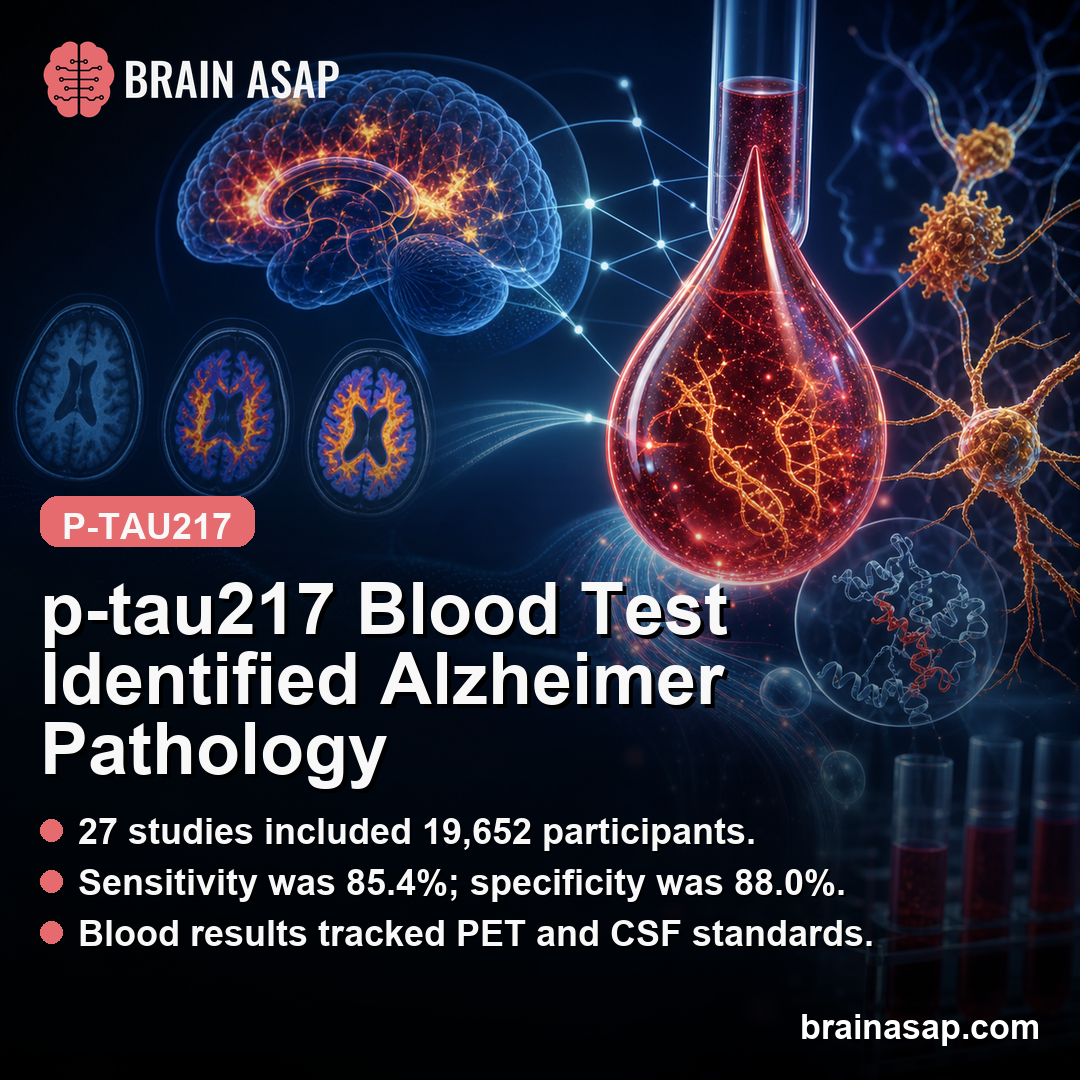
TL;DR: A 2026 systematic review and meta-analysis in Molecular Neurobiology found that plasma phosphorylated tau 217 (p-tau217), a blood marker of Alzheimer-linked tau pathology, identified biomarker-defined Alzheimer’s disease with pooled sensitivity of 85.4% and specificity of 88.0% across 27 studies.
Key Findings
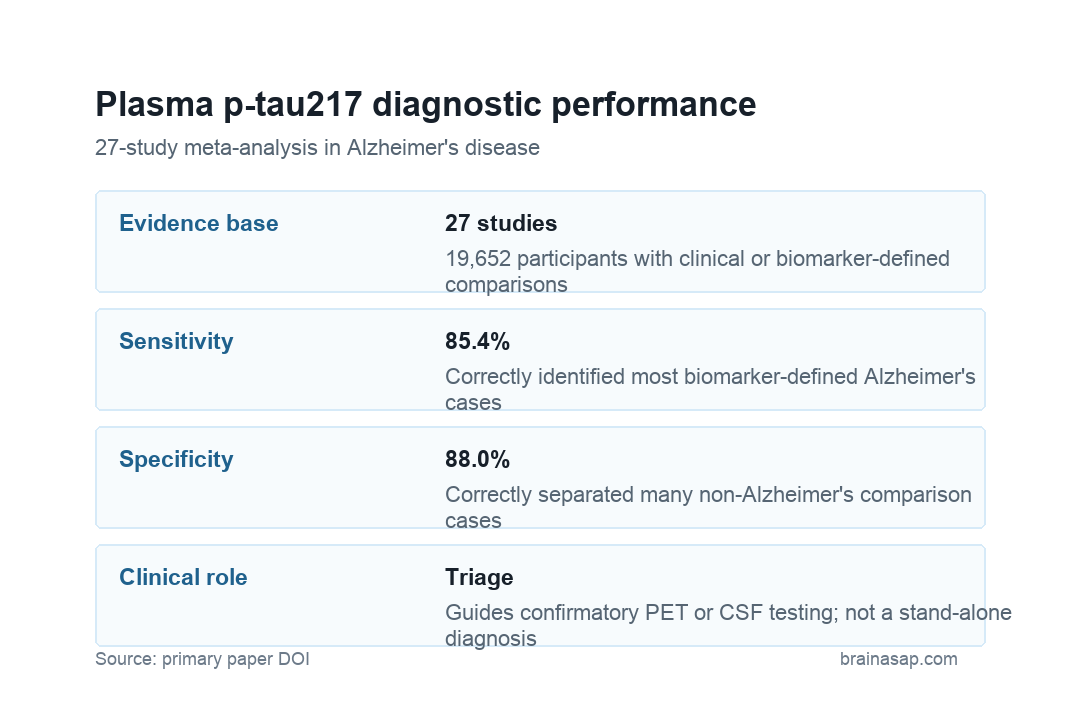
- 27-study evidence base: Researchers analyzed 19,652 participants from studies that compared plasma p-tau217 with amyloid positron emission tomography (PET), tau PET, cerebrospinal fluid (CSF), a fluid sample taken from around the brain and spinal cord, or clinical Alzheimer’s diagnosis.
- 85.4% sensitivity: Plasma p-tau217 correctly identified most biomarker-defined Alzheimer’s cases, with a 95% posterior interval of 81.4% to 88.7%.
- 88.0% specificity: The blood marker also separated many non-Alzheimer’s comparison cases, with a 95% posterior interval of 85.1% to 90.6%.
- 42.7 diagnostic odds ratio: Positive and negative likelihood ratios supported triage use, especially when the blood test guides who should receive confirmatory PET or CSF testing.
- Assay caution: Cutoffs, platforms, populations, and reference definitions differed across studies, so the review does not turn p-tau217 into a stand-alone diagnosis.
Source: Molecular Neurobiology (2026) | Gebril et al.
Alzheimer’s disease is increasingly defined by biology, not only by memory symptoms. Amyloid beta plaques and tau tangles can be measured with positron emission tomography (PET), a brain scan using a radioactive tracer, or through CSF assays, but those tools are expensive, invasive, or limited to specialty centers.
Plasma p-tau217 is being studied because it could move the first diagnostic step into a standard blood draw. The marker reflects tau phosphorylation at threonine 217, a change closely tied to Alzheimer’s pathology rather than ordinary aging alone.
Plasma p-tau217 Was Tested Against PET, CSF, and Clinical Alzheimer’s Diagnosis
Researchers searched PubMed, Scopus, and Web of Science through July 2025 and included studies that reported diagnostic accuracy for Alzheimer’s disease or Alzheimer’s-type biomarker positivity. The review followed PRISMA methods, assessed study quality with QUADAS-2, and pooled diagnostic performance with a Bayesian bivariate model.
The final dataset included 27 studies and 19,652 participants. Reference standards varied, which is both a strength and a limitation: the marker was not tested against a single artificial benchmark, but the pooled estimate had to combine different diagnostic contexts.
- Amyloid reference standards: Some studies compared plasma p-tau217 with amyloid PET or CSF amyloid measures.
- Tau reference standards: Other studies used tau positivity, where p-tau217 had especially high specificity.
- Clinical diagnosis: A smaller subset used clinical Alzheimer’s disease diagnosis, which produced lower sensitivity than biomarker-defined comparisons.
Blood p-tau217 Showed High Sensitivity and Specificity
The pooled estimates were clinically meaningful. Sensitivity was 85.4%, meaning the marker detected most people with Alzheimer’s-type pathology in the included datasets. Specificity was 88.0%, meaning many people without the reference-standard Alzheimer’s signal were correctly classified as negative.
Likelihood ratios describe how much a test changes diagnostic probability. The positive likelihood ratio was 7.13, and the negative likelihood ratio was 0.167. Those values support a triage role: a positive test can raise concern enough to justify confirmatory workup, while a negative test can lower the probability in many settings.
Alzheimer’s Biomarker Accuracy Varied by Reference Standard
When studies used amyloid positivity as the reference, plasma p-tau217 had sensitivity of 87.3% and specificity of 85.5%. For tau positivity, sensitivity was 84.9% and specificity reached 93.8%, consistent with the marker’s direct link to tau biology.
Clinical diagnosis was harder. Sensitivity was 72.9% and specificity was 89.5% for clinically defined Alzheimer’s disease. That difference is expected because clinical diagnosis can include mixed dementia, vascular disease, atypical presentations, and variable access to biomarker confirmation.
- Best use case: The marker may help decide who needs PET, CSF testing, or specialty evaluation.
- Lower-confidence use case: A single blood result should not replace a full dementia assessment.
- Implementation need: Clinics still need standardized assays, validated cutoffs, and population-specific performance data.
p-tau217 Could Make Alzheimer’s Workups More Accessible
Blood biomarkers are attractive because they can be repeated, scaled, and offered outside major memory centers. A reliable triage test could reduce unnecessary PET scans, identify likely Alzheimer’s biology earlier, and help enroll patients into trials where amyloid or tau status matters.
Access is especially relevant now that anti-amyloid treatments require accurate diagnosis and monitoring. A blood draw cannot answer every question, but it can make the diagnostic pathway less dependent on a lumbar puncture or expensive imaging as the first step.
The review also fits a broader shift in dementia medicine. Biomarker-defined Alzheimer’s disease increasingly determines trial entry, treatment eligibility, and counseling, so scalable blood tests could make the first step more consistent across clinics.
For patients, the advantage is not only convenience. Earlier triage may reduce months of uncertainty when memory symptoms overlap with depression, sleep problems, vascular disease, medication effects, or other causes of cognitive change.
Assay Differences Still Limit Clinical Certainty
The meta-analysis also explains why clinicians should be cautious. Studies used different assay platforms and cutoff strategies, and some thresholds were optimized inside the original study datasets. A threshold that performs well in one cohort may perform differently in primary care, in a mixed dementia clinic, or in racially and medically diverse populations.
The most practical interpretation is that plasma p-tau217 is a strong candidate for triage and risk stratification. Confirmatory testing, clinical history, cognitive testing, and imaging still matter when the result will affect treatment, counseling, or trial eligibility.
Citation: DOI: 10.1007/s12035-026-05864-2; Gebril et al; From Cerebrospinal Fluid to Blood Draw: Plasma p-Tau217 as a Non-Invasive Biomarker for Alzheimer’s Disease: A Fagan Nomogram-Based Meta-Analytic Study; Molecular Neurobiology; 2026;63:606.
Study Design: Systematic review and Bayesian diagnostic meta-analysis.
Sample Size: 27 studies including 19,652 participants.
Key Statistic: Pooled sensitivity 85.4% and specificity 88.0% for biomarker-defined Alzheimer’s disease.
Caveat: Assay heterogeneity, optimized cutoffs, and different reference standards limit direct clinical replacement of PET or CSF testing.