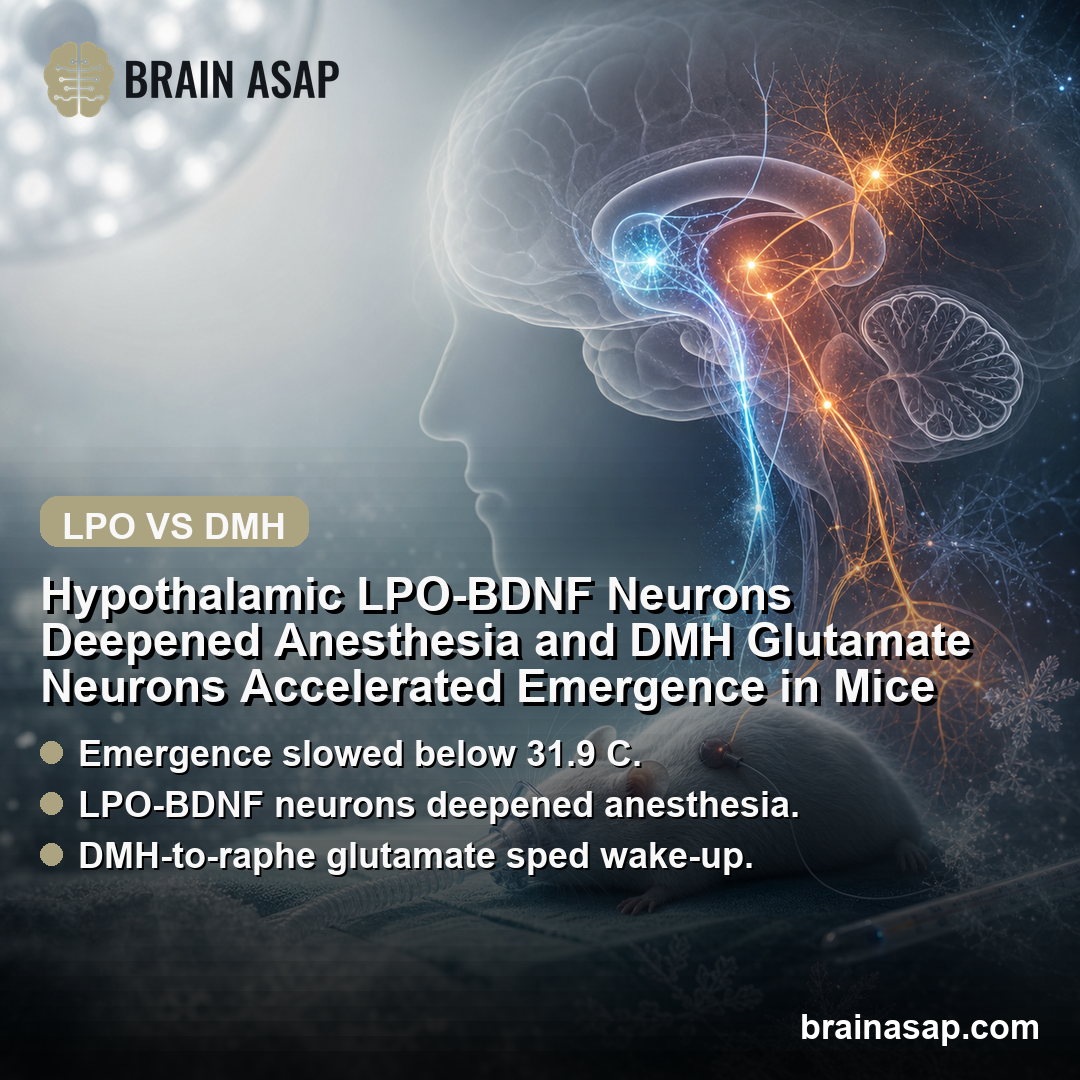
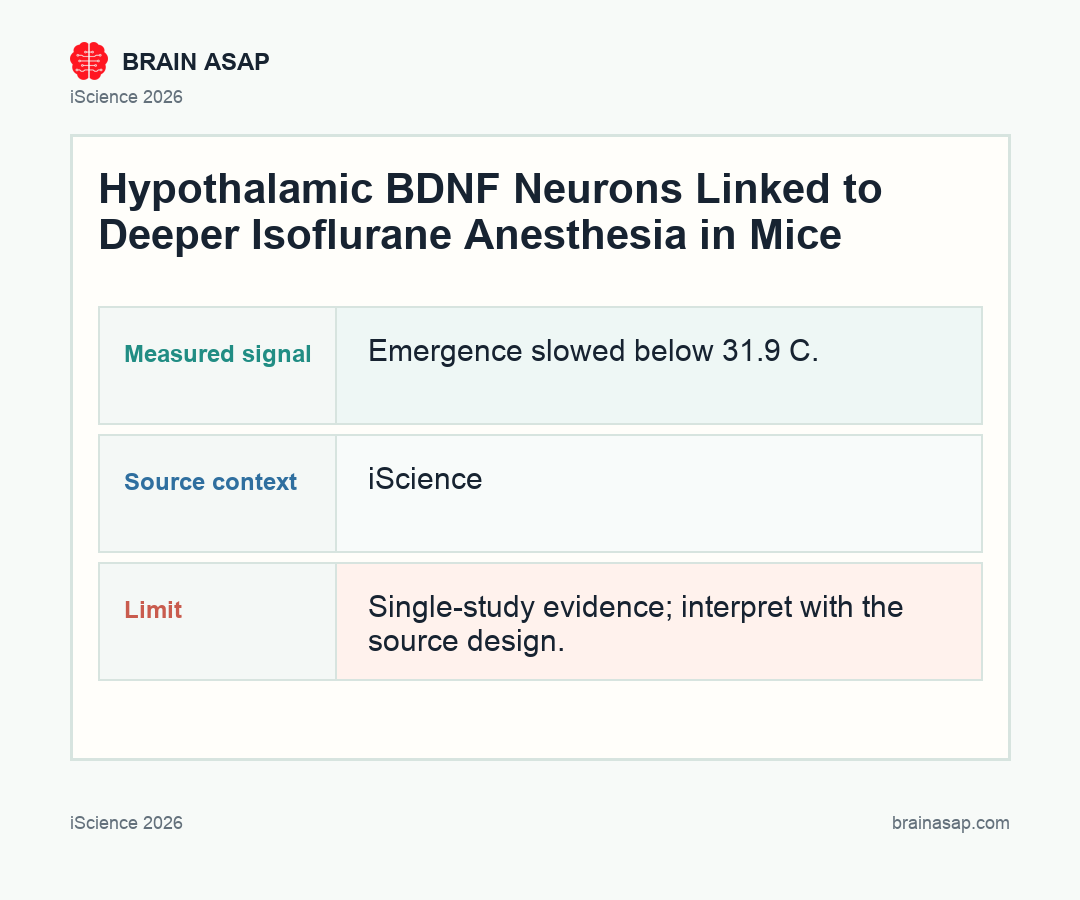
TL;DR: A 2026 mouse study in iScience found that anesthetic emergence slowed sharply below 31.9°C because two hypothalamic thermoregulatory pathways pushed anesthesia in opposite directions: preoptic BDNF neurons deepened anesthesia, while a dorsomedial-hypothalamus-to-raphe-pallidus glutamate pathway accelerated emergence.
Key Findings
- Emergence delay grows logarithmically below 31.9°C core temperature: In mice, anesthetic emergence time increases logarithmically as core body temperature drops below 31.9°C — defining a specific threshold for the temperature-anesthesia relationship.
- BDNF-expressing preoptic neurons deepen anesthesia temperature-dependently: Lateral preoptic area (LPO) BDNF neurons potentiate anesthetic depth through a mechanism that scales with temperature changes.
- DMH→RPa glutamatergic projection accelerates emergence independently of temperature: A dorsomedial hypothalamus (DMH) glutamatergic projection to raphe pallidus (RPa) speeds anesthetic emergence through mechanisms that don’t depend on temperature changes.
- Two opposite-direction pathways from neighboring hypothalamic neurons: The preoptic and DMH circuits sit in adjacent thermoregulatory territory but push anesthesia in opposite directions through fundamentally different mechanisms.
- Reframes anesthetic emergence as actively gated: Anesthesia isn’t passively reversed when drug clears — specific neural circuits actively modulate how quickly consciousness returns.
- Clinical implication for hypothermia in surgery: The intentional hypothermia used in some surgeries (cardiac, neurosurgical) may interact with anesthetic recovery through more circuits than the field has appreciated.
Source: iScience (2026) | Cai, Yang, Xu, Yu, Zheng, Shen et al.
Surgical anesthesia has a clinical pattern that anesthesiologists know well: cold patients take longer to wake up. The longer the surgery and the lower the body temperature, the slower the return to consciousness.
Most accounts have framed this as an indirect drug-metabolism issue: cold slows enzymes, and anesthetic clearance lags. Cai and colleagues identified a more specific circuit explanation. Hypothalamic neurons that normally regulate body temperature also feed back into anesthetic depth.
Why Anesthesia Depth Has More Than One Mechanism
The standard mental model of anesthesia is pharmacological: a drug like isoflurane reaches the brain, binds GABA-A receptors and other targets, suppresses cortical and subcortical activity, produces unconsciousness. Wake-up happens when the drug clears. Most clinical thinking treats anesthetic emergence as a passive process — just drug elimination.
The Cai paper challenges that picture. The hypothalamus contains neurons whose normal job is body temperature regulation, but these same neurons turn out to actively gate how deep anesthesia goes and how quickly emergence happens. Two neighboring populations work in opposite directions:
- BDNF preoptic neurons push anesthesia deeper as temperature falls.
- DMH→RPa glutamatergic neurons push emergence faster, independent of temperature.
This is a real reframing: anesthetic depth is the net output of competing circuits, some scaling with temperature and some operating independently of it.
The 31.9°C Threshold and Why It Matters Clinically
The team identified a specific core-body-temperature threshold: below 31.9°C, anesthetic emergence delay grows logarithmically rather than linearly. That’s not an academic curiosity:
- Cardiac surgery intentionally cools patients to lower metabolic demand, sometimes well below 31.9°C in deep hypothermic circulatory arrest.
- Targeted temperature management after cardiac arrest typically operates around 33°C — close to the threshold.
- Long surgeries can produce inadvertent hypothermia in non-cooled patients, particularly elderly or low-body-weight individuals.
- Neurosurgical procedures sometimes use hypothermia for neuroprotection during specific phases.
If emergence delay grows logarithmically below this threshold, prolonged operative hypothermia could produce extended post-anesthetic recovery times that aren’t simply explained by drug metabolism. The clinical question becomes: are we under-modeling the temperature dependence of anesthetic recovery?
Why Two Pathways Going Opposite Directions Is the Interesting Story
The bigger conceptual move in the Cai paper is showing that hypothalamic thermoregulatory circuits don’t all push the same direction on anesthesia. Two pathways from neighboring populations do opposite work:
- LPO BDNF neurons: Brain-derived neurotrophic factor-expressing neurons in the lateral preoptic area — a region long known for sleep and thermoregulation — potentiate anesthetic depth as temperature drops. The mechanism is temperature-dependent, meaning it scales with how cold the body is getting.
- DMH→RPa Vglut2 neurons: Glutamatergic projection neurons from the dorsomedial hypothalamus to the raphe pallidus — part of the brainstem thermoregulatory output system — accelerate anesthetic emergence. This effect is temperature-independent, meaning it operates through a non-thermal mechanism.
The implication is that the hypothalamus isn’t a single dial setting anesthetic depth. It’s a balance between competing circuits, some thermally gated and some not, whose net activity determines how deep the patient is and how fast they wake.
What “Temperature-Dependent vs Temperature-Independent” Mechanism Means
The split between the two pathways tells a deeper story about how the hypothalamus integrates information:
- The temperature-dependent pathway (LPO BDNF): Likely senses thermal information directly or through warm-sensitive neurons, then modulates downstream targets in proportion to thermal state. As temperature falls, these neurons increase their anesthesia-deepening output.
- The temperature-independent pathway (DMH→RPa): Operates through projection-specific signaling that doesn’t track thermal state. Its emergence-accelerating effect persists regardless of body temperature.
The dual-mechanism design means the hypothalamus can balance anesthetic depth even when temperature is changing — one circuit responds to cold by deepening anesthesia, while another constitutively pushes toward emergence. The competing circuits stabilize the net response across the temperature ranges patients actually encounter.
What This Reveals About How Consciousness Returns After Surgery
The Cai findings fit a growing picture in anesthesia neuroscience: the brain doesn’t passively recover from drug action — specific circuits actively gate the return of consciousness. Other recent work has identified arousal-promoting circuits in the lateral hypothalamus, brainstem cholinergic systems, and basal forebrain that play similar roles. The Cai paper extends this picture to hypothalamic thermoregulatory neurons.
This has clinical implications:
- Anesthetic emergence is shaped by patient state, not just drug pharmacokinetics. Body temperature, hypothalamic function, and possibly other factors that modulate these circuits all matter.
- Targeted activation of arousal-promoting circuits (like DMH→RPa) might accelerate emergence in a controlled, drug-free way — potentially useful when prolonged emergence is a clinical problem.
- Temperature management during and after surgery may interact with anesthetic recovery through specific neural circuits, not just enzyme kinetics.
- Individual variation in emergence timing may partly reflect baseline hypothalamic function or thermoregulatory capacity.
The Honest Limits of This Mouse Study
- Mouse anesthesia is not human anesthesia. Translational distance is real for any animal anesthesia work. Specific isoflurane sensitivities, threshold temperatures, and pathway proportions may differ in humans.
- Isoflurane is one anesthetic. Whether the same circuits gate anesthesia from propofol, ketamine, sevoflurane, or other agents requires separate testing — especially since these drugs have different molecular targets.
- The 31.9°C threshold is mouse-specific. Human threshold temperatures will need direct measurement; mice and humans have different baseline core temperatures and thermoregulatory capacities.
- The clinical translation isn’t immediate. Knowing the circuits exist doesn’t yet provide a clinically usable intervention to manipulate them in patients.
Why This Matters Beyond Anesthesia Research
The hypothalamic thermoregulatory system has connections to sleep, arousal, metabolism, and stress responses that go well beyond anesthesia. If two neighboring hypothalamic populations can push competing effects on anesthetic state through temperature-dependent and temperature-independent mechanisms, similar dual-pathway architectures probably operate in normal sleep-wake regulation, fever responses, and other state transitions.
The Cai paper is most directly an anesthesia paper, but the architecture it reveals — opposite-direction circuits from adjacent hypothalamic populations, with one gated by temperature and one not — is a template for thinking about how the hypothalamus more broadly stabilizes physiological states across varying conditions. The next decade of hypothalamic circuit research will probably find similar dual-pathway designs in many functions the field currently treats as monolithic.
Citation: Cai S, Yang WZ, Xu M, et al. Hypothalamic thermoregulatory neurons divergently modulate isoflurane anesthesia via temperature dependent and independent mechanisms. iScience. 2026.
Study Design: Mouse anesthesia experiments combining behavioral measurement of anesthetic emergence at varying core body temperatures with circuit-specific manipulation of hypothalamic neuron populations (LPO BDNF neurons; DMH glutamatergic projections to raphe pallidus).
Sample/Model: Mice undergoing isoflurane anesthesia — see full publication for sample sizes per experiment.
Key Result: Below 31.9°C core temperature, anesthetic emergence delay grows logarithmically. LPO BDNF neurons potentiate anesthetic depth through temperature-dependent mechanisms; DMH→RPa glutamatergic projections accelerate emergence through temperature-independent mechanisms.
Caveat: Mouse model with isoflurane specifically; threshold temperatures and pathway proportions likely differ in humans; clinical translation requires confirmation that homologous circuits operate in human anesthesia and direct testing across other anesthetic agents.