TL;DR: A 2026 study in PLOS One found that Big Five personality traits were linked to how often 5,225 partnered adults reported sexual fantasies: conscientiousness and agreeableness predicted lower fantasy frequency, while the depression facet of negative emotionality predicted higher frequency.
Key Findings
- Partnered adult sample: researchers surveyed 5,225 partnered adults recruited through Qualtrics Panels, with a mean age of 58.3 years.
- Conscientiousness predicted fewer fantasies: higher conscientiousness was linked to lower frequency across exploratory, intimate, impersonal, and sadomasochistic fantasy domains.
- Agreeableness also predicted lower frequency: the association was weaker after controls, but it remained part of the broad pattern.
- Depressive tendency predicted more frequency: the depression facet of negative emotionality was the clearest positive facet-level predictor.
- Extraversion and open-mindedness were less informative: both showed small or inconsistent relationships once other traits, age, and gender were considered.
Source: PLOS One (2026) | Cannoot et al.
Sexual fantasies are common, but research often treats them as either embarrassing, clinical, or too private to study carefully.
This paper took a more ordinary psychological question: do broad personality traits help explain why some people report sexual fantasies more often than others?
The answer was yes, but not in a dramatic or deterministic way. Personality helped predict frequency, especially when the researchers looked beneath broad Big Five labels and into narrower facets such as responsibility, respectfulness, and depressive tendency.
5,225 Partnered Adults Linked Big Five Traits to Fantasy Frequency
The study analyzed 5,225 adults recruited from Qualtrics Panels. Participants were between 18 and 94 years old, and everyone in the sample was currently married or dating.
Relationship context affects interpretation. This was not a general population snapshot of every adult.
The sample consisted of partnered adults, many of whom were older and in long relationships. The mean relationship length was nearly 30 years.
Participants completed a short Big Five personality measure covering five broad traits:
- Extraversion: sociability, assertiveness, and energy level.
- Agreeableness: compassion, respectfulness, and trust.
- Conscientiousness: organization, productiveness, and responsibility.
- Negative emotionality: anxiety, depression, and emotional volatility.
- Open-mindedness: aesthetic sensitivity, intellectual curiosity, and creative imagination.
Sexual fantasies were measured with a 40-item questionnaire. Participants rated how often they had fantasies across four broad domains: exploratory, intimate, impersonal, and sadomasochistic.
The study focused on frequency, not whether a fantasy was good, bad, desired, acted on, distressing, or meaningful in a relationship. That keeps the result narrower, but also cleaner.
Conscientiousness and Agreeableness Predicted Lower Fantasy Frequency
Conscientiousness was the most consistent negative predictor. Higher conscientiousness was associated with lower overall fantasy frequency and lower frequency in all four fantasy domains.
The two strongest negative trait-level patterns were:
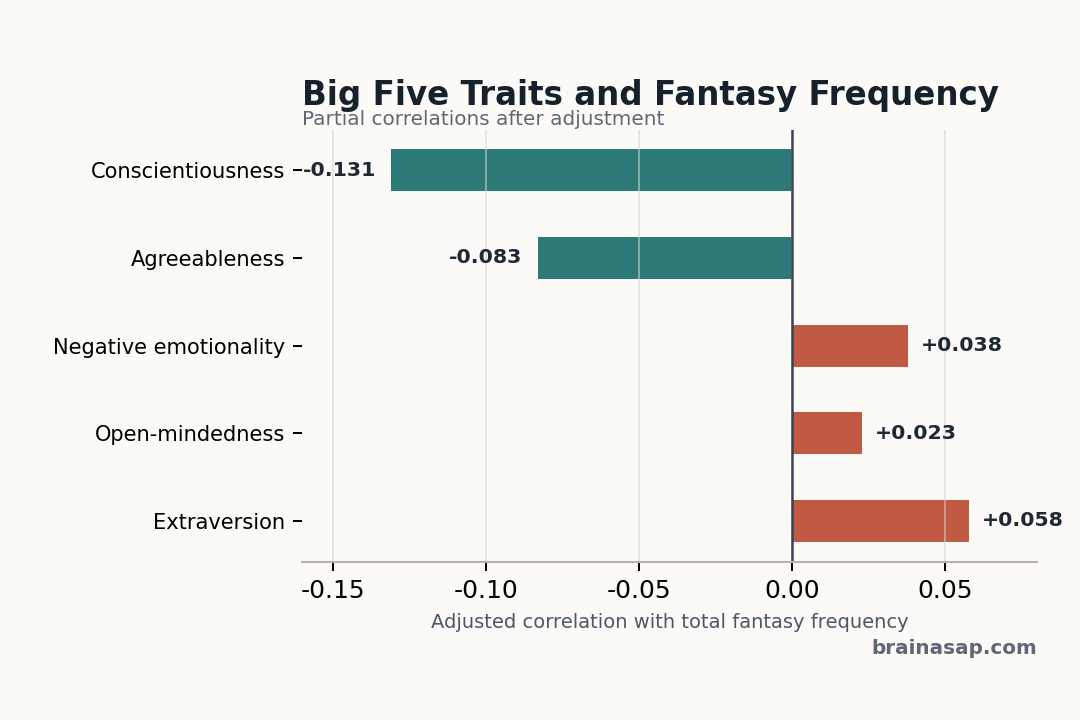
- Conscientiousness: the simple correlation with total fantasy frequency was r = -0.265; after adjusting for other traits, age, and gender, the partial correlation was r = -0.131.
- Agreeableness: the simple correlation was r = -0.228; the adjusted partial correlation was r = -0.083.
Those are not large effects. They do not let anyone infer a person’s private thoughts from a personality score.
Cleaner interpretation: people who scored higher in conscientiousness and agreeableness tended, on average, to report fewer sexual fantasies. The association was strongest before adjustment and remained smaller after accounting for overlapping personality traits and demographics.
Responsibility and Respectfulness Explained Much of the Lower-Frequency Pattern
The facet analysis gave the study more precision than a basic Big Five result.
For conscientiousness, the important subcomponent was responsibility, not organization or productiveness. For agreeableness, the important subcomponent was respectfulness, not compassion or trust.
That distinction helps prevent a vague personality explanation. The paper does not suggest that being orderly, productive, compassionate, or trusting is the key issue.
Instead, lower reported fantasy frequency was most tied to facets that involve responsibility, norm-following, and respect for rules or others. The authors interpret this cautiously, suggesting that some people high in these facets may be less likely to engage in sexual thinking that feels nontraditional or norm-violating.
Important caveat: the study measured self-reported fantasy frequency, not moral judgment, sexual satisfaction, behavior, or relationship quality. Responsibility and respectfulness were linked to reporting fewer fantasies, not necessarily to healthier or less healthy sexuality.
Depression Facet Predicted More Frequent Sexual Fantasies
Negative emotionality was associated with more frequent fantasies, but the broad trait became much less informative after controls.
The more specific result came from the depression facet. People who scored higher on depressive tendency reported more frequent sexual fantasies across domains. Anxiety and emotional volatility were not the same kind of predictors.
Negative emotionality can mean several things. A person might be anxious, emotionally reactive, prone to sadness, or some mixture of those. In this dataset, the fantasy-frequency association was clearest for depressive tendency.
The authors discuss one possible interpretation: fantasies may sometimes function as emotion regulation or as positive mental content during negative mood states. That is plausible, but the study cannot prove it.
Safer wording: the data show that the depression facet was associated with more frequent sexual fantasizing. They do not show whether fantasies were helping mood, worsening distress, reflecting loneliness, improving intimacy, or doing different things for different people.
Extraversion and Open-Mindedness Were Weak Predictors
Some readers might expect extraversion or open-mindedness to dominate this kind of result. The study did not find that.
Extraversion had small positive relationships with fantasy frequency mainly after covariates were included. Open-mindedness was mostly unrelated, except for a small positive relationship with intimate fantasies in some analyses.
That is a needed correction to easy assumptions. A more sociable or more imaginative personality does not automatically translate into much higher fantasy frequency once other traits, age, and gender are included.
The larger pattern was more about self-regulation, responsibility, respectfulness, and depressive tendency than about social boldness or artistic curiosity.
Self-Report and Cross-Sectional Design Limit the Claim
The study had several strengths: a large sample, facet-level personality data, and a questionnaire that separated fantasy domains instead of treating sexual fantasy as one flat category.
The limitations are also straightforward.
- Self-report: sexual fantasy is sensitive, so embarrassment, privacy concerns, or social desirability may affect answers.
- Cross-sectional design: the data show associations at one point in time, not whether personality causes changes in fantasies.
- Partnered sample: all participants were married or dating, so the findings may not generalize to single adults or people in different relationship structures.
- Frequency only: the study did not test whether fantasies were wanted, distressing, fulfilling, private, shared, or connected to relationship outcomes.
Because the sample was large, even tiny correlations could become statistically significant. The authors therefore emphasized magnitude and robustness rather than treating every significant result as practically large.
Sexual wellbeing research needs individual differences.
The main contribution is not that any personality trait “explains” sexual fantasy. It does not.
Better summary: sexual fantasies are common, variable, and patterned enough that personality can help describe part of that variation.
For clinicians, educators, and researchers, that supports a less pathologizing approach. Frequency by itself should not be treated as a warning sign without context. People differ in how often sexual thoughts arise, what role those thoughts serve, and whether they matter in daily life or relationships.
The facet-level result also suggests that broad personality labels can hide the relevant part.
Negative emotionality was less informative than depressive tendency. Conscientiousness was less specific than responsibility. Agreeableness was less specific than respectfulness.
Practical reading: personality does not decode private desire, but it may help researchers ask better questions about sexual thought, emotion regulation, norms, and relationship context.
Source: DOI: 10.1371/journal.pone.0329745
Authors: Cannoot E, Moors AC, Chopik WJ.
Paper: Associations between Big Five personality traits, facets, and sexual fantasies. PLOS One. 2026;21(2):e0329745.
Study Design: Cross-sectional online survey of partnered adults using Big Five personality traits, Big Five facets, and a 40-item sexual fantasy questionnaire.
Sample Size: 5,225 adults, ages 18 to 94, recruited through Qualtrics Panels.
Key Statistic: Conscientiousness had the strongest adjusted negative association with total fantasy frequency (partial r = -0.131), while negative emotionality showed a smaller adjusted positive association (partial r = 0.038).