TL;DR: A 2026 study in Journal of Experimental Psychology: Learning, Memory, and Cognition found that across 12 online experiments, memorable faces helped people remember paired names, but memorable scenes did not give the same boost to paired city names or first names. The result suggests that some faces are better retrieval cues, and that face memorability can carry over to associated person-like information.
Key Findings
- 12 online experiments tested paired memory: participants saw faces or scenes while hearing names or city names.
- 120 face images were used in the face experiments: the researchers selected highly memorable and highly forgettable faces from a standardized database.
- Recognition replicated the basic memorability effect: high-memorability images were recognized better than low-memorability images.
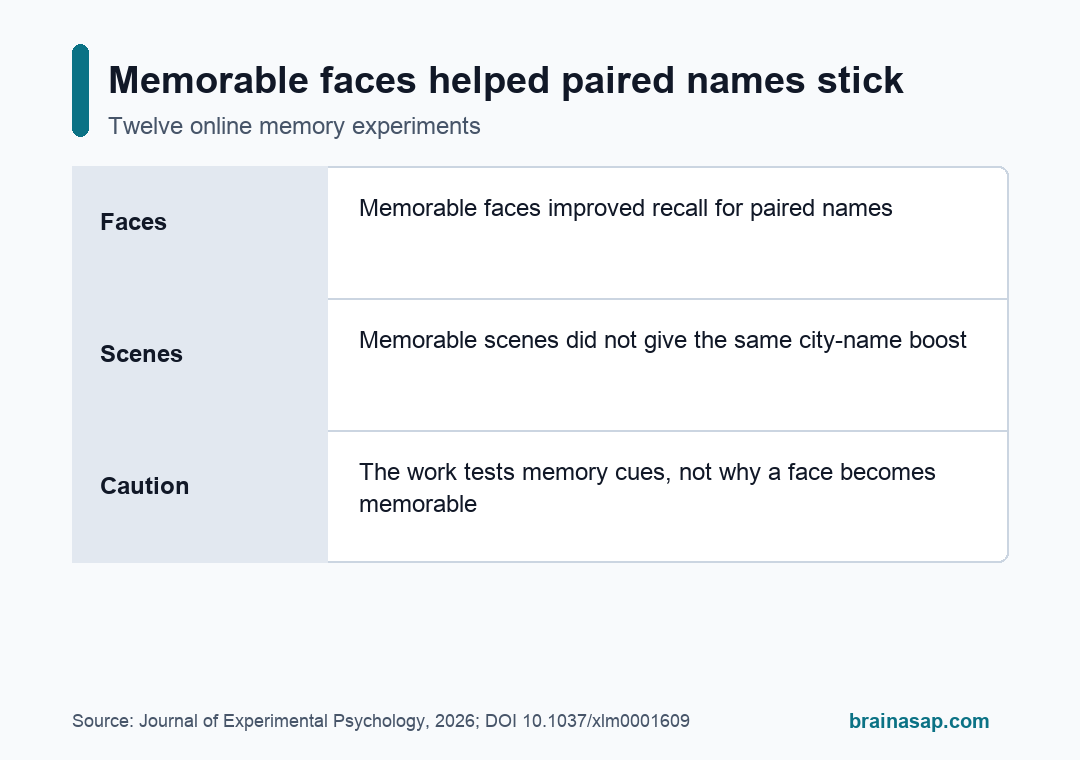
- Faces boosted associated recall: first names and city names paired with memorable faces were more likely to be remembered.
- Scenes did not transfer the same benefit: memorable scenes were recognized well, but they did not reliably improve recall of paired city names or first names.
Source: Journal of Experimental Psychology: Learning, Memory, and Cognition (2026) | Cook et al.
Forgetting a name is usually treated as a failure of effort.
You met someone, heard the name, recognized the face later, and still could not pull the name out.
This study adds a helpful twist: the face itself affects how easy the name is to retrieve.
The study is about memorability.
In memory research, memorability means that some stimuli are consistently remembered by many different people.
A face can be memorable not just because one person found it informative, but because many people tend to remember that face better than other faces.
Cook and Westerman asked whether memorability stays attached only to the image, or whether it can help associated information.
If a highly memorable face is paired with the name “Andrew,” does the face make “Andrew” easier to recall later?
Memorability Means Some Images Are Remembered by Almost Everyone
Memorability is not the same as beauty, strangeness, emotion, or personal preference. A memorable image is one that tends to be remembered across many observers.
Different people often remember and forget the same images at surprisingly similar rates. Memorability is therefore a property of the cue, not only a property of the learner.
In this study, the cue is plausibly a face or a scene. The associated information is plausibly a first name or a city name.
The researchers used high- and low-memorability images so they could ask a clean test: if two people learn names under similar conditions, but one name is paired with a more memorable face, does that name have an advantage later?
The answer for faces was yes. Highly memorable faces did not simply help people recognize the faces themselves. They also helped people retrieve the information paired with those faces.
The 12 Experiments Separated Faces, Scenes, Names, and Cities
The 12 experiments changed the cue and the associated information, so the finding was not limited to one obvious face-name setup.
- Face plus first name: participants saw a face and heard a common first name.
- Face plus city name: participants saw a face and heard a city name, testing whether faces can boost non-person information too.
- Scene plus city name: participants saw indoor or outdoor scenes paired with cities, a more natural match for places.
- Scene plus first name: participants saw scenes paired with first names, testing whether any memorable image can help any name.
If memorable scenes had helped city names just as much as memorable faces helped first names, the result would support a general “memorable images help paired facts” effect.
Instead, the strongest transfer came from faces.
That finding suggests face memorability is especially good at supporting associated verbal information, perhaps because faces are naturally used to identify people and retrieve social information.
Cued Recall and Free Recall Tested Two Kinds of Retrieval
The paper also separated cued recall from free recall.
- Cued recall: the participant sees the face again and types the name that was paired with it.
- Free recall: the participant lists remembered names without seeing the original face cue.
Memorable faces helped in both settings.
Cued recall could be explained by the face simply being a stronger prompt at test, but free recall suggests the face-name pairing had been encoded in a way that made the name more available even when the face was not shown again.
The effect is not a guarantee that every memorable face will rescue a name. Across experiments, names paired with high-memorability faces had a retrieval advantage over names paired with low-memorability faces.
In everyday terms, a face can give the brain a better handle. If the handle is easier to grab, the associated name becomes easier to retrieve.
Memorable Scenes Were Recognized but Did Not Boost Paired Names
The scene experiments keep the result from becoming too simple. Memorable scenes were memorable as scenes, and participants recognized them better than less memorable scenes.
That visual memorability did not reliably help people recall the city names or first names paired with the scenes.
That distinction shows why the face result is more specific than “informative pictures help memory.” A scene can be memorable without making the associated verbal label easier to retrieve.
One possibility is that faces are privileged social cues. A face is more than a visual pattern; it is the usual entry point for remembering a person.
Names, occupations, emotions, trust judgments, and social context often attach to faces in real life. Scenes can be memorable visually, but they do not bind as naturally to an arbitrary name.
The face-city result complicates the picture in a good way. Faces helped city names too, which suggests the benefit is not limited to first names.
Still, the scene controls show that high image memorability alone is not enough. The authors point toward applied settings such as advertising, education, and political messaging.
The idea is straightforward: if memorable faces can improve recall of associated information, then choosing the right face could change what people remember from a message.
That is plausibly helpful, but it also deserves caution.
A memorable face can help people remember a candidate’s name, a public-health message, a teacher’s example, or a brand.
The same mechanism could also be used to make weak or misleading messages stick better.
For learning, the result suggests that the cue paired with information can matter as much as the information itself.
If a lesson, poster, or campaign uses a face as a cue, the memorability of that face influences whether the paired material survives later recall.
The paper also gives ordinary name forgetting a more generous explanation. Memory failure is not always just laziness or lack of attention. Some cues are easier to use than others.
Online Pairing Tasks Are Not Real Introductions
The experiments used controlled online tasks with still images and audio names. Real introductions are messier.
People move, speak, smile, interrupt, and appear in context. The learner may be anxious, distracted, tired, or trying to remember several people at once.
Under real-world conditions, motion, voice, emotion, conversation, repetition, and personal relevance could strengthen or weaken the face-memorability effect.
The study does not prove that one photograph can predict every name-memory outcome in daily life.
Face memorability can transfer to associated-name recall under controlled learning conditions, and this transfer was stronger for faces than for scenes.
The result shows that the outside world helps shape what the brain can retrieve.
Citation: DOI: 10.1037/xlm0001609. Cook et al. Do People Forget Your Name?
Your Face is plausibly the Problem: The Effect of Cue Memorability on Recall of Associations.
Journal of Experimental Psychology: Learning, Memory, and Cognition.
2026.
Study Design: Twelve online paired-associate memory experiments using memorable or forgettable faces and scenes paired with first names or city names.
Sample/Model: Undergraduate online samples across the 12 experiments.
Key Statistic: Highly memorable faces improved cued and free recall for paired first names and city names, while highly memorable scenes did not produce the same transfer for paired names.
Caveat: Controlled online image-name tasks do not capture the full complexity of real social introductions.