TL;DR: A 2026 study in The British Journal of Psychiatry found that serious mental illness labels shifted often in real-world psychiatric records: 64% of patients with schizophrenia, bipolar disorder, or severe major depression received multiple diagnoses over time.
Key Findings
- Diagnosis switching was the norm: The cohort covered records from 2005 to 2022 at a specialised mental health hospital in Colombia, focusing on schizophrenia, bipolar disorder, and severe or recurrent major depressive disorder.
- 64% received multiple diagnoses: Most patients did not remain inside a single diagnostic lane over time, reflecting either primary-diagnosis switching, accumulating comorbidities, or both.
- 19% switched between core SMI labels: Nearly one in five crossed between the three headline disorders themselves, not just into secondary symptom codes.
- Prior switching was the strongest predictor of more switching: In the mixed-effects model, previous diagnostic switching carried an odds ratio of 4.01 (95% CI 3.7-4.34), dwarfing many more static factors.
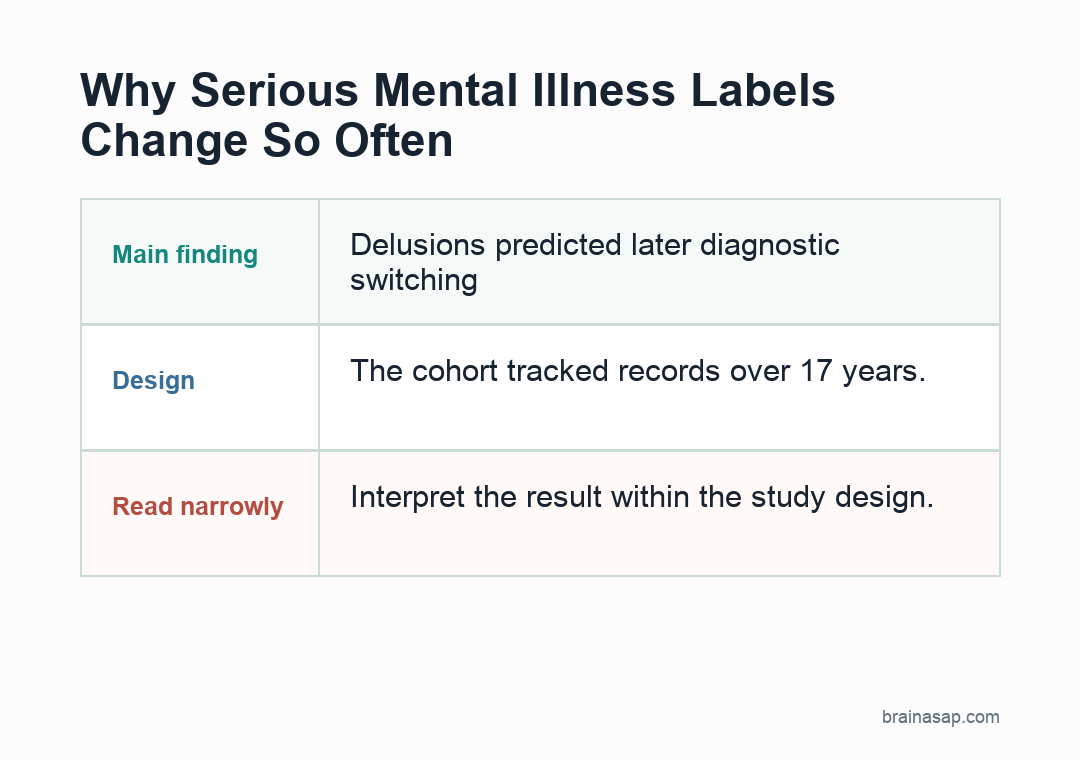
- Delusions pushed instability upward: Clinical-note mentions of delusions were linked to 1.47x higher switching odds (95% CI 1.34-1.61), suggesting symptom patterns in free text can predict where trajectories may bend next.
Source: The British Journal of Psychiatry (2026) | De la Hoz et al.
Psychiatric diagnosis is supposed to reduce chaos. This study shows how often it instead tracks moving terrain.
The striking part is not that clinicians occasionally revise a label. It is that longitudinal care made diagnostic overlap look normal.
Why a Real Psychiatric Record Looks Messier Than the DSM
The clean version of psychiatric diagnosis says that schizophrenia, bipolar disorder, and major depression are distinct enough to support distinct labels.
Three details anchor the result:
- Diagnosis switching was the norm: The cohort covered records from 2005 to 2022 at a specialised mental health hospital in Colombia, focusing on schizophrenia, bipolar disorder, and severe or recurrent major depressive disorder
- 64% received multiple diagnoses: Most patients did not remain inside a single diagnostic lane over time, reflecting either primary-diagnosis switching, accumulating comorbidities, or both
- 19% switched between core SMI labels: Nearly one in five crossed between the three headline disorders themselves, not just into secondary symptom codes
The messy version is what clinicians live with.
A person arrives in crisis, symptoms cluster imperfectly, history is incomplete, and the label that fits best this month does not necessarily survive the next 2 years.
This study is valuable because it does not argue that abstractly. It follows 22,447 patients through a real-world mental health system and asks what their diagnoses did over time.
The answer is that diagnostic movement was not an edge case. It was common enough to look structural.
The setting also matters. Most large psychiatric EHR analyses come from high-income health systems.
This one used records from Clínica San Juan de Dios Manizales in Colombia, giving a lower- and middle-income country context that is often missing from precision-psychiatry conversations.
If the same transdiagnostic patterns show up there too, the phenomenon starts looking less like a local documentation quirk and more like a property of serious mental illness itself.
What 22,447 Colombian Records Said About Diagnostic Instability
The main number is the one that sticks: 64% of patients received multiple diagnoses over time. That umbrella figure includes several kinds of movement, and the paper helpfully splits them apart.
About 19% switched between the three primary serious mental illness diagnoses themselves. Another 30% accumulated diagnostic comorbidities. And 15% did both, making them the most clinically fluid group in the whole dataset.
- Primary switching: 19% crossed between schizophrenia, bipolar disorder, and severe major depression labels.
- Comorbidity accumulation: 30% added other diagnoses over time.
- Both patterns: 15% both switched core labels and accumulated comorbidities.
The breakdown is important because it reframes what “misdiagnosis” means in psychiatry.
Some of this movement reflects imperfect first-pass assessment.
But some of it likely reflects something deeper: symptoms evolve, psychosis and mood symptoms cross category boundaries, and the underlying biology does not necessarily respect the boundaries nearly as much as the billing code does.
The study also found high frequencies of suicidality and psychosis across diagnoses, reinforcing the same point. In practice, the symptom architecture was transdiagnostic even when the chart label was singular.
Delusions and Prior Switching Predicted More Switching Later
The paper gets more helpful when it moves from description to prediction. The mixed-effects logistic model asked which features made future switching more likely, and two stood out.
First, prior switching predicted more switching with an odds ratio of 4.01. That sounds obvious on one level, but it is also clinically revealing.
Once a patient has already crossed categories, their illness is telling you something important about instability, symptom breadth, or evolving expression. A moving label can itself be a marker of disease trajectory.
Second, mentions of delusions in free-text notes predicted more switching too, with 1.47x higher odds. Here, the study starts to function as a precision-psychiatry prototype rather than only an epidemiology analysis.
The actionable readout was not locked only inside diagnosis codes. It was embedded in clinical language.
That has practical implications. Structured diagnoses are tidy but coarse.
Clinical notes contain the symptoms that made the clinician uneasy: delusions, hallucinations, suicidality, mixed features, and timing.
Mining that unstructured language can become one of the better ways to forecast how a supposedly fixed psychiatric label will change over time.
6 Years to Stability Is Both Reassuring and Uncomfortable
The researchers do not portray psychiatric diagnosis as hopelessly unstable. More than 80% of patients reached diagnostic stability within 6 years of their first record.
That is an important counterweight. These are not infinitely drifting labels.
But 6 years is also a long time. It means many patients lived through a clinically meaningful portion of their illness while the chart was still settling.
In psychiatry, where treatment choices, prognosis, and even self-understanding can hinge on diagnosis, that is not a minor administrative lag. It shapes care.
The timeline also complicates the usual debate between “categories are wrong” and “clinicians just need better training.” The likely truth is more mixed. Some patients may present with incomplete patterns early on.
Some evolve biologically. Some have overlapping syndromes from the start. And some look unstable because the categories themselves carve nature at the wrong joints.
The six-year figure is therefore reassuring only in a narrow sense. Yes, many patients eventually settle. No, that does not show the categories were clean all along.
What This Means for Precision Psychiatry in Lower-Resource Settings
One of the paper’s strongest arguments is methodological rather than conceptual: EHR data from an LMIC setting can do serious translational work.
The study pulled value from both structured billing-style codes and free-text notes, then used them together to map trajectories that would be hard to see in smaller, manually curated cohorts.
Precision psychiatry is often framed as something that arrives only when everyone has multimodal imaging, genomics, and digital phenotyping. This study offers a more grounded path.
Rich longitudinal notes already exist in many systems. If they are analyzed well, they can expose transdiagnostic patterns, switching risks, and clinically meaningful trajectories at scale.
The caution is that EHRs are never pure biology. They contain clinician habits, institutional conventions, and access effects.
But the size of the measures here is too large to treat as mere paperwork noise.
When two-thirds of a serious mental illness cohort receives multiple diagnoses over time, the deeper lesson is not simply that records are messy.
It is that the disorders themselves are more porous than the manuals admit.
The paper’s quiet provocation is this: the future of psychiatric classification belongs less to sharper boxes and more to trajectory-aware models that treat symptoms, time, and switching history as first-class data.
Once you see that, a single static diagnosis starts to look less like a destination and more like a temporary summary.
Citation: DOI: 10.1192/bjp.2025.107. De et al. Characterisation of serious mental illness trajectories through transdiagnostic clinical features. The British Journal of Psychiatry. 2026;228(5):446-455.
Study Design: Cohort study
Sample/Model: 22,447 patients over 17 years: The cohort covered records from 2005 to 2022 at a specialised mental health hospital in Colombia, focusing on schizophrenia, bipolar disorder, and severe or recurrent major depressive disorder.
Key Statistic: 64% received multiple diagnoses: Most patients did not remain inside a single diagnostic lane over time, reflecting either primary-diagnosis switching, accumulating comorbidities, or both.
Caveat: Single-study evidence; interpret with the source design and sample.